Cellular Respiration Step by Step: Glycolysis, the Krebs Cycle and the Electron Transport Chain

10 questions · 17 points · Grades 9–10 · English · Preview the 10 questions

Made by Leah Rosen · LessonRally (AI-assisted)

Digital classroom activity

What is a digital classroom activity?

Teachers who sign in can assign LessonRally activities to their Google Classroom classes: students open them in Classroom and answer online, and their grades go to the teacher's Classroom gradebook. Practice lets you try it first, the way students see it.

Free for teachers. Sign in to assign activities to your Google Classroom classes.

Printable worksheet

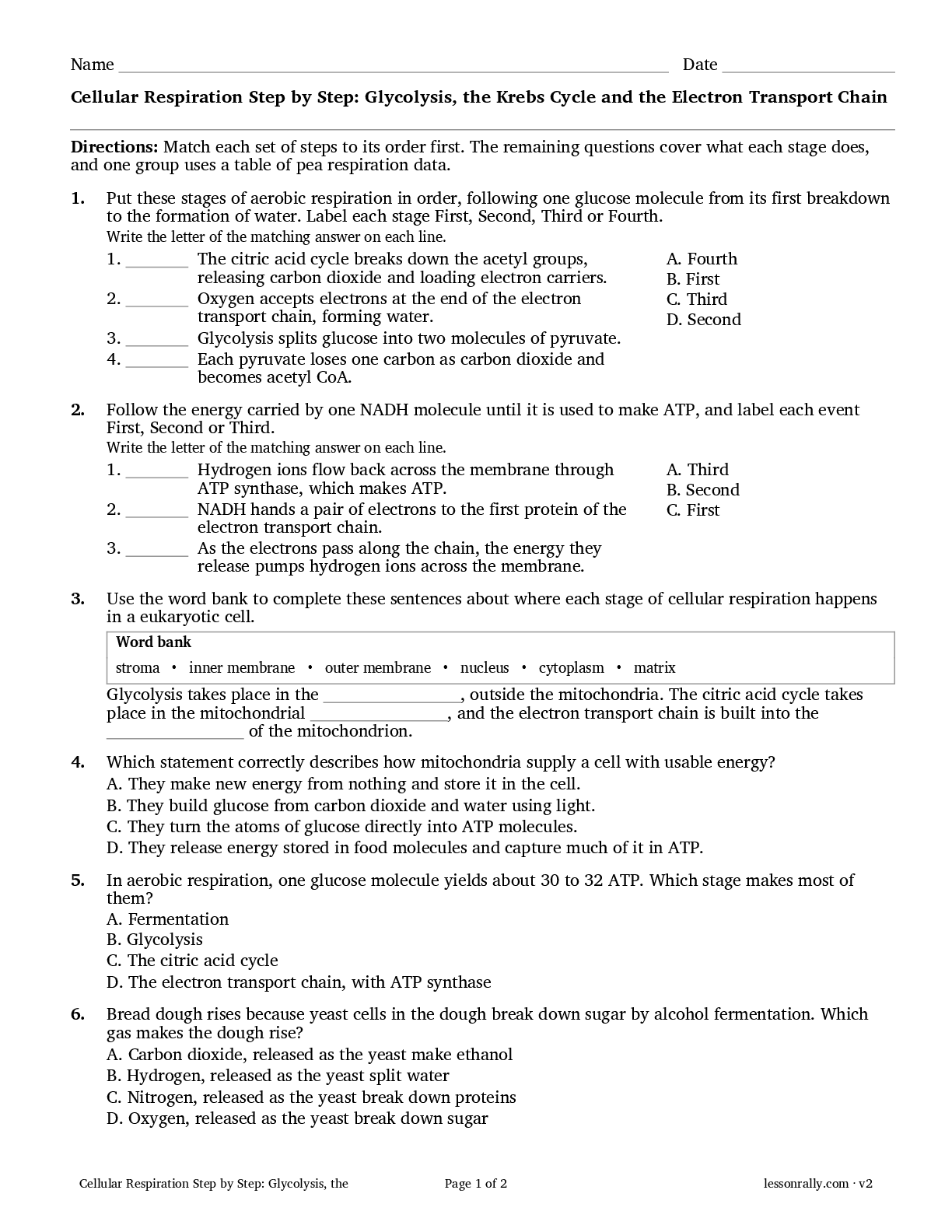
Students put the stages of aerobic cellular respiration and the steps of the electron transport chain in order, then answer questions about where each stage happens, how mitochondria release the energy stored in food, where most ATP comes from, fermentation in yeast and muscle cells, and a table of respiration data from germinating and dry peas. The citric acid cycle is also called the Krebs cycle.

Learning goal: Put the stages of aerobic cellular respiration in order, explain what each stage does and where it happens, and compare aerobic respiration with fermentation.

Estimated reading level 9.7

  1. Grade 7Hard
  2. Grade 8Stretch
  3. Grade 9On level
  4. Grade 10Easier
  5. Grade 11Easy
About this estimate

The estimate is halfway between the two middle scores of four readability formulas. Their scores run from 8.5 to 11.7.

  • Flesch-Kincaid GradeSentence length and syllables per word8.5
  • Gunning FogSentence length and words of three or more syllables11.7
  • Coleman-Liau Middle scoreLetters per word and sentences per 100 words10.8
  • Automated Readability Index Middle scoreCharacters per word and words per sentence8.6
Flesch Reading Ease
59.1 on a 0 to 100 scale where higher is easier: fairly difficult. Not part of the estimate.
Text measured
686 words, 22 sentences

Adapted from common readability formulas (Flesch-Kincaid, Gunning Fog, Coleman-Liau and ARI, plus SMOG for long texts), which look at sentence length and word length. Answer choices count toward word length only. Grades below the estimate will likely find the text harder, grades above it easier. It does not measure ideas, background knowledge or images.

Common Core

Closest anchor: CCRA.R.7 Integrate and evaluate content presented in diverse media and formats, including visually and quantitatively, as well as in words.Anchor Standards for ReadingShow 1 matched standardHide matched standard

Matched standard

  • RST.9-10.7

    Translate quantitative or technical information expressed in words in a text into visual form (e.g., a table or chart) and translate information expressed visually or mathematically (e.g., in an equation) into words.

    Student preview question 9

Matched independently by two AI models from this activity's questions.

© Copyright 2010. National Governors Association Center for Best Practices and Council of Chief State School Officers. All rights reserved.

Topic: Photosynthesis and Cellular Respiration Chosen by LessonRally

Question types: matching, fill in the blank, multiple choice.

Student preview

The questions as students see them, without the answers.

Match each set of steps to its order first. The remaining questions cover what each stage does, and one group uses a table of pea respiration data.

Question 1

Put these stages of aerobic respiration in order, following one glucose molecule from its first breakdown to the formation of water. Label each stage First, Second, Third or Fourth.

Match each item to an option.

Items

  1. The citric acid cycle breaks down the acetyl groups, releasing carbon dioxide and loading electron carriers.
  2. Oxygen accepts electrons at the end of the electron transport chain, forming water.
  3. Glycolysis splits glucose into two molecules of pyruvate.
  4. Each pyruvate loses one carbon as carbon dioxide and becomes acetyl CoA.

Options
  1. First
  2. Third
  3. Fourth
  4. Second

Question 2

Follow the energy carried by one NADH molecule until it is used to make ATP, and label each event First, Second or Third.

Match each item to an option.

Items

  1. Hydrogen ions flow back across the membrane through ATP synthase, which makes ATP.
  2. NADH hands a pair of electrons to the first protein of the electron transport chain.
  3. As the electrons pass along the chain, the energy they release pumps hydrogen ions across the membrane.

Options

  1. Third
  2. Second
  3. First

Question 3

Use the word bank to complete these sentences about where each stage of cellular respiration happens in a eukaryotic cell.

Fill in each blank.

Glycolysis takes place in the blank 1, outside the mitochondria. The citric acid cycle takes place in the mitochondrial blank 2, and the electron transport chain is built into the blank 3 of the mitochondrion.

Word bank

  • inner membrane
  • matrix
  • cytoplasm
  • nucleus
  • stroma
  • outer membrane

Question 4

Which statement correctly describes how mitochondria supply a cell with usable energy?

Choose one answer.

  • They build glucose from carbon dioxide and water using light.
  • They make new energy from nothing and store it in the cell.
  • They release energy stored in food molecules and capture much of it in ATP.
  • They turn the atoms of glucose directly into ATP molecules.

Question 5

In aerobic respiration, one glucose molecule yields about 30 to 32 ATP. Which stage makes most of them?

Choose one answer.

  • The citric acid cycle
  • Glycolysis
  • Fermentation
  • The electron transport chain, with ATP synthase

Question 6

Bread dough rises because yeast cells in the dough break down sugar by alcohol fermentation. Which gas makes the dough rise?

Choose one answer.

  • Hydrogen, released as the yeast split water
  • Oxygen, released as the yeast break down sugar
  • Carbon dioxide, released as the yeast make ethanol
  • Nitrogen, released as the yeast break down proteins

Question 7

A cell gets far less ATP from each glucose molecule by fermentation than by aerobic respiration. What explains the difference?

Choose one answer.

  • Fermentation makes ATP only through glycolysis, so much of the energy stays in lactate or ethanol.
  • Fermentation destroys the ATP that glycolysis makes.
  • Fermentation takes place in the mitochondria, which work slowly without oxygen.
  • Fermentation uses oxygen less efficiently than the electron transport chain.

Question 8

During fermentation, pyruvate is turned into lactate or ethanol. What does this step do for the cell?

Choose one answer.

  • It stores the pyruvate as glucose for the cell to use later.
  • It produces the oxygen that the electron transport chain needs.
  • It breaks pyruvate down completely to carbon dioxide and water.
  • It turns NADH back into NAD⁺, so glycolysis can keep making ATP.

Oxygen Use by Peas

In an investigation, respirometers held germinating peas, dry peas or glass beads only, and glass beads were added to the dry pea tubes so every tube held the same total volume. Each tube also held a chemical that absorbs carbon dioxide, so in the pea tubes a drop in gas volume showed oxygen being used. All tubes sat in a 25 °C water bath, and readings were taken every 5 minutes.

Mean readings from 3 respirometers of each kind at 25 °C. The peas' oxygen use was estimated after correcting for the gas-volume change in the glass-bead tubes.
Time (minutes)Germinating peas: estimated oxygen used (mL)Dry peas: estimated oxygen used (mL)Glass beads only: decrease in gas volume (mL)
00.000.000.00
50.260.020.00
100.510.050.01
150.770.070.00
201.030.090.01

Question 9

Which conclusion about the germinating and dry peas fits these results?

Choose one answer.

  • Glass beads carry out cellular respiration slowly, like dry peas.
  • In this test, germinating peas used oxygen much faster than dry peas.
  • All seeds use about 1 mL of oxygen every 20 minutes.
  • Dry peas are not alive, since they used no oxygen at all.

Question 10

Why did the investigation include respirometers holding only glass beads?

Choose one answer.

  • To show any change in gas volume not caused by living things, such as from small temperature shifts
  • To absorb the carbon dioxide that the peas gave off
  • To keep the peas at 25 °C during the test
  • To give the peas extra oxygen to use

Reviews

No reviews yet.

Reviews come from teachers who assigned this activity to a class.

Sign in to write a review

Have a topic of your own? Make a printable worksheet and online quiz, free.

Create an activity

Answer key

Answer keys come with Premium

Print this worksheet with the correct answers marked. The key includes any explanations, sample answers, and rubrics supplied with the activity.

Answer keys aren't public: only teachers with Premium and the people who can edit an activity can download one, so students can't get a ready-to-print key from this page.

Premium includes:

  • No ads for you, and no ads for your students on the assignments you post.
  • Answer keys for printable worksheets, with the correct answers marked and any explanations, sample answers, and rubrics.
  • Create with AI: up to 100 activities a year (5 during the free trial), with every answer checked before you see the draft.

$29 a year, plus sales tax where it applies.

New Premium teachers can try it free for 7 days. A card or other payment method is needed to start. Unless you cancel before the trial ends, you are charged then and the plan renews every year.

Already have Premium or edit this activity? Sign in