Teachers who sign in can assign LessonRally activities to their Google Classroom classes: students open them in Classroom and answer online, and their grades go to the teacher's Classroom gradebook. Practice lets you try it first, the way students see it.
Students review homeostasis: set points, the sensor, control center and effector of a feedback loop, what negative feedback means, a thermostat model, how the body warms up and cools down, how insulin and glucagon control blood glucose, positive feedback in childbirth and blood clotting, and a table of blood glucose and insulin after a meal.
Learning goal: Explain how negative feedback keeps body temperature and blood glucose near their set points, compare it with positive feedback, and interpret glucose and insulin data after a meal.
Estimated reading level9.2
Grade 7Hard
Grade 8Stretch
Grade 9On level
Grade 10Easier
Grade 11Easy
About this estimate
The estimate is halfway between the two middle scores of four readability formulas. Their scores run from 8.0 to 10.0.
Flesch-Kincaid GradeSentence length and syllables per word8.0
Gunning FogSentence length and words of three or more syllables10.0
Coleman-Liau Middle scoreLetters per word and sentences per 100 words9.9
Automated Readability Index Middle scoreCharacters per word and words per sentence8.5
Grade 181216
Flesch Reading Ease
65.0 on a 0 to 100 scale where higher is easier: standard. Not part of the estimate.
Text measured
1,086 words, 28 sentences
Adapted from common readability formulas (Flesch-Kincaid, Gunning Fog, Coleman-Liau and ARI, plus SMOG for long texts), which look at sentence length and word length. Answer choices count toward word length only. Grades below the estimate will likely find the text harder, grades above it easier. It does not measure ideas, background knowledge or images.
Common Core
Press Ctrl+C or Command+C to copy.
Closest anchor:CCRA.R.7Integrate and evaluate content presented in diverse media and formats, including visually and quantitatively, as well as in words.Anchor Standards for ReadingShow 1 matched standardHide matched standard
Translate quantitative or technical information expressed in words in a text into visual form (e.g., a table or chart) and translate information expressed visually or mathematically (e.g., in an equation) into words.
Question types: multiple choice, matching, select all that apply, fill in the blank.
Student preview
The questions as students see them, without the answers.
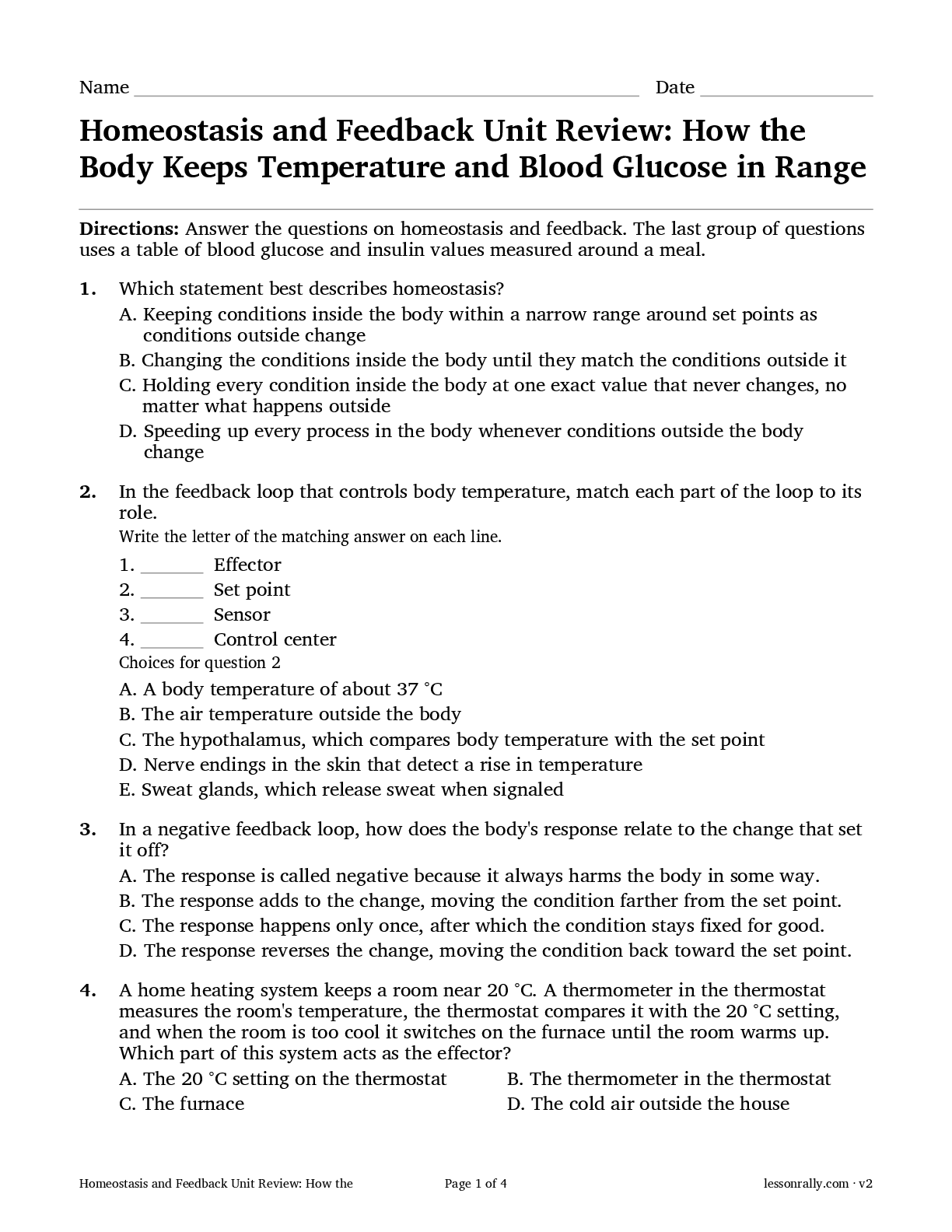
Answer the questions on homeostasis and feedback. The last group of questions uses a table of blood glucose and insulin values measured around a meal.
Question 1
Which statement best describes homeostasis?
Choose one answer.
Keeping conditions inside the body within a narrow range around set points as conditions outside change
Holding every condition inside the body at one exact value that never changes, no matter what happens outside
Changing the conditions inside the body until they match the conditions outside it
Speeding up every process in the body whenever conditions outside the body change
Question 2
In the feedback loop that controls body temperature, match each part of the loop to its role.
Match each item to an option.
Items
Effector
Set point
Sensor
Control center
Options
Nerve endings in the skin that detect a rise in temperature
The air temperature outside the body
A body temperature of about 37 °C
The hypothalamus, which compares body temperature with the set point
Sweat glands, which release sweat when signaled
Question 3
In a negative feedback loop, how does the body's response relate to the change that set it off?
Choose one answer.
The response happens only once, after which the condition stays fixed for good.
The response adds to the change, moving the condition farther from the set point.
The response is called negative because it always harms the body in some way.
The response reverses the change, moving the condition back toward the set point.
Question 4
A home heating system keeps a room near 20 °C. A thermometer in the thermostat measures the room's temperature, the thermostat compares it with the 20 °C setting, and when the room is too cool it switches on the furnace until the room warms up. Which part of this system acts as the effector?
Choose one answer.
The cold air outside the house
The thermometer in the thermostat
The furnace
The 20 °C setting on the thermostat
Question 5
When body temperature drops below its set point, which two responses help bring it back up?
Choose 2 answers.
Widening of the blood vessels in the skin
Sweating
Shivering
Lowering the body's temperature set point
Narrowing of the blood vessels in the skin
Question 6
On a hot day, body temperature starts to rise, and sweat glands release sweat onto the skin. How does sweating help cool the body?
Choose one answer.
As the sweat evaporates from the skin, it carries heat away from the body.
The sweat narrows the blood vessels in the skin, so less warm blood reaches it.
The sweat removes extra glucose from the blood, so the cells release less heat.
The sweat is colder than the body, so it chills the skin as soon as it comes out.
Question 7
Fill in the blanks about how blood glucose comes back down after a meal, using the word bank.
Fill in each blank.
After a meal, blood sugar rises, and the pancreas releases the hormone blank 1. This hormone helps body cells take up blank 2 from the blood, and it signals the liver to store some of it as blank 3.
Word bank
insulin
oxygen
starch
glucagon
glycogen
glucose
Question 8
Several hours after a meal, blood glucose drops below its set point. Which response brings it back up?
Choose one answer.
The pancreas releases glucagon, which signals the liver to break down glycogen and release glucose.
The pancreas releases more insulin, which signals body cells to take up even more glucose from the blood.
The liver stores more glucose as glycogen until the amount of glucose in the blood rises again.
The hypothalamus releases glucagon, which signals the muscles to start shivering for energy.
Question 9
During childbirth, the baby's head pushes against the cervix and stretches it, which triggers the release of the hormone oxytocin. Oxytocin makes the uterus contract more strongly, which pushes the head harder against the cervix and releases still more oxytocin. What kind of feedback is this, and what ends it?
Choose one answer.
Positive feedback, which never ends once the first contraction has started
Positive feedback, which ends when the baby is born and the stretching of the cervix stops
Negative feedback, which ends when the body runs out of the hormone oxytocin
Negative feedback, which ends when the strength of the contractions returns to its set point
Question 10
Which statement about feedback in the human body is accurate?
Choose one answer.
Positive feedback never happens in the human body, because it would push conditions away from set points.
Most homeostatic control uses negative feedback, though positive feedback also occurs, as in blood clotting.
Body temperature and blood glucose are both controlled mainly by positive feedback loops in the body.
Most homeostatic control uses positive feedback, and negative feedback takes place only during childbirth.
Blood Glucose and Insulin After a Meal
In a study, 12 adult volunteers without diabetes ate the same meal after not eating overnight. Blood samples were taken just before the meal began (0 minutes) and at five times afterward, and blood glucose and insulin were measured in each sample. Each value in the table is the mean for the 12 volunteers.
Mean blood glucose and insulin of 12 adults before and after the same meal
Time after the meal began (min)
Mean blood glucose (mg/dL)
Mean blood insulin (microunits per mL)
0
88
7
30
138
54
60
124
62
90
106
38
120
93
19
180
86
8
Question 11
By how much did mean blood glucose rise from just before the meal to its highest value?
Choose one answer.
About 50 mg/dL
About 36 mg/dL
About 14 mg/dL
About 138 mg/dL
Question 12
How did the timing of the peak in mean insulin compare with the timing of the peak in mean glucose?
Choose one answer.
Insulin peaked at 0 minutes, before the meal had raised glucose.
Insulin peaked at 60 minutes, about 30 minutes after glucose peaked.
Insulin peaked at 120 minutes, once glucose was nearly back to its start.
Insulin peaked at 30 minutes, at the same time as glucose peaked.
Question 13
Which claim about blood glucose control is supported by the table?
Choose one answer.
Glucose rose after the meal and then stayed at its highest value for all 180 minutes of the study, so no feedback took place.
Insulin rose before glucose did, which shows that the rise in insulin is what made glucose rise after the meal.
These results prove that insulin is the only hormone in the body that can ever lower the glucose in the blood.
Glucose rose after the meal and then fell back near its starting value while insulin was raised, which fits negative feedback.
Question 14
In type 1 diabetes, the pancreas makes little or no insulin. Suppose a person with type 1 diabetes ate the same meal without taking any insulin for it. Compared with the table, how would this person's results most likely differ?
Choose one answer.
Glucose would fall below its starting value, because glucagon would do insulin's job.
Glucose would rise less than in the table, because insulin is what raises glucose.
Glucose would rise higher and stay high longer, and insulin would stay low.
Glucose and insulin would both follow the table closely, since the meal is the same.