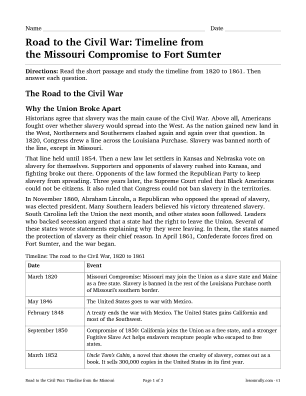
Causes of the American Revolution: From the French and Indian War to Lexington

10 questions · 16 points · Grade 8 · English · Preview the 10 questions

Made by Monica Ellison · LessonRally (AI-assisted)

Digital classroom activity

What is a digital classroom activity?

Teachers who sign in can assign LessonRally activities to their Google Classroom classes: students open them in Classroom and answer online, and their grades go to the teacher's Classroom gradebook. Practice lets you try it first, the way students see it.

Free for teachers. Sign in to assign activities to your Google Classroom classes.

Printable worksheet

Students read a short passage and a timeline of real events from 1763 to 1775, then connect the two to explain the causes of the American Revolution. They match each cause to its effect, put events in order, and trace how British taxes such as the Stamp Act met protests and boycotts, and how the Boston Tea Party and the Coercive Acts led to the fighting at Lexington and Concord.

Learning goal: Explain how British policies after 1763 and colonial responses to them led to the American Revolution.

Estimated reading level 9.2

  1. Grade 7Hard
  2. Grade 8Stretch
  3. Grade 9On level
  4. Grade 10Easier
  5. Grade 11Easy
About this estimate

The estimate is the middle score of five readability formulas. Their scores run from 6.9 to 9.7.

  • Flesch-Kincaid GradeSentence length and syllables per word6.9
  • Gunning FogSentence length and words of three or more syllables9.7
  • Coleman-Liau Middle scoreLetters per word and sentences per 100 words9.2
  • Automated Readability IndexCharacters per word and words per sentence7.4
  • SMOGWords of three or more syllables, for texts of 30 sentences or more9.5
Flesch Reading Ease
68.4 on a 0 to 100 scale where higher is easier: standard. Not part of the estimate.
Text measured
862 words, 38 sentences

Adapted from common readability formulas (Flesch-Kincaid, Gunning Fog, Coleman-Liau and ARI, plus SMOG for long texts), which look at sentence length and word length. Answer choices count toward word length only. Grades below the estimate will likely find the text harder, grades above it easier. It does not measure ideas, background knowledge or images.

Topic: American Revolution Chosen by LessonRally

Question types: multiple choice, matching, fill in the blank, select all that apply.

Student preview

The questions as students see them, without the answers.

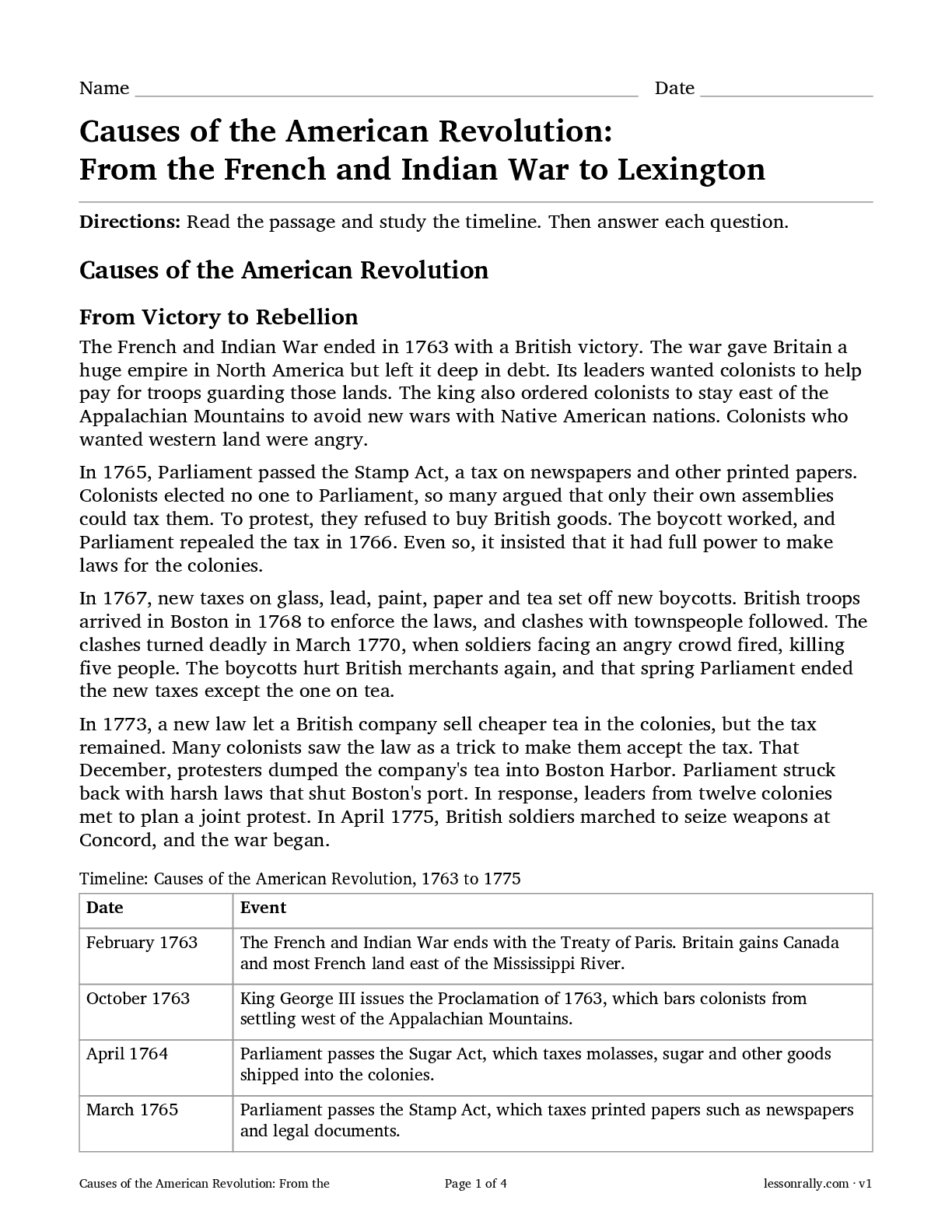
Read the passage and study the timeline. Then answer each question.

Causes of the American Revolution

From Victory to Rebellion

The French and Indian War ended in 1763 with a British victory. The war gave Britain a huge empire in North America but left it deep in debt. Its leaders wanted colonists to help pay for troops guarding those lands. The king also ordered colonists to stay east of the Appalachian Mountains to avoid new wars with Native American nations. Colonists who wanted western land were angry.

In 1765, Parliament passed the Stamp Act, a tax on newspapers and other printed papers. Colonists elected no one to Parliament, so many argued that only their own assemblies could tax them. To protest, they refused to buy British goods. The boycott worked, and Parliament repealed the tax in 1766. Even so, it insisted that it had full power to make laws for the colonies.

In 1767, new taxes on glass, lead, paint, paper and tea set off new boycotts. British troops arrived in Boston in 1768 to enforce the laws, and clashes with townspeople followed. The clashes turned deadly in March 1770, when soldiers facing an angry crowd fired, killing five people. The boycotts hurt British merchants again, and that spring Parliament ended the new taxes except the one on tea.

In 1773, a new law let a British company sell cheaper tea in the colonies, but the tax remained. Many colonists saw the law as a trick to make them accept the tax. That December, protesters dumped the company's tea into Boston Harbor. Parliament struck back with harsh laws that shut Boston's port. In response, leaders from twelve colonies met to plan a joint protest. In April 1775, British soldiers marched to seize weapons at Concord, and the war began.


Timeline: Causes of the American Revolution, 1763 to 1775
DateEvent
February 1763The French and Indian War ends with the Treaty of Paris. Britain gains Canada and most French land east of the Mississippi River.
October 1763King George III issues the Proclamation of 1763, which bars colonists from settling west of the Appalachian Mountains.
April 1764Parliament passes the Sugar Act, which taxes molasses, sugar and other goods shipped into the colonies.
March 1765Parliament passes the Stamp Act, which taxes printed papers such as newspapers and legal documents.
October 1765Delegates from nine colonies meet in New York at the Stamp Act Congress to protest the tax.
March 1766Parliament repeals the Stamp Act. In the same month, it passes the Declaratory Act, which claims full power to make laws for the colonies.
1767Parliament passes the Townshend Acts, which tax glass, lead, paint, paper and tea brought into the colonies.
March 1770Boston Massacre: British soldiers fire into a crowd and kill five people.
May 1773Parliament passes the Tea Act, which helps the British East India Company sell tea in the colonies. The tax on tea stays in place.
December 1773Boston Tea Party: in Boston Harbor, protesters dump more than 300 chests of tea owned by the East India Company.
March to June 1774Parliament passes the Coercive Acts to punish Massachusetts. One of them shuts Boston's port to shipping.
September 1774Delegates from twelve colonies meet in Philadelphia at the First Continental Congress and agree to boycott British goods.
April 1775British troops march to seize colonial weapons at Concord. Fighting breaks out at Lexington and Concord.

Question 1

According to the passage, what was one reason British leaders wanted colonists to pay new taxes after 1763?

Choose one answer.

  • Colonists had asked Britain to send more soldiers to Boston.
  • Britain needed money to fight the colonists in the Revolutionary War.
  • The war left Britain deep in debt, with troops to pay in North America.
  • France demanded that Britain pay for the land it lost in the war.

Question 2

Many colonists said Parliament had no right to tax them. What reason does the passage give?

Choose one answer.

  • Their taxes were already higher than taxes in Britain.
  • The Treaty of Paris had let each colony set its own taxes.
  • The Declaration of Independence had already freed them from British laws.
  • They elected no one to represent them in Parliament.

Question 3

The passage says that after repealing the Stamp Act, Parliament "insisted that it had full power to make laws for the colonies." Which law on the timeline made that claim?

Choose one answer.

  • The Declaratory Act
  • The Sugar Act
  • The Townshend Acts
  • The Coercive Acts

Question 4

Match each cause to its effect, as the passage describes them.

Match each item to an option.

Items

  1. The king hoped to avoid new wars with Native American nations
  2. Colonists refused to buy British goods to protest the Stamp Act
  3. British troops arrived in Boston in 1768 to enforce the laws
  4. Many colonists saw the 1773 tea law as a trick to make them accept the tax

Options

  1. Clashes with townspeople turned deadly in 1770
  2. Parliament repealed the Stamp Act in 1766
  3. Protesters dumped the company's tea into Boston Harbor
  4. Colonists were ordered to stay east of the Appalachian Mountains
  5. Colonists won seats in Parliament

Question 5

What was one effect of the boycotts that followed the new taxes of 1767?

Choose one answer.

  • In 1763, the king ordered colonists to stay east of the mountains.
  • In 1774, Parliament shut the port of Boston.
  • In 1766, Parliament repealed the Stamp Act.
  • In 1770, Parliament ended the new taxes except the one on tea.

Question 6

Use the dates in the timeline to put these events in order. Match each event to First, Second or Third.

Match each item to an option.

Items

  1. Parliament passes the Tea Act
  2. Delegates meet at the Stamp Act Congress
  3. Parliament passes the Townshend Acts

Options

  1. Second
  2. First
  3. Third

Question 7

Complete the sentences with terms from the word bank. You will need both the passage and the timeline.

Fill in each blank.

After the Boston Tea Party, Parliament passed the blank 1, and one of them shut Boston's port. In response, delegates from twelve colonies met at the blank 2 in Philadelphia.

Word bank

  • First Continental Congress
  • Townshend Acts
  • Stamp Act Congress
  • Declaratory Act
  • Coercive Acts

Question 8

Why did British soldiers march to Concord in April 1775?

Choose one answer.

  • To stop colonists from settling west of the Appalachian Mountains
  • To collect the tea tax from shops in Concord
  • To defend Concord from an attack by French troops
  • To seize weapons the colonists had stored there

Question 9

Based on the passage and the timeline, which three of these were ways colonists protested British laws between 1765 and 1774?

Choose 3 answers.

  • Electing their own members to Parliament
  • Refusing to buy British goods
  • Dumping tea into Boston Harbor
  • Passing the Declaratory Act
  • Sending delegates to the Stamp Act Congress
  • Signing the Declaration of Independence

Question 10

Which statement best describes how the conflict changed from 1765 to 1775, based on the passage and the timeline?

Choose one answer.

  • Britain and the colonies slowly agreed on who could tax the colonies.
  • Parliament gave up its claim to make laws for the colonies.
  • A quarrel over taxes grew, step by step, into armed fighting.
  • Colonists stopped protesting once the Stamp Act was repealed.

Reviews

No reviews yet.

Reviews come from teachers who assigned this activity to a class.

Sign in to write a review

Have a topic of your own? Make a printable worksheet and online quiz, free.

Create an activity

Answer key

Answer keys come with Premium

Print this worksheet with the correct answers marked. The key includes any explanations, sample answers, and rubrics supplied with the activity.

Answer keys aren't public: only teachers with Premium and the people who can edit an activity can download one, so students can't get a ready-to-print key from this page.

Premium includes:

  • No ads for you, and no ads for your students on the assignments you post.
  • Answer keys for printable worksheets, with the correct answers marked and any explanations, sample answers, and rubrics.
  • Create with AI: up to 100 activities a year (5 during the free trial), with every answer checked before you see the draft.

$29 a year, plus sales tax where it applies.

New Premium teachers can try it free for 7 days. A card or other payment method is needed to start. Unless you cancel before the trial ends, you are charged then and the plan renews every year.

Already have Premium or edit this activity? Sign in