

American Revolution
The American Revolution grew from disputes over British taxes and control after 1763 into a war for independence. Students trace its causes, read the Declaration of Independence, and follow the war from Lexington and Concord to Yorktown.
Topics are chosen by LessonRally.
Filter by grade
- Social StudiesFeatured
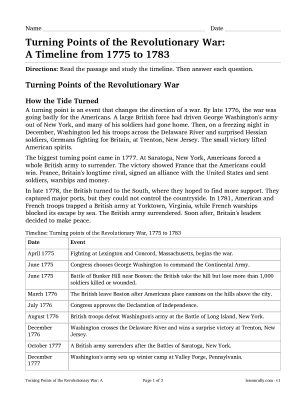
Turning Points of the Revolutionary War: A Timeline from 1775 to 1783 (opens in a new tab)
- Grade 8
- 8 questions
- Estimated reading level 8.8
Common Core RH.6-8.7
Made by Monica Ellison · LessonRally (AI-assisted)
- Social StudiesFeatured
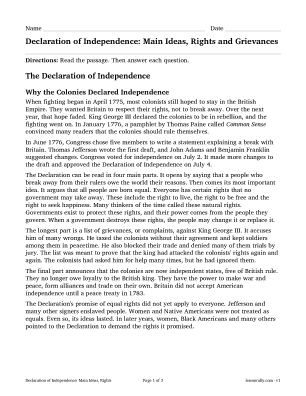
Declaration of Independence: Main Ideas, Rights and Grievances (opens in a new tab)
- Grade 8
- 10 questions
- Estimated reading level 9.6
Common Core RH.6-8.2
Made by Monica Ellison · LessonRally (AI-assisted)
- Social StudiesFeatured
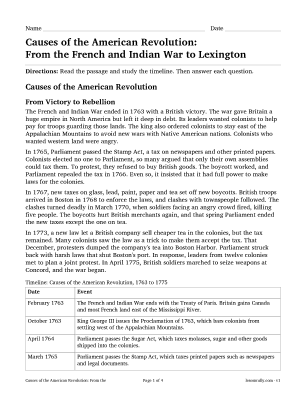
Causes of the American Revolution: From the French and Indian War to Lexington (opens in a new tab)
- Grade 8
- 10 questions
- Estimated reading level 9.2
Made by Monica Ellison · LessonRally (AI-assisted)
About teaching American Revolution
- What students practice
- Pairing British acts with colonial responses, such as the Tea Act with the Boston Tea Party, dividing the Declaration of Independence into its ideas about rights, its grievances against the king and its declaration of independence, and explaining why the win at Saratoga brought France into the war.
- Common mistakes
- Students often think the war began with the Declaration, but fighting started at Lexington and Concord in 1775. Many think the Boston Tea Party protested more expensive tea, but the Tea Act made tea cheaper; colonists objected to the tax and the East India Company’s monopoly. Others assume every colonist was a Patriot; many were Loyalists or neutral.
- Ways to use these activities
- Use one of these activities before students build a cause-and-effect chain from 1763 to 1776. In pairs, one student argues for independence as a Patriot and the other answers as a Loyalist, each citing an event or document.