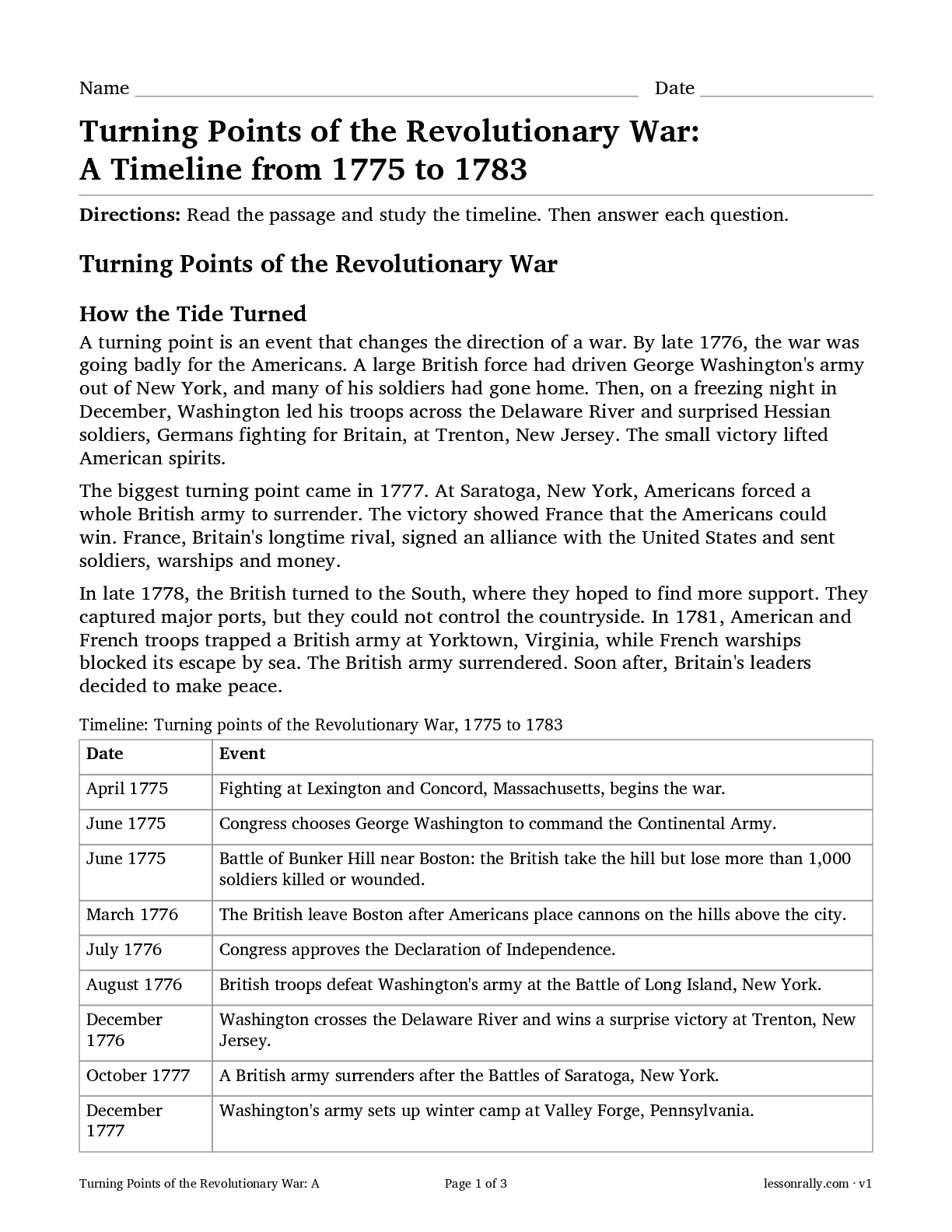
A turning point is an event that changes the direction of a war. By late 1776, the war was going badly for the Americans. A large British force had driven George Washington's army out of New York, and many of his soldiers had gone home. Then, on a freezing night in December, Washington led his troops across the Delaware River and surprised Hessian soldiers, Germans fighting for Britain, at Trenton, New Jersey. The small victory lifted American spirits.
The biggest turning point came in 1777. At Saratoga, New York, Americans forced a whole British army to surrender. The victory showed France that the Americans could win. France, Britain's longtime rival, signed an alliance with the United States and sent soldiers, warships and money.
In late 1778, the British turned to the South, where they hoped to find more support. They captured major ports, but they could not control the countryside. In 1781, American and French troops trapped a British army at Yorktown, Virginia, while French warships blocked its escape by sea. The British army surrendered. Soon after, Britain's leaders decided to make peace.