Declaration of Independence: Main Ideas, Rights and Grievances

10 questions · 14 points · Grade 8 · English · Preview the 10 questions

Made by Monica Ellison · LessonRally (AI-assisted)

Digital classroom activity

What is a digital classroom activity?

Teachers who sign in can assign LessonRally activities to their Google Classroom classes: students open them in Classroom and answer online, and their grades go to the teacher's Classroom gradebook. Practice lets you try it first, the way students see it.

Free for teachers. Sign in to assign activities to your Google Classroom classes.

Printable worksheet

Students read a plain-language summary of the Declaration of Independence, then find the central idea, summarize the document's main idea about rights and government, and explain why it lists grievances against King George III. Questions also cover why Congress declared independence in July 1776, what each part of the Declaration does, who was left out of its promise of equal rights, and how later Americans used its ideas.

Learning goal: Determine the central ideas of a passage about the Declaration of Independence and summarize the Declaration's argument about rights, government and independence.

Estimated reading level 9.6

  1. Grade 7Hard
  2. Grade 8Stretch
  3. Grade 9On level
  4. Grade 10Easier
  5. Grade 11Easy
About this estimate

The estimate is the middle score of five readability formulas. Their scores run from 6.9 to 9.8.

  • Flesch-Kincaid GradeSentence length and syllables per word6.9
  • Gunning Fog Middle scoreSentence length and words of three or more syllables9.6
  • Coleman-LiauLetters per word and sentences per 100 words9.8
  • Automated Readability IndexCharacters per word and words per sentence7.2
  • SMOGWords of three or more syllables, for texts of 30 sentences or more9.7
Flesch Reading Ease
67.1 on a 0 to 100 scale where higher is easier: standard. Not part of the estimate.
Text measured
976 words, 47 sentences

Adapted from common readability formulas (Flesch-Kincaid, Gunning Fog, Coleman-Liau and ARI, plus SMOG for long texts), which look at sentence length and word length. Answer choices count toward word length only. Grades below the estimate will likely find the text harder, grades above it easier. It does not measure ideas, background knowledge or images.

Common Core

Closest anchor: CCRA.R.2 Determine central ideas or themes of a text and analyze their development; summarize the key supporting details and ideas.Anchor Standards for ReadingShow 1 matched standardHide matched standard

Matched standard

  • RH.6-8.2

    Determine the central ideas or information of a primary or secondary source; provide an accurate summary of the source distinct from prior knowledge or opinions.

    Student preview questions 1, 4

Matched independently by two AI models from this activity's questions.

© Copyright 2010. National Governors Association Center for Best Practices and Council of Chief State School Officers. All rights reserved.

Topic: American Revolution Chosen by LessonRally

Question types: multiple choice, matching, fill in the blank, select all that apply.

Student preview

The questions as students see them, without the answers.

Read the passage. Then answer each question.

The Declaration of Independence

Why the Colonies Declared Independence

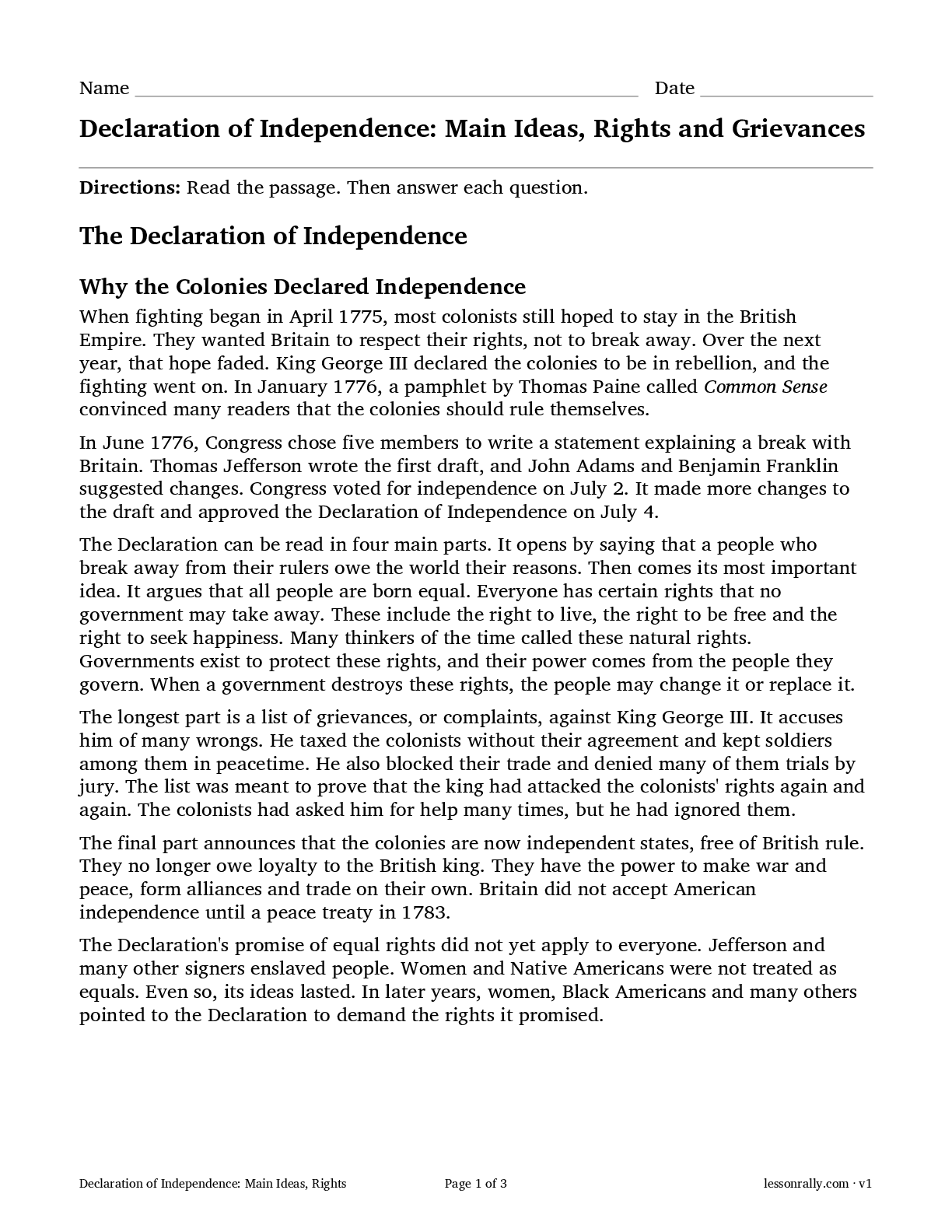
When fighting began in April 1775, most colonists still hoped to stay in the British Empire. They wanted Britain to respect their rights, not to break away. Over the next year, that hope faded. King George III declared the colonies to be in rebellion, and the fighting went on. In January 1776, a pamphlet by Thomas Paine called Common Sense convinced many readers that the colonies should rule themselves.

In June 1776, Congress chose five members to write a statement explaining a break with Britain. Thomas Jefferson wrote the first draft, and John Adams and Benjamin Franklin suggested changes. Congress voted for independence on July 2. It made more changes to the draft and approved the Declaration of Independence on July 4.

The Declaration can be read in four main parts. It opens by saying that a people who break away from their rulers owe the world their reasons. Then comes its most important idea. It argues that all people are born equal. Everyone has certain rights that no government may take away. These include the right to live, the right to be free and the right to seek happiness. Many thinkers of the time called these natural rights. Governments exist to protect these rights, and their power comes from the people they govern. When a government destroys these rights, the people may change it or replace it.

The longest part is a list of grievances, or complaints, against King George III. It accuses him of many wrongs. He taxed the colonists without their agreement and kept soldiers among them in peacetime. He also blocked their trade and denied many of them trials by jury. The list was meant to prove that the king had attacked the colonists' rights again and again. The colonists had asked him for help many times, but he had ignored them.

The final part announces that the colonies are now independent states, free of British rule. They no longer owe loyalty to the British king. They have the power to make war and peace, form alliances and trade on their own. Britain did not accept American independence until a peace treaty in 1783.

The Declaration's promise of equal rights did not yet apply to everyone. Jefferson and many other signers enslaved people. Women and Native Americans were not treated as equals. Even so, its ideas lasted. In later years, women, Black Americans and many others pointed to the Declaration to demand the rights it promised.


Question 1

Which statement best expresses the central idea of "Why the Colonies Declared Independence"?

Choose one answer.

  • In 1776, the Declaration explained why the colonies were breaking from Britain, based on the idea that governments must protect people's rights.
  • Thomas Paine wrote a pamphlet called Common Sense in January 1776.
  • The Declaration of Independence ended the war with Britain in 1776.
  • The Declaration asked King George III to forgive the colonies and take them back.

Question 2

What was one reason many colonists gave up hope of staying in the British Empire?

Choose one answer.

  • France had ordered the colonies to break away.
  • The colonies had already won the war.
  • King George III declared the colonies to be in rebellion, and the fighting went on.
  • Britain had already agreed to let the colonies go.

Question 3

Match each part of the Declaration to what it does, as the passage describes it.

Match each item to an option.

Items

  1. The opening
  2. The part with its most important idea
  3. The longest part
  4. The final part

Options

  1. Sets out ideas about rights and government
  2. Lists complaints against King George III
  3. Asks the king to forgive the colonies
  4. Says that a people who break away owe the world their reasons
  5. Announces that the colonies are now independent states

Question 4

Which sentence best summarizes the Declaration's most important idea, as the passage explains it?

Choose one answer.

  • Only Parliament can decide which rights the colonists have.
  • People must obey their government even when it destroys their rights.
  • People are born with rights, governments exist to protect them, and people may replace a government that destroys them.
  • Kings hold their power for life, so the people can never replace them.

Question 5

Use the word bank to finish these two sentences about the Declaration.

Fill in each blank.

The Declaration's list of blank 1 accused King George III of many wrongs. Rights that people are born with, such as the right to be free, were often called blank 2.

Word bank

  • natural rights
  • grievances
  • alliances
  • taxes
  • treaties

Question 6

Why does the Declaration include such a long list of the king's wrongs?

Choose one answer.

  • To prove that he had attacked the colonists' rights again and again, so breaking away was justified
  • To list the new laws the colonies planned to pass
  • To ask the king for permission to collect their own taxes
  • To explain why the colonies wanted to join France

Question 7

Which three complaints against the king does the passage say the Declaration made?

Choose 3 answers.

  • Forcing them to adopt the Articles of Confederation
  • Refusing to let the colonists elect a president
  • Denying many of them trials by jury
  • Keeping soldiers among them in peacetime
  • Banning them from building schools
  • Taxing the colonists without their agreement

Question 8

What happened after Congress approved the Declaration?

Choose one answer.

  • The king agreed to every complaint in the list.
  • Britain did not accept American independence until a peace treaty in 1783.
  • The colonies rejoined the British Empire within a year.
  • Britain accepted American independence right away.

Question 9

What was one way the Declaration's promise of equal rights did not yet apply to everyone?

Choose one answer.

  • Jefferson and many other signers enslaved people.
  • It was kept secret from the colonists.
  • It said that rights belonged only to the king.
  • Only members of Parliament could sign it.

Question 10

How have later Americans used the Declaration?

Choose one answer.

  • They have used it to end all trade with other nations.
  • They have pointed to it to demand the rights it promised.
  • They have used it to bring back rule by a king.
  • They have treated it as a list of taxes to collect.

Reviews

No reviews yet.

Reviews come from teachers who assigned this activity to a class.

Sign in to write a review

Have a topic of your own? Make a printable worksheet and online quiz, free.

Create an activity

Answer key

Answer keys come with Premium

Print this worksheet with the correct answers marked. The key includes any explanations, sample answers, and rubrics supplied with the activity.

Answer keys aren't public: only teachers with Premium and the people who can edit an activity can download one, so students can't get a ready-to-print key from this page.

Premium includes:

  • No ads for you, and no ads for your students on the assignments you post.
  • Answer keys for printable worksheets, with the correct answers marked and any explanations, sample answers, and rubrics.
  • Create with AI: up to 100 activities a year (5 during the free trial), with every answer checked before you see the draft.

$29 a year, plus sales tax where it applies.

New Premium teachers can try it free for 7 days. A card or other payment method is needed to start. Unless you cancel before the trial ends, you are charged then and the plan renews every year.

Already have Premium or edit this activity? Sign in