Question 1
Which variable did the class change on purpose in this investigation?
Choose one answer.
- Whether the seedlings got light
- The kind of soil in each pot
- How much water each pot got
- The dry mass of each seedling


Teachers who sign in can assign LessonRally activities to their Google Classroom classes: students open them in Classroom and answer online, and their grades go to the teacher's Classroom gradebook. Practice lets you try it first, the way students see it.
Free for teachers. Sign in to assign activities to your Google Classroom classes.
 (opens in a new tab)
2 pages · Student copy, no answers
Print worksheet (opens in a new tab)Answer keyPremiumStudents read about an investigation of bean seedlings grown in light and in darkness, then use a data table to explain how photosynthesis lets plants make food and gain dry mass. Questions cover variables, a fair test, finding a mean, and choosing the claim the evidence supports.
Learning goal: Use data from an investigation to explain that plants need light to make food and grow.
The estimate is the middle score of five readability formulas. Their scores run from 4.6 to 7.8.
Adapted from common readability formulas (Flesch-Kincaid, Gunning Fog, Coleman-Liau and ARI, plus SMOG for long texts), which look at sentence length and word length. Answer choices count toward word length only. Grades below the estimate will likely find the text harder, grades above it easier. It does not measure ideas, background knowledge or images.
Integrate quantitative or technical information expressed in words in a text with a version of that information expressed visually (e.g., in a flowchart, diagram, model, graph, or table).
Matched independently by two AI models from this activity's questions.
© Copyright 2010. National Governors Association Center for Best Practices and Council of Chief State School Officers. All rights reserved.
Topics: Photosynthesis and Cellular Respiration, Experimental Design Chosen by LessonRally
Question types: multiple choice, number answer.
The questions as students see them, without the answers.
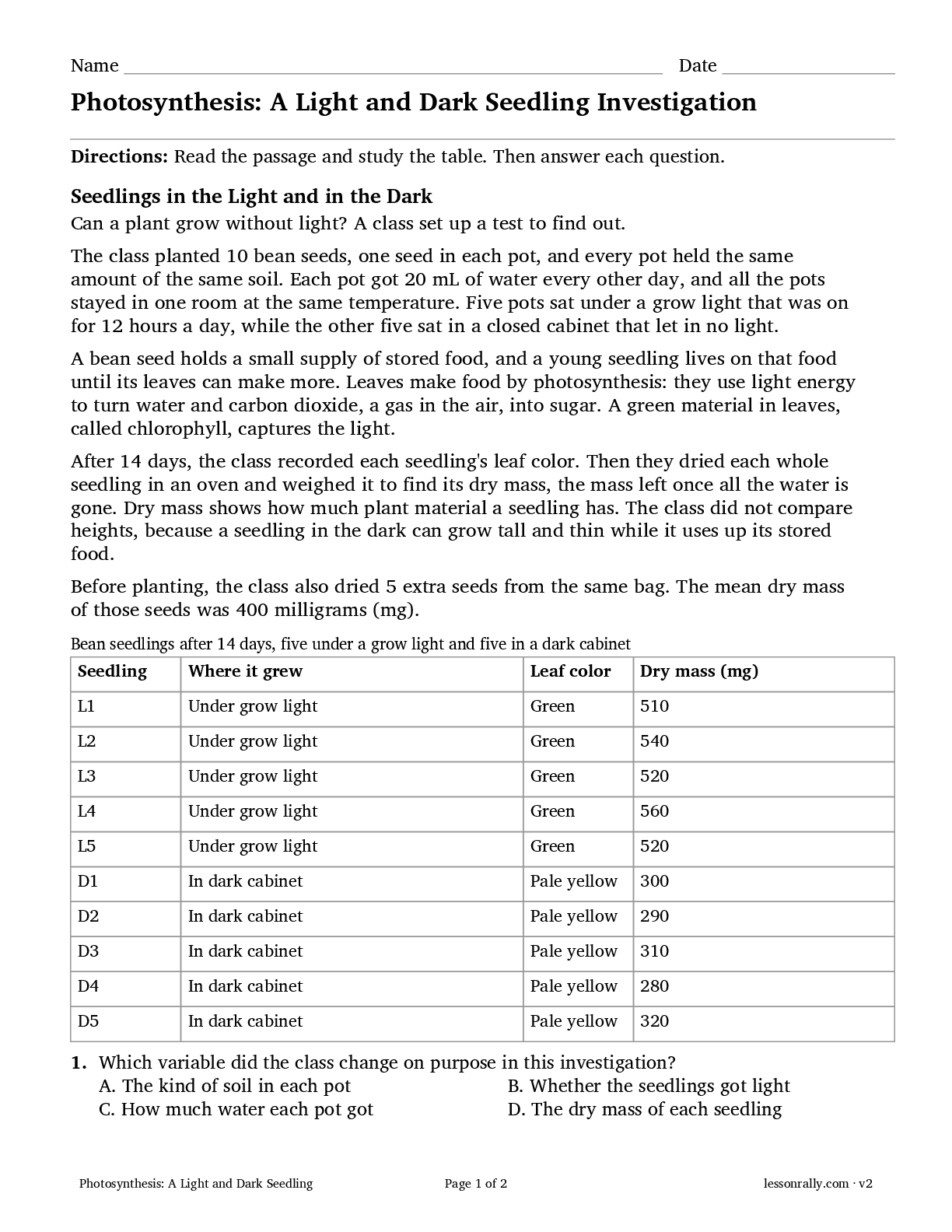
Read the passage and study the table. Then answer each question.
Can a plant grow without light? A class set up a test to find out.
The class planted 10 bean seeds, one seed in each pot, and every pot held the same amount of the same soil. Each pot got 20 mL of water every other day, and all the pots stayed in one room at the same temperature. Five pots sat under a grow light that was on for 12 hours a day, while the other five sat in a closed cabinet that let in no light.
A bean seed holds a small supply of stored food, and a young seedling lives on that food until its leaves can make more. Leaves make food by photosynthesis: they use light energy to turn water and carbon dioxide, a gas in the air, into sugar. A green material in leaves, called chlorophyll, captures the light.
After 14 days, the class recorded each seedling's leaf color. Then they dried each whole seedling in an oven and weighed it to find its dry mass, the mass left once all the water is gone. Dry mass shows how much plant material a seedling has. The class did not compare heights, because a seedling in the dark can grow tall and thin while it uses up its stored food.
Before planting, the class also dried 5 extra seeds from the same bag. The mean dry mass of those seeds was 400 milligrams (mg).
| Seedling | Where it grew | Leaf color | Dry mass (mg) |
|---|---|---|---|
| L1 | Under grow light | Green | 510 |
| L2 | Under grow light | Green | 540 |
| L3 | Under grow light | Green | 520 |
| L4 | Under grow light | Green | 560 |
| L5 | Under grow light | Green | 520 |
| D1 | In dark cabinet | Pale yellow | 300 |
| D2 | In dark cabinet | Pale yellow | 290 |
| D3 | In dark cabinet | Pale yellow | 310 |
| D4 | In dark cabinet | Pale yellow | 280 |
| D5 | In dark cabinet | Pale yellow | 320 |
Which variable did the class change on purpose in this investigation?
Choose one answer.
Every pot held the same soil and got the same amount of water. Why did that matter for this test?
Choose one answer.
The passage says chlorophyll is the green material that captures light. Which seedlings in the table most likely had little or no chlorophyll?
Choose one answer.
What was the mean dry mass of the five seedlings that grew under the grow light (L1 to L5)?
Enter a number.
mg
Find the mean dry mass of the five seedlings that grew in the dark cabinet (D1 to D5). How many milligrams lower is it than the mean dry mass of the seeds before planting?
Enter a number.
mg
The dark seedlings ended with less dry mass than the seeds had before planting. Which explanation fits the passage and the table?
Choose one answer.
The seedlings under the grow light ended with more dry mass than the seeds had at the start. Where did most of this new plant material come from?
Choose one answer.
Which claim does the evidence from this investigation support?
Choose one answer.
Suppose the class added a third group of five seedlings with a grow light on for only 6 hours a day. Everything else stayed the same. What would most likely happen to this group's mean dry mass after 14 days?
Choose one answer.
No reviews yet.
Reviews come from teachers who assigned this activity to a class.
Have a topic of your own? Make a printable worksheet and online quiz, free.
Create an activityCommon Core RST.6-8.7
Made by Theo Nakamura · LessonRally (AI-assisted)
Common Core RST.6-8.4
Made by Myra Jefferson · LessonRally (AI-assisted)
Made by Theo Nakamura · LessonRally (AI-assisted)
Common Core RST.6-8.4
Made by Myra Jefferson · LessonRally (AI-assisted)