Simile and Metaphor in a Poem: Bus Stop in January

8 questions · 8 points · Grade 6 · English · Preview the 8 questions

Made by Claire Fenwood · LessonRally (AI-assisted)

Digital classroom activity

What is a digital classroom activity?

Teachers who sign in can assign LessonRally activities to their Google Classroom classes: students open them in Classroom and answer online, and their grades go to the teacher's Classroom gradebook. Practice lets you try it first, the way students see it.

Free for teachers. Sign in to assign activities to your Google Classroom classes.

Printable worksheet

Students read an original poem full of figurative language about waiting for the school bus on a dark January morning. They find the similes and metaphors, tell a simile from a metaphor, explain what each comparison suggests, and decide how the last stanza fits the whole poem.

Learning goal: Identify similes and metaphors in a poem and explain what each comparison suggests.

Estimated reading level 5.3

  1. Grade 3Hard
  2. Grade 4Stretch
  3. Grade 5On level
  4. Grade 6Easier
  5. Grade 7Easy
About this estimate

The estimate is halfway between the two middle scores of four readability formulas. Their scores run from 4.3 to 6.8.

  • Flesch-Kincaid Grade Middle scoreSentence length and syllables per word4.8
  • Gunning FogSentence length and words of three or more syllables6.8
  • Coleman-Liau Middle scoreLetters per word and sentences per 100 words5.8
  • Automated Readability IndexCharacters per word and words per sentence4.3
Flesch Reading Ease
84.3 on a 0 to 100 scale where higher is easier: easy. Not part of the estimate.
Text measured
609 words, 24 sentences

Adapted from common readability formulas (Flesch-Kincaid, Gunning Fog, Coleman-Liau and ARI, plus SMOG for long texts), which look at sentence length and word length. Answer choices count toward word length only. Grades below the estimate will likely find the text harder, grades above it easier. It does not measure ideas, background knowledge or images.

Common Core

Closest anchor: CCRA.L.5 Demonstrate understanding of figurative language, word relationships, and nuances in word meanings.Anchor Standards for LanguageShow 1 matched standardHide matched standard

Matched standard

  • L.6.5a

    Interpret figures of speech (e.g., personification) in context.

    Student preview questions 1, 3, 5, 7

Matched independently by two AI models from this activity's questions.

© Copyright 2010. National Governors Association Center for Best Practices and Council of Chief State School Officers. All rights reserved.

Topic: Figurative Language Chosen by LessonRally

Question types: multiple choice, select all that apply.

Student preview

The questions as students see them, without the answers.

Read the poem carefully. Then answer each question.

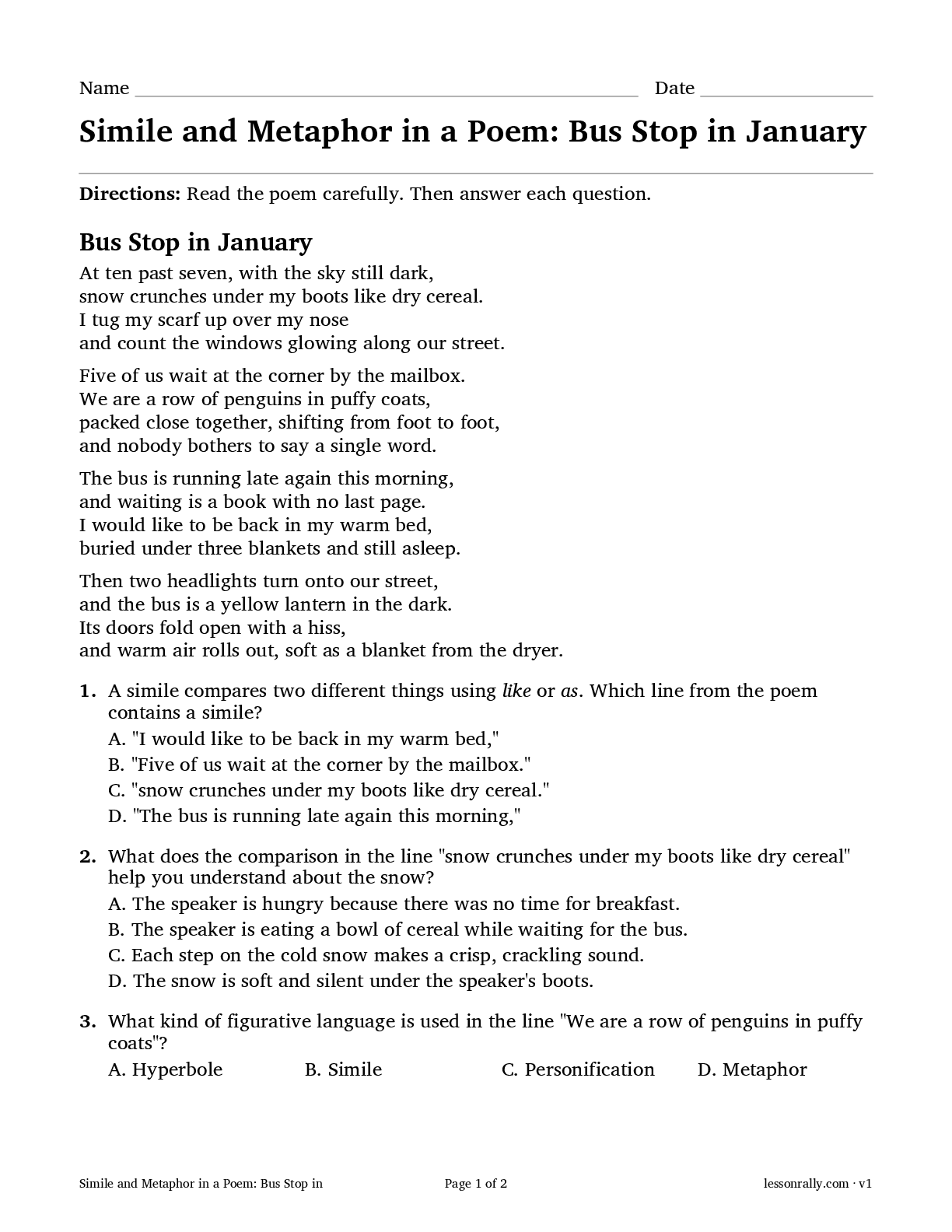
Bus Stop in January

At ten past seven, with the sky still dark,
snow crunches under my boots like dry cereal.
I tug my scarf up over my nose
and count the windows glowing along our street.

Five of us wait at the corner by the mailbox.
We are a row of penguins in puffy coats,
packed close together, shifting from foot to foot,
and nobody bothers to say a single word.

The bus is running late again this morning,
and waiting is a book with no last page.
I would like to be back in my warm bed,
buried under three blankets and still asleep.

Then two headlights turn onto our street,
and the bus is a yellow lantern in the dark.
Its doors fold open with a hiss,
and warm air rolls out, soft as a blanket from the dryer.


Question 1

A simile compares two different things using like or as. Which line from the poem contains a simile?

Choose one answer.

  • "I would like to be back in my warm bed,"
  • "snow crunches under my boots like dry cereal."
  • "Five of us wait at the corner by the mailbox."
  • "The bus is running late again this morning,"

Question 2

What does the comparison in the line "snow crunches under my boots like dry cereal" help you understand about the snow?

Choose one answer.

  • Each step on the cold snow makes a crisp, crackling sound.
  • The speaker is hungry because there was no time for breakfast.
  • The snow is soft and silent under the speaker's boots.
  • The speaker is eating a bowl of cereal while waiting for the bus.

Question 3

What kind of figurative language is used in the line "We are a row of penguins in puffy coats"?

Choose one answer.

  • Hyperbole
  • Personification
  • Metaphor
  • Simile

Question 4

What does the speaker suggest by calling the kids at the bus stop "a row of penguins in puffy coats"?

Choose one answer.

  • They huddle close together and shuffle their feet to stay warm.
  • They are all wearing black-and-white coats.
  • They are on a class trip to see the penguins at the zoo.
  • They stand far apart and keep perfectly still.

Question 5

A metaphor says one thing is another thing, without using like or as. Which two lines from the poem are metaphors? Select two.

Choose 2 answers.

  • "and waiting is a book with no last page."
  • "and warm air rolls out, soft as a blanket from the dryer."
  • "and the bus is a yellow lantern in the dark."
  • "At ten past seven, with the sky still dark,"
  • "I tug my scarf up over my nose"

Question 6

In the third stanza, the speaker says that "waiting is a book with no last page." What does this tell you about the wait?

Choose one answer.

  • The speaker left a library book at home.
  • The speaker is reading a long book while waiting for the bus.
  • The speaker thinks waiting is as much fun as a good story.
  • The wait feels like it will never end.

Question 7

In the last stanza, the speaker says "the bus is a yellow lantern in the dark." What does the comparison show about the bus?

Choose one answer.

  • The driver hangs a lamp in the front window.
  • Its headlights are broken, so it is hard to see.
  • Its lights glow brightly in the dark morning.
  • It is small enough for a person to carry.

Question 8

The last stanza compares the bus to a lantern and the warm air to a blanket. How does this stanza fit into the poem as a whole?

Choose one answer.

  • It shows that the speaker will have to wait even longer.
  • It explains why the bus was late that morning.
  • It brings the long, cold wait to a warm, comforting end.
  • It describes the speaker walking to the bus stop.

Reviews

No reviews yet.

Reviews come from teachers who assigned this activity to a class.

Sign in to write a review

Have a topic of your own? Make a printable worksheet and online quiz, free.

Create an activity

Answer key

Answer keys come with Premium

Print this worksheet with the correct answers marked. The key includes any explanations, sample answers, and rubrics supplied with the activity.

Answer keys aren't public: only teachers with Premium and the people who can edit an activity can download one, so students can't get a ready-to-print key from this page.

Premium includes:

  • No ads for you, and no ads for your students on the assignments you post.
  • Answer keys for printable worksheets, with the correct answers marked and any explanations, sample answers, and rubrics.
  • Create with AI: up to 100 activities a year (5 during the free trial), with every answer checked before you see the draft.

$29 a year, plus sales tax where it applies.

New Premium teachers can try it free for 7 days. A card or other payment method is needed to start. Unless you cancel before the trial ends, you are charged then and the plan renews every year.

Already have Premium or edit this activity? Sign in