Cellular Respiration: Yeast, Sugar and Gas Bubbles

9 questions · 9 points · Grade 7 · English · Preview the 9 questions

Made by Myra Jefferson · LessonRally (AI-assisted)

Digital classroom activity

What is a digital classroom activity?

Teachers who sign in can assign LessonRally activities to their Google Classroom classes: students open them in Classroom and answer online, and their grades go to the teacher's Classroom gradebook. Practice lets you try it first, the way students see it.

Free for teachers. Sign in to assign activities to your Google Classroom classes.

Printable worksheet

Students read about a yeast investigation and use a table of gas measurements to explain how cells break down sugar to release energy and give off carbon dioxide. Questions cover cellular respiration, controlled variables, repeated trials, finding means, and weighing evidence for a claim.

Learning goal: Use evidence from a yeast investigation to explain that cells break down sugar to release energy and give off carbon dioxide.

Estimated reading level 5.5

  1. Grade 3Hard
  2. Grade 4Stretch
  3. Grade 5On level
  4. Grade 6Easier
  5. Grade 7Easy
About this estimate

The estimate is the middle score of five readability formulas. Their scores run from 4.2 to 8.2.

  • Flesch-Kincaid GradeSentence length and syllables per word4.9
  • Gunning FogSentence length and words of three or more syllables7.3
  • Coleman-Liau Middle scoreLetters per word and sentences per 100 words5.5
  • Automated Readability IndexCharacters per word and words per sentence4.2
  • SMOGWords of three or more syllables, for texts of 30 sentences or more8.2
Flesch Reading Ease
82.7 on a 0 to 100 scale where higher is easier: easy. Not part of the estimate.
Text measured
709 words, 31 sentences

Adapted from common readability formulas (Flesch-Kincaid, Gunning Fog, Coleman-Liau and ARI, plus SMOG for long texts), which look at sentence length and word length. Answer choices count toward word length only. Grades below the estimate will likely find the text harder, grades above it easier. It does not measure ideas, background knowledge or images.

Common Core

Closest anchor: CCRA.R.8 Delineate and evaluate the argument and specific claims in a text, including the validity of the reasoning as well as the relevance and sufficiency of the evidence.Anchor Standards for ReadingShow 1 matched standardHide matched standard

Matched standard

  • RST.6-8.8

    Distinguish among facts, reasoned judgment based on research findings, and speculation in a text.

    Student preview questions 6, 7

Matched independently by two AI models from this activity's questions.

© Copyright 2010. National Governors Association Center for Best Practices and Council of Chief State School Officers. All rights reserved.

Topics: Photosynthesis and Cellular Respiration, Experimental Design Chosen by LessonRally

Question types: multiple choice, select all that apply, number answer.

Student preview

The questions as students see them, without the answers.

Read the passage and study the table. Then answer each question.

Yeast, Sugar and a Gas Test

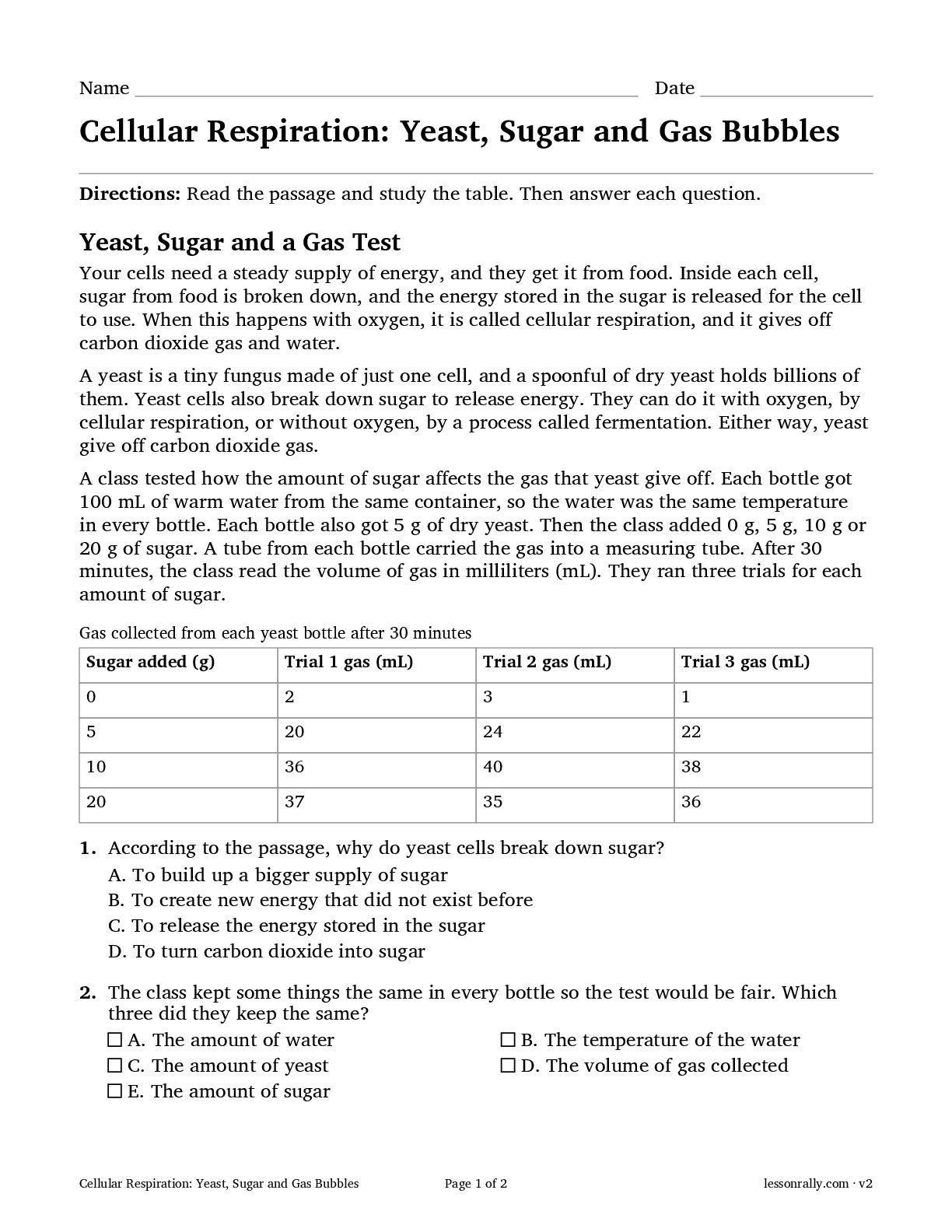
Your cells need a steady supply of energy, and they get it from food. Inside each cell, sugar from food is broken down, and the energy stored in the sugar is released for the cell to use. When this happens with oxygen, it is called cellular respiration, and it gives off carbon dioxide gas and water.

A yeast is a tiny fungus made of just one cell, and a spoonful of dry yeast holds billions of them. Yeast cells also break down sugar to release energy. They can do it with oxygen, by cellular respiration, or without oxygen, by a process called fermentation. Either way, yeast give off carbon dioxide gas.

A class tested how the amount of sugar affects the gas that yeast give off. Each bottle got 100 mL of warm water from the same container, so the water was the same temperature in every bottle. Each bottle also got 5 g of dry yeast. Then the class added 0 g, 5 g, 10 g or 20 g of sugar. A tube from each bottle carried the gas into a measuring tube. After 30 minutes, the class read the volume of gas in milliliters (mL). They ran three trials for each amount of sugar.


Gas collected from each yeast bottle after 30 minutes
Sugar added (g)Trial 1 gas (mL)Trial 2 gas (mL)Trial 3 gas (mL)
0231
5202422
10364038
20373536

Question 1

According to the passage, why do yeast cells break down sugar?

Choose one answer.

  • To build up a bigger supply of sugar
  • To release the energy stored in the sugar
  • To create new energy that did not exist before
  • To turn carbon dioxide into sugar

Question 2

The class kept some things the same in every bottle so the test would be fair. Which three did they keep the same?

Choose 3 answers.

  • The amount of water
  • The amount of sugar
  • The temperature of the water
  • The amount of yeast
  • The volume of gas collected

Question 3

What was the mean volume of gas for the three trials with 5 g of sugar?

Enter a number.

mL

Question 4

The class ran three trials for each amount of sugar instead of just one. How does this help?

Choose one answer.

  • It gives the yeast more time to use up the sugar.
  • It shows whether the results repeat, so one odd bottle does not mislead the class.
  • It lets the class test three different amounts of yeast.
  • It makes sure every trial gives exactly the same volume of gas.

Question 5

Find the mean volume of gas for the trials with 10 g of sugar and for the trials with 0 g of sugar. How many more milliliters is the 10 g mean than the 0 g mean?

Enter a number.

mL

Question 6

A student predicted that more sugar would always mean more gas. Which evidence from the table goes against that prediction?

Choose one answer.

  • The 20 g trials collected less gas, on average, than the 10 g trials.
  • The 5 g trials collected more gas than the 0 g trials.
  • The 10 g trials collected more gas than the 5 g trials.
  • The 0 g trials collected the least gas.

Question 7

Which claim does the evidence from this test support?

Choose one answer.

  • In this test, the yeast with no sugar gave off no gas at all.
  • In this test, warmer water made the yeast give off more gas.
  • In this test, adding sugar caused the yeast to give off much more gas.
  • In this test, the more sugar the class added, the more gas the yeast gave off.

Question 8

Suppose the class set up one more bottle with warm water and 10 g of sugar but no yeast. What would most likely happen after 30 minutes?

Choose one answer.

  • Little or no gas would collect, because no living cells would be there to break down the sugar.
  • More gas than the 10 g yeast bottles would collect, because no yeast would be using up the sugar.
  • About as much gas as the 10 g yeast bottles would collect, because the gas comes from the sugar dissolving.

Question 9

A student says the gas from the yeast bottles was oxygen, like the oxygen that plants give off. Which statement corrects the student?

Choose one answer.

  • The gas was carbon dioxide, which yeast give off when they break down sugar.
  • The student is right, because all living cells give off oxygen.
  • The gas was air that the sugar let out as it dissolved.
  • The gas was water vapor that rose from the warm water.

Reviews

No reviews yet.

Reviews come from teachers who assigned this activity to a class.

Sign in to write a review

Have a topic of your own? Make a printable worksheet and online quiz, free.

Create an activity

Answer key

Answer keys come with Premium

Print this worksheet with the correct answers marked. The key includes any explanations, sample answers, and rubrics supplied with the activity.

Answer keys aren't public: only teachers with Premium and the people who can edit an activity can download one, so students can't get a ready-to-print key from this page.

Premium includes:

  • No ads for you, and no ads for your students on the assignments you post.
  • Answer keys for printable worksheets, with the correct answers marked and any explanations, sample answers, and rubrics.
  • Create with AI: up to 100 activities a year (5 during the free trial), with every answer checked before you see the draft.

$29 a year, plus sales tax where it applies.

New Premium teachers can try it free for 7 days. A card or other payment method is needed to start. Unless you cancel before the trial ends, you are charged then and the plan renews every year.

Already have Premium or edit this activity? Sign in