Question 1
Student 3's resting heart rate in the table is 68 beats per minute. Using the class's method from the passage, how many beats did Student 3 count in 15 seconds?
Enter a number.
beats


Teachers who sign in can assign LessonRally activities to their Google Classroom classes: students open them in Classroom and answer online, and their grades go to the teacher's Classroom gradebook. Practice lets you try it first, the way students see it.
Free for teachers. Sign in to assign activities to your Google Classroom classes.
 (opens in a new tab)
2 pages · Student copy, no answers
Print worksheet (opens in a new tab)Answer keyPremiumStudents read how a class measured pulse at rest and after jumping jacks, then use a table of heart rates to find means, compare increases and track how heart rate falls during recovery. Questions connect the class data to how the heart moves oxygen to working muscles.
Learning goal: Read and analyze class heart rate data to explain how the circulatory system responds to exercise and recovery.
The estimate is halfway between the two middle scores of four readability formulas. Their scores run from 5.3 to 8.4.
Adapted from common readability formulas (Flesch-Kincaid, Gunning Fog, Coleman-Liau and ARI, plus SMOG for long texts), which look at sentence length and word length. Answer choices count toward word length only. Grades below the estimate will likely find the text harder, grades above it easier. It does not measure ideas, background knowledge or images.
Topic: Human Body Systems Chosen by LessonRally
Question types: number answer, multiple choice.
The questions as students see them, without the answers.
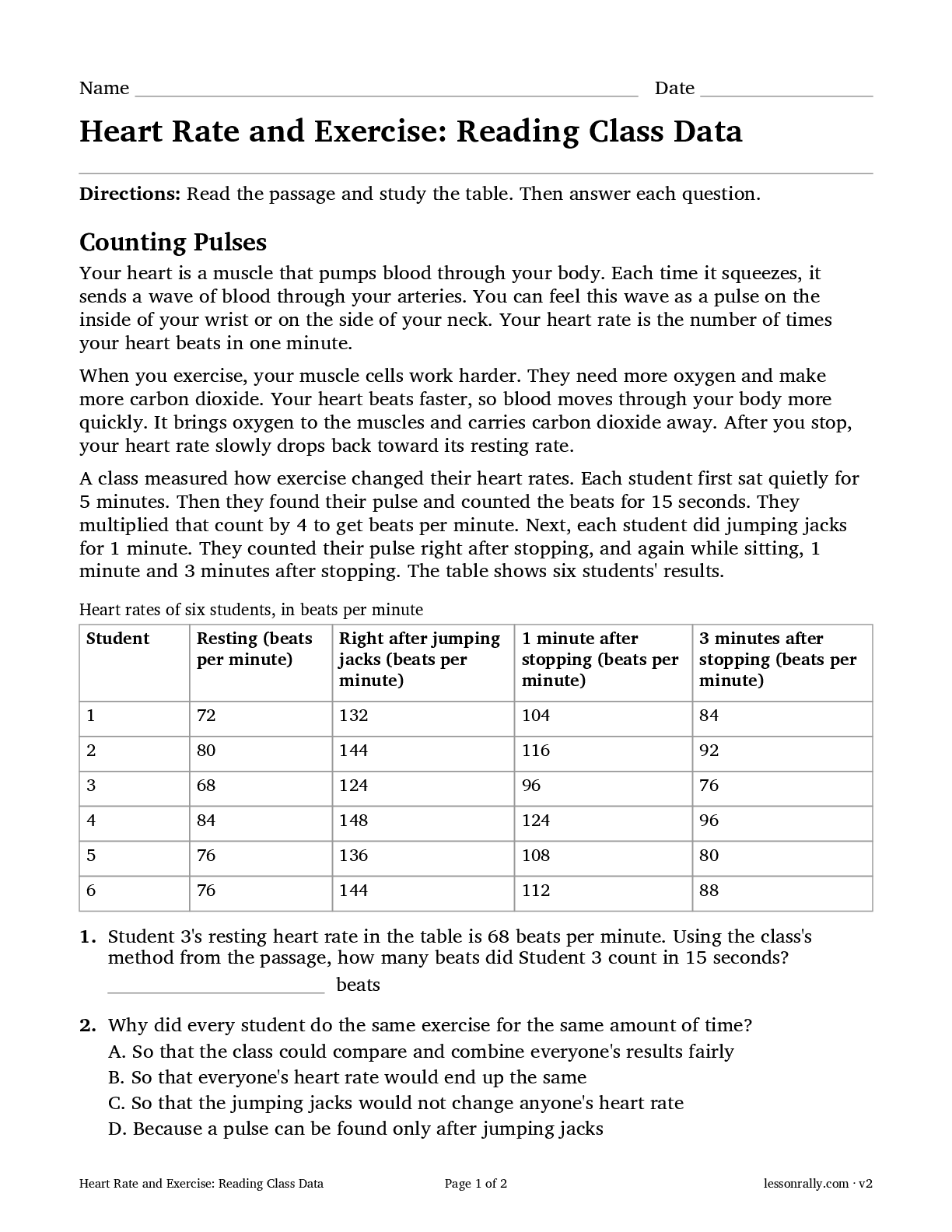
Read the passage and study the table. Then answer each question.
Your heart is a muscle that pumps blood through your body. Each time it squeezes, it sends a wave of blood through your arteries. You can feel this wave as a pulse on the inside of your wrist or on the side of your neck. Your heart rate is the number of times your heart beats in one minute.
When you exercise, your muscle cells work harder. They need more oxygen and make more carbon dioxide. Your heart beats faster, so blood moves through your body more quickly. It brings oxygen to the muscles and carries carbon dioxide away. After you stop, your heart rate slowly drops back toward its resting rate.
A class measured how exercise changed their heart rates. Each student first sat quietly for 5 minutes. Then they found their pulse and counted the beats for 15 seconds. They multiplied that count by 4 to get beats per minute. Next, each student did jumping jacks for 1 minute. They counted their pulse right after stopping, and again while sitting, 1 minute and 3 minutes after stopping. The table shows six students' results.
| Student | Resting (beats per minute) | Right after jumping jacks (beats per minute) | 1 minute after stopping (beats per minute) | 3 minutes after stopping (beats per minute) |
|---|---|---|---|---|
| 1 | 72 | 132 | 104 | 84 |
| 2 | 80 | 144 | 116 | 92 |
| 3 | 68 | 124 | 96 | 76 |
| 4 | 84 | 148 | 124 | 96 |
| 5 | 76 | 136 | 108 | 80 |
| 6 | 76 | 144 | 112 | 88 |
Student 3's resting heart rate in the table is 68 beats per minute. Using the class's method from the passage, how many beats did Student 3 count in 15 seconds?
Enter a number.
beats
Why did every student do the same exercise for the same amount of time?
Choose one answer.
What was the mean resting heart rate of the six students?
Enter a number.
beats per minute
Which student's heart rate rose the most from resting to right after the jumping jacks?
Choose one answer.
By how many beats per minute did the six students' mean heart rate rise from resting to right after the jumping jacks?
Enter a number.
beats per minute
According to the passage, why does the heart beat faster during exercise?
Choose one answer.
Which of these pairs of measurements shows the largest drop in the six students' mean heart rate?
Choose one answer.
Which claim does the evidence from these six students support?
Choose one answer.
Suppose the class measured again 10 minutes after stopping. Based on the table and the passage, what would the six students' mean heart rate most likely be?
Choose one answer.
No reviews yet.
Reviews come from teachers who assigned this activity to a class.
Have a topic of your own? Make a printable worksheet and online quiz, free.
Create an activityCommon Core RST.6-8.7
Made by Theo Nakamura · LessonRally (AI-assisted)
Common Core RST.6-8.4
Made by Myra Jefferson · LessonRally (AI-assisted)
Made by Theo Nakamura · LessonRally (AI-assisted)
Common Core RST.6-8.4
Made by Myra Jefferson · LessonRally (AI-assisted)