Personification: A Storm Moves In

10 questions · 13 points · Grade 6 · English · Preview the 10 questions

Made by Claire Fenwood · LessonRally (AI-assisted)

Digital classroom activity

What is a digital classroom activity?

Teachers who sign in can assign LessonRally activities to their Google Classroom classes: students open them in Classroom and answer online, and their grades go to the teacher's Classroom gradebook. Practice lets you try it first, the way students see it.

Free for teachers. Sign in to assign activities to your Google Classroom classes.

Printable worksheet

Students read sentences about a thunderstorm moving into town. They find the personification, explain what each human action suggests about the wind, thunder, rain, lightning and sun, and tell personification apart from a simile, a metaphor and hyperbole. Figurative language practice with no reading passage.

Learning goal: Identify personification in sentences and interpret what each human action suggests about the thing being described.

Estimated reading level 4.9

  1. Grade 2Hard
  2. Grade 3Stretch
  3. Grade 4On level
  4. Grade 5Easier
  5. Grade 6Easy
About this estimate

The estimate is halfway between the two middle scores of four readability formulas. Their scores run from 3.7 to 7.0.

  • Flesch-Kincaid GradeSentence length and syllables per word3.7
  • Gunning Fog Middle scoreSentence length and words of three or more syllables5.6
  • Coleman-LiauLetters per word and sentences per 100 words7.0
  • Automated Readability Index Middle scoreCharacters per word and words per sentence4.3
Flesch Reading Ease
86.2 on a 0 to 100 scale where higher is easier: easy. Not part of the estimate.
Text measured
577 words, 22 sentences

Adapted from common readability formulas (Flesch-Kincaid, Gunning Fog, Coleman-Liau and ARI, plus SMOG for long texts), which look at sentence length and word length. Answer choices count toward word length only. Grades below the estimate will likely find the text harder, grades above it easier. It does not measure ideas, background knowledge or images.

Common Core

Closest anchor: CCRA.L.5 Demonstrate understanding of figurative language, word relationships, and nuances in word meanings.Anchor Standards for LanguageShow 1 matched standardHide matched standard


Matched standard

  • L.6.5a

    Interpret figures of speech (e.g., personification) in context.

    Student preview questions 2, 4, 6, 7, 9

Matched independently by two AI models from this activity's questions.

© Copyright 2010. National Governors Association Center for Best Practices and Council of Chief State School Officers. All rights reserved.

Topic: Figurative Language Chosen by LessonRally

Question types: multiple choice, select all that apply, matching.

Student preview

The questions as students see them, without the answers.

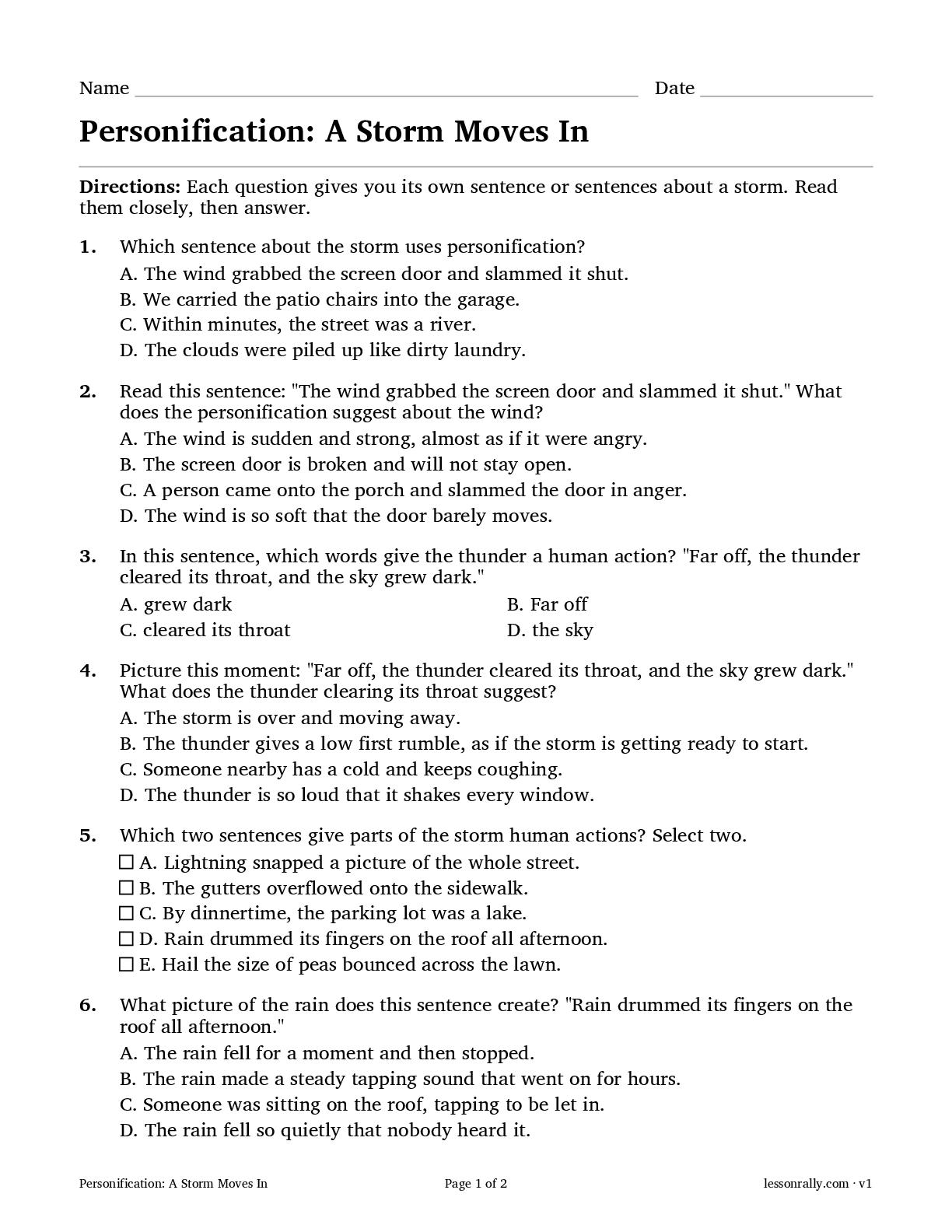
Each question gives you its own sentence or sentences about a storm. Read them closely, then answer.

Question 1

Which sentence about the storm uses personification?

Choose one answer.

  • We carried the patio chairs into the garage.
  • The wind grabbed the screen door and slammed it shut.
  • Within minutes, the street was a river.
  • The clouds were piled up like dirty laundry.

Question 2

Read this sentence: "The wind grabbed the screen door and slammed it shut." What does the personification suggest about the wind?

Choose one answer.

  • The screen door is broken and will not stay open.
  • The wind is sudden and strong, almost as if it were angry.
  • A person came onto the porch and slammed the door in anger.
  • The wind is so soft that the door barely moves.

Question 3

In this sentence, which words give the thunder a human action? "Far off, the thunder cleared its throat, and the sky grew dark."

Choose one answer.

  • grew dark
  • Far off
  • cleared its throat
  • the sky

Question 4

Picture this moment: "Far off, the thunder cleared its throat, and the sky grew dark." What does the thunder clearing its throat suggest?

Choose one answer.

  • The thunder gives a low first rumble, as if the storm is getting ready to start.
  • The storm is over and moving away.
  • The thunder is so loud that it shakes every window.
  • Someone nearby has a cold and keeps coughing.

Question 5

Which two sentences give parts of the storm human actions? Select two.

Choose 2 answers.

  • By dinnertime, the parking lot was a lake.
  • Rain drummed its fingers on the roof all afternoon.
  • The gutters overflowed onto the sidewalk.
  • Lightning snapped a picture of the whole street.
  • Hail the size of peas bounced across the lawn.

Question 6

What picture of the rain does this sentence create? "Rain drummed its fingers on the roof all afternoon."

Choose one answer.

  • The rain made a steady tapping sound that went on for hours.
  • The rain fell so quietly that nobody heard it.
  • Someone was sitting on the roof, tapping to be let in.
  • The rain fell for a moment and then stopped.

Question 7

Think about this sentence: "Lightning snapped a picture of the whole street." What does it suggest about the lightning?

Choose one answer.

  • A neighbor was taking photos of the storm.
  • It broke something on the street with a loud snap.
  • It stayed bright for the rest of the night.
  • It lit up the whole street in one quick, bright flash.

Question 8

Match each sentence about the storm to the kind of figurative language it uses.

Match each item to an option.

Items

  1. The trees waved hello to the passing cars.
  2. Hail rattled on the car roof like popcorn in a pan.
  3. The low clouds were a gray blanket over the town.
  4. We waited about a thousand years for the power to come back.

Options

  1. Metaphor
  2. Hyperbole
  3. Simile
  4. Personification

Question 9

As the storm calms down, a writer wants the rain to seem gentle. Which sentence uses personification to do that?

Choose one answer.

  • The storm stomped through the neighborhood.
  • The wind punched at the shutters.
  • The rain whispered against the window.
  • The thunder shouted over the rooftops.

Question 10

Read this short description of the end of the storm:

"The rain slowed to a drizzle. Water dripped from the gutters. At last, the sun pushed the clouds aside and peeked down at the soggy yard."

How does the last sentence fit with the rest of the description?

Choose one answer.

  • It shows that a new storm is about to begin.
  • It shows a person moving the clouds with both hands.
  • It shows that the yard has already dried out.
  • It shows the storm ending as the sun comes back out.

Reviews

No reviews yet.

Reviews come from teachers who assigned this activity to a class.

Sign in to write a review

Have a topic of your own? Make a printable worksheet and online quiz, free.

Create an activity

Answer key

Answer keys come with Premium

Print this worksheet with the correct answers marked. The key includes any explanations, sample answers, and rubrics supplied with the activity.

Answer keys aren't public: only teachers with Premium and the people who can edit an activity can download one, so students can't get a ready-to-print key from this page.

Premium includes:

  • No ads for you, and no ads for your students on the assignments you post.
  • Answer keys for printable worksheets, with the correct answers marked and any explanations, sample answers, and rubrics.
  • Create with AI: up to 100 activities a year (5 during the free trial), with every answer checked before you see the draft.

$29 a year, plus sales tax where it applies.

New Premium teachers can try it free for 7 days. A card or other payment method is needed to start. Unless you cancel before the trial ends, you are charged then and the plan renews every year.

Already have Premium or edit this activity? Sign in