Describing a Character with Evidence and Finding the Central Message: The New Goalie

7 questions · 7 points · Grade 4 · English · Preview the 7 questions

Made by Andre Whitaker · LessonRally (AI-assisted)

Digital classroom activity

What is a digital classroom activity?

Teachers who sign in can assign LessonRally activities to their Google Classroom classes: students open them in Classroom and answer online, and their grades go to the teacher's Classroom gradebook. Practice lets you try it first, the way students see it.

Free for teachers. Sign in to assign activities to your Google Classroom classes.

Printable worksheet

Students read a short original story about Dara, who agrees to play goalie for her soccer team. They choose answers about how she feels, what her words and actions show and which story details support ideas about her. One question asks them to choose the central message. Grade 4 reading comprehension practice on character traits and text evidence in fiction.

Learning goal: Describe a character in a story in depth, drawing on her thoughts, words and actions.

Estimated reading level 4.0

  1. Grade 2Hard
  2. Grade 3Stretch
  3. Grade 4On level
  4. Grade 5Easier
  5. Grade 6Easy
About this estimate

The estimate is the middle score of five readability formulas. Their scores run from 1.4 to 5.5.

  • Flesch-Kincaid GradeSentence length and syllables per word2.0
  • Gunning Fog Middle scoreSentence length and words of three or more syllables4.0
  • Coleman-LiauLetters per word and sentences per 100 words4.1
  • Automated Readability IndexCharacters per word and words per sentence1.4
  • SMOGWords of three or more syllables, for texts of 30 sentences or more5.5
Flesch Reading Ease
94.9 on a 0 to 100 scale where higher is easier: very easy. Not part of the estimate.
Text measured
602 words, 42 sentences

Adapted from common readability formulas (Flesch-Kincaid, Gunning Fog, Coleman-Liau and ARI, plus SMOG for long texts), which look at sentence length and word length. Answer choices count toward word length only. Grades below the estimate will likely find the text harder, grades above it easier. It does not measure ideas, background knowledge or images.

Common Core

Closest anchor: CCRA.R.3 Analyze how and why individuals, events, or ideas develop and interact over the course of a text.Anchor Standards for ReadingShow 3 matched standardsHide matched standards

Matched standards

  • RL.4.3

    Describe in depth a character, setting, or event in a story or drama, drawing on specific details in the text (e.g., a character's thoughts, words, or actions).

    Student preview questions 2, 3, 5, 6

  • RL.4.1

    Refer to details and examples in a text when explaining what the text says explicitly and when drawing inferences from the text.

    Student preview questions 2, 3, 7

  • RL.4.2

    Determine a theme of a story, drama, or poem from details in the text; summarize the text.

    Student preview question 1

Matched independently by two AI models from this activity's questions.

© Copyright 2010. National Governors Association Center for Best Practices and Council of Chief State School Officers. All rights reserved.

Topics: Characterization, Citing Text Evidence, Theme Chosen by LessonRally

Question types: multiple choice, select all that apply.

Student preview

The questions as students see them, without the answers.

Read the story about Dara. Use details from the story to answer each question. Choose one answer unless the question asks you to choose two.

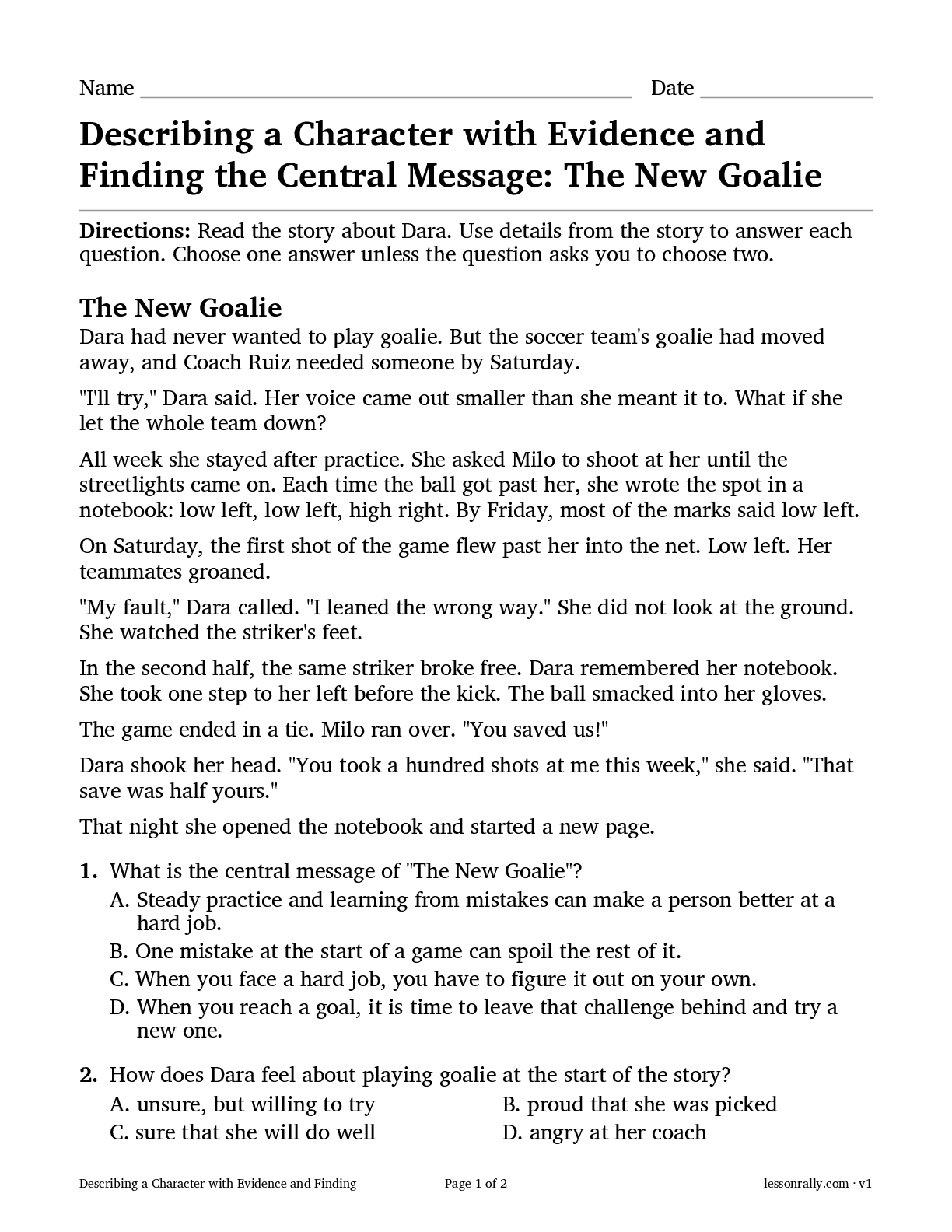
The New Goalie

Dara had never wanted to play goalie. But the soccer team's goalie had moved away, and Coach Ruiz needed someone by Saturday.

"I'll try," Dara said. Her voice came out smaller than she meant it to. What if she let the whole team down?

All week she stayed after practice. She asked Milo to shoot at her until the streetlights came on. Each time the ball got past her, she wrote the spot in a notebook: low left, low left, high right. By Friday, most of the marks said low left.

On Saturday, the first shot of the game flew past her into the net. Low left. Her teammates groaned.

"My fault," Dara called. "I leaned the wrong way." She did not look at the ground. She watched the striker's feet.

In the second half, the same striker broke free. Dara remembered her notebook. She took one step to her left before the kick. The ball smacked into her gloves.

The game ended in a tie. Milo ran over. "You saved us!"

Dara shook her head. "You took a hundred shots at me this week," she said. "That save was half yours."

That night she opened the notebook and started a new page.

Question 1

What is the central message of "The New Goalie"?

Choose one answer.

  • When you reach a goal, it is time to leave that challenge behind and try a new one.
  • Steady practice and learning from mistakes can make a person better at a hard job.
  • One mistake at the start of a game can spoil the rest of it.
  • When you face a hard job, you have to figure it out on your own.

Question 2

How does Dara feel about playing goalie at the start of the story?

Choose one answer.

  • proud that she was picked
  • unsure, but willing to try
  • angry at her coach
  • sure that she will do well

Question 3

Dara works hard to get ready for the game. Which detail does the story give as proof?

Choose one answer.

  • She watches goalies on television each night.
  • She stays after practice all week.
  • She runs around the field each morning.
  • She asks Coach Ruiz for an extra lesson.

Question 4

Dara keeps a notebook to help her play goalie. Which two details show how she uses it? Select two.

Choose 2 answers.

  • She draws the field on the first page.
  • She shows the notebook to Coach Ruiz.
  • She remembers her notebook when the striker breaks free in the second half.
  • She copies drills from a library book.
  • While she practices with Milo, she writes down the spot each time a shot gets past her.

Question 5

What does Dara's response to the first goal show about her?

Choose one answer.

  • She lets her anger take over.
  • She needs someone else to tell her what to do next.
  • She can admit a mistake and stay focused.
  • She uses a joke to get over a mistake.

Question 6

After the game, Milo says that Dara saved the team. What does her answer show about her?

Choose one answer.

  • She thinks the save was mostly luck.
  • She shares the credit for the save.
  • She is still upset about the first goal.
  • She thinks she deserves all the credit for the save.

Question 7

Dara uses what she learned in practice during the game. What in the story shows this?

Choose one answer.

  • She calls to a teammate, who blocks the shot.
  • She runs out and kicks the ball away from the striker.
  • She dives to her right and tips the ball over the net.
  • She steps to her left before the kick and stops the ball.

Reviews

No reviews yet.

Reviews come from teachers who assigned this activity to a class.

Sign in to write a review

Have a topic of your own? Make a printable worksheet and online quiz, free.

Create an activity

Answer key

Answer keys come with Premium

Print this worksheet with the correct answers marked. The key includes any explanations, sample answers, and rubrics supplied with the activity.

Answer keys aren't public: only teachers with Premium and the people who can edit an activity can download one, so students can't get a ready-to-print key from this page.

Premium includes:

  • No ads for you, and no ads for your students on the assignments you post.
  • Answer keys for printable worksheets, with the correct answers marked and any explanations, sample answers, and rubrics.
  • Create with AI: up to 100 activities a year (5 during the free trial), with every answer checked before you see the draft.

$29 a year, plus sales tax where it applies.

New Premium teachers can try it free for 7 days. A card or other payment method is needed to start. Unless you cancel before the trial ends, you are charged then and the plan renews every year.

Already have Premium or edit this activity? Sign in