Text Structure, Cause and Effect: What Makes a Dust Storm

8 questions · 11 points · Grade 4 · English · Preview the 8 questions

Made by Andre Whitaker · LessonRally (AI-assisted)

Digital classroom activity

What is a digital classroom activity?

Teachers who sign in can assign LessonRally activities to their Google Classroom classes: students open them in Classroom and answer online, and their grades go to the teacher's Classroom gradebook. Practice lets you try it first, the way students see it.

Free for teachers. Sign in to assign activities to your Google Classroom classes.

Printable worksheet

Students read a short informational passage about what causes dust storms and work with its cause and effect structure: they tell what two paragraphs add to the answer to the opening question, match causes to effects, find the signal phrase that links one cause to its effect and choose how the last paragraph adds to it. They also find the main idea, select two details about the southern Great Plains and choose one supporting detail for each of two ideas. Grade 4 reading comprehension.

Learning goal: Describe the cause and effect structure of an informational passage by identifying causes, effects and the signal words that link them.

Estimated reading level 5.0

  1. Grade 3Hard
  2. Grade 4Stretch
  3. Grade 5On level
  4. Grade 6Easier
  5. Grade 7Easy
About this estimate

The estimate is the middle score of five readability formulas. Their scores run from 2.5 to 5.9.

  • Flesch-Kincaid GradeSentence length and syllables per word2.5
  • Gunning Fog Middle scoreSentence length and words of three or more syllables5.0
  • Coleman-LiauLetters per word and sentences per 100 words5.9
  • Automated Readability IndexCharacters per word and words per sentence3.5
  • SMOGWords of three or more syllables, for texts of 30 sentences or more5.9
Flesch Reading Ease
95.5 on a 0 to 100 scale where higher is easier: very easy. Not part of the estimate.
Text measured
774 words, 38 sentences

Adapted from common readability formulas (Flesch-Kincaid, Gunning Fog, Coleman-Liau and ARI, plus SMOG for long texts), which look at sentence length and word length. Answer choices count toward word length only. Grades below the estimate will likely find the text harder, grades above it easier. It does not measure ideas, background knowledge or images.

Common Core

Closest anchor: CCRA.R.1 Read closely to determine what the text says explicitly and to make logical inferences from it; cite specific textual evidence when writing or speaking to support conclusions drawn from the text.Anchor Standards for ReadingShow 3 matched standardsHide matched standards

Matched standards

  • RI.4.1

    Refer to details and examples in a text when explaining what the text says explicitly and when drawing inferences from the text.

    Student preview questions 5, 6

  • RI.4.3

    Explain events, procedures, ideas, or concepts in a historical, scientific, or technical text, including what happened and why, based on specific information in the text.

    Student preview questions 2, 3

  • RI.4.2

    Determine the main idea of a text and explain how it is supported by key details; summarize the text.

    Student preview question 1

Matched independently by two AI models from this activity's questions.

© Copyright 2010. National Governors Association Center for Best Practices and Council of Chief State School Officers. All rights reserved.

Topics: Text Structure, Main Idea and Key Details Chosen by LessonRally

Question types: multiple choice, matching, select all that apply.

Student preview

The questions as students see them, without the answers.

Read the passage about dust storms. Then answer the questions, going back to the passage when you need it.

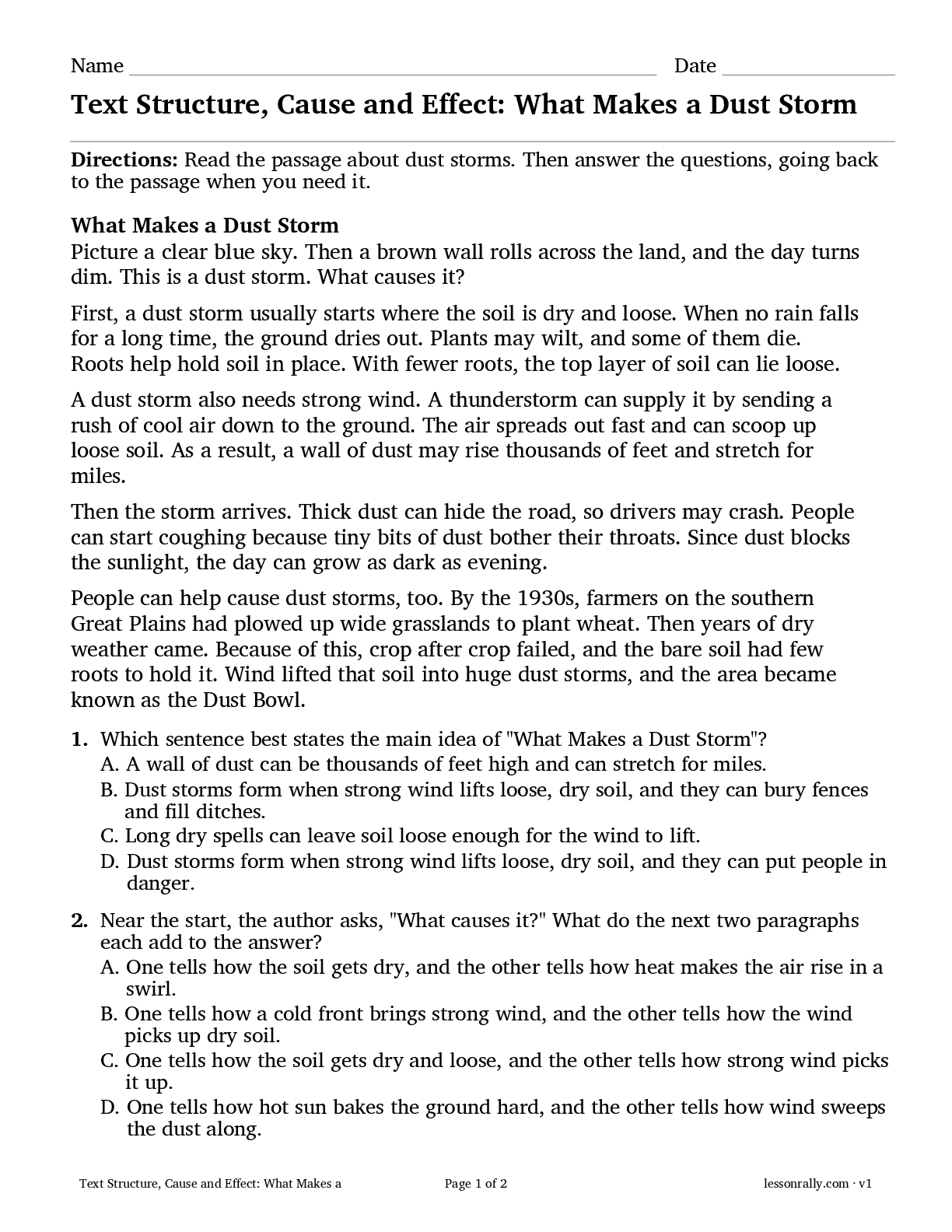
What Makes a Dust Storm

Picture a clear blue sky. Then a brown wall rolls across the land, and the day turns dim. This is a dust storm. What causes it?

First, a dust storm usually starts where the soil is dry and loose. When no rain falls for a long time, the ground dries out. Plants may wilt, and some of them die. Roots help hold soil in place. With fewer roots, the top layer of soil can lie loose.

A dust storm also needs strong wind. A thunderstorm can supply it by sending a rush of cool air down to the ground. The air spreads out fast and can scoop up loose soil. As a result, a wall of dust may rise thousands of feet and stretch for miles.

Then the storm arrives. Thick dust can hide the road, so drivers may crash. People can start coughing because tiny bits of dust bother their throats. Since dust blocks the sunlight, the day can grow as dark as evening.

People can help cause dust storms, too. By the 1930s, farmers on the southern Great Plains had plowed up wide grasslands to plant wheat. Then years of dry weather came. Because of this, crop after crop failed, and the bare soil had few roots to hold it. Wind lifted that soil into huge dust storms, and the area became known as the Dust Bowl.


Question 1

Which sentence best states the main idea of "What Makes a Dust Storm"?

Choose one answer.

  • Dust storms form when strong wind lifts loose, dry soil, and they can bury fences and fill ditches.
  • Long dry spells can leave soil loose enough for the wind to lift.
  • A wall of dust can be thousands of feet high and can stretch for miles.
  • Dust storms form when strong wind lifts loose, dry soil, and they can put people in danger.

Question 2

Near the start, the author asks, "What causes it?" What do the next two paragraphs each add to the answer?

Choose one answer.

  • One tells how hot sun bakes the ground hard, and the other tells how wind sweeps the dust along.
  • One tells how the soil gets dry and loose, and the other tells how strong wind picks it up.
  • One tells how the soil gets dry, and the other tells how heat makes the air rise in a swirl.
  • One tells how a cold front brings strong wind, and the other tells how the wind picks up dry soil.

Question 3

Each of these causes comes from one sentence in the passage. Match it to the effect that the same sentence gives. Four effects will be left over.

Match each item to an option.

Items

  1. No rain falls for a long time.
  2. Thick dust hides the road.
  3. Tiny bits of dust bother people's throats.
  4. Dust blocks the sunlight.

Options

  1. The day can grow dark.
  2. The ground dries out.
  3. Drivers may slow down and stop.
  4. People can start coughing.
  5. Ponds and streams may shrink.
  6. People may cover their mouths.
  7. Drivers may crash.
  8. Street lights may switch on.

Question 4

Which signal word or phrase does the author use to link the rushing air to the wall of dust?

Choose one answer.

  • As a result
  • so
  • Since
  • Because of this

Question 5

Which two of these details about the southern Great Plains are in the passage? Select two.

Choose 2 answers.

  • Cattle grazed on the open grasslands.
  • Many farm families packed up and moved west.
  • Farmers planted rows of trees to slow the wind.
  • Farmers plowed up wide grasslands.
  • Years of dry weather came.

Question 6

Ground covered with healthy plants is less likely to lose its soil to the wind. What does the passage say that backs up this idea?

Choose one answer.

  • Fallen leaves can cover patches of bare soil.
  • Leaves can shade the soil so it dries more slowly.
  • Roots help hold soil in place.
  • Grass slows the wind near the ground.

Question 7

Some kinds of weather can stir up strong wind near the ground. What example does the author give?

Choose one answer.

  • A cold front can push strong winds across dry fields.
  • A hurricane can bring strong winds far inland.
  • A winter storm can send strong winds across open land.
  • A thunderstorm can send cool air rushing down to the ground.

Question 8

How does the last paragraph add to what the earlier paragraphs explain?

Choose one answer.

  • It gives an example of people changing the land in a way that helped dust storms form.
  • It gives an example of farmers changing the land to keep the wind from carrying soil away.
  • It gives an example of strong wind lifting soil from land that was never farmed.
  • It gives an example of dust storms ruining the crops that farmers had planted.

Reviews

No reviews yet.

Reviews come from teachers who assigned this activity to a class.

Sign in to write a review

Have a topic of your own? Make a printable worksheet and online quiz, free.

Create an activity

Answer key

Answer keys come with Premium

Print this worksheet with the correct answers marked. The key includes any explanations, sample answers, and rubrics supplied with the activity.

Answer keys aren't public: only teachers with Premium and the people who can edit an activity can download one, so students can't get a ready-to-print key from this page.

Premium includes:

  • No ads for you, and no ads for your students on the assignments you post.
  • Answer keys for printable worksheets, with the correct answers marked and any explanations, sample answers, and rubrics.
  • Create with AI: up to 100 activities a year (5 during the free trial), with every answer checked before you see the draft.

$29 a year, plus sales tax where it applies.

New Premium teachers can try it free for 7 days. A card or other payment method is needed to start. Unless you cancel before the trial ends, you are charged then and the plan renews every year.

Already have Premium or edit this activity? Sign in