Teachers who sign in can assign LessonRally activities to their Google Classroom classes: students open them in Classroom and answer online, and their grades go to the teacher's Classroom gradebook. Practice lets you try it first, the way students see it.
Students review photosynthesis: what it takes in and gives off, chlorophyll, thylakoids, stroma and stomata, which plant cells photosynthesize, why leaves look green, how light energy becomes chemical energy, where the oxygen comes from, the light-dependent reactions (light reactions) and the Calvin cycle, plant respiration and where a plant's mass comes from, then analyze light intensity data from pondweed.
Learning goal: Explain how the light-dependent reactions and the Calvin cycle store light energy in sugar, and interpret data on how light intensity affects the rate of photosynthesis.
Estimated reading level8.4
Grade 6Hard
Grade 7Stretch
Grade 8On level
Grade 9Easier
Grade 10Easy
About this estimate
The estimate is halfway between the two middle scores of four readability formulas. Their scores run from 7.4 to 9.3.
Flesch-Kincaid GradeSentence length and syllables per word7.4
Gunning Fog Middle scoreSentence length and words of three or more syllables9.0
Coleman-LiauLetters per word and sentences per 100 words9.3
Automated Readability Index Middle scoreCharacters per word and words per sentence7.7
Grade 181216
Flesch Reading Ease
68.4 on a 0 to 100 scale where higher is easier: standard. Not part of the estimate.
Text measured
927 words, 27 sentences
Adapted from common readability formulas (Flesch-Kincaid, Gunning Fog, Coleman-Liau and ARI, plus SMOG for long texts), which look at sentence length and word length. Answer choices count toward word length only. Grades below the estimate will likely find the text harder, grades above it easier. It does not measure ideas, background knowledge or images.
Common Core
Press Ctrl+C or Command+C to copy.
Closest anchor:CCRA.R.7Integrate and evaluate content presented in diverse media and formats, including visually and quantitatively, as well as in words.Anchor Standards for ReadingShow 1 matched standardHide matched standard
Translate quantitative or technical information expressed in words in a text into visual form (e.g., a table or chart) and translate information expressed visually or mathematically (e.g., in an equation) into words.
Question types: fill in the blank, matching, multiple choice, select all that apply.
Student preview
The questions as students see them, without the answers.
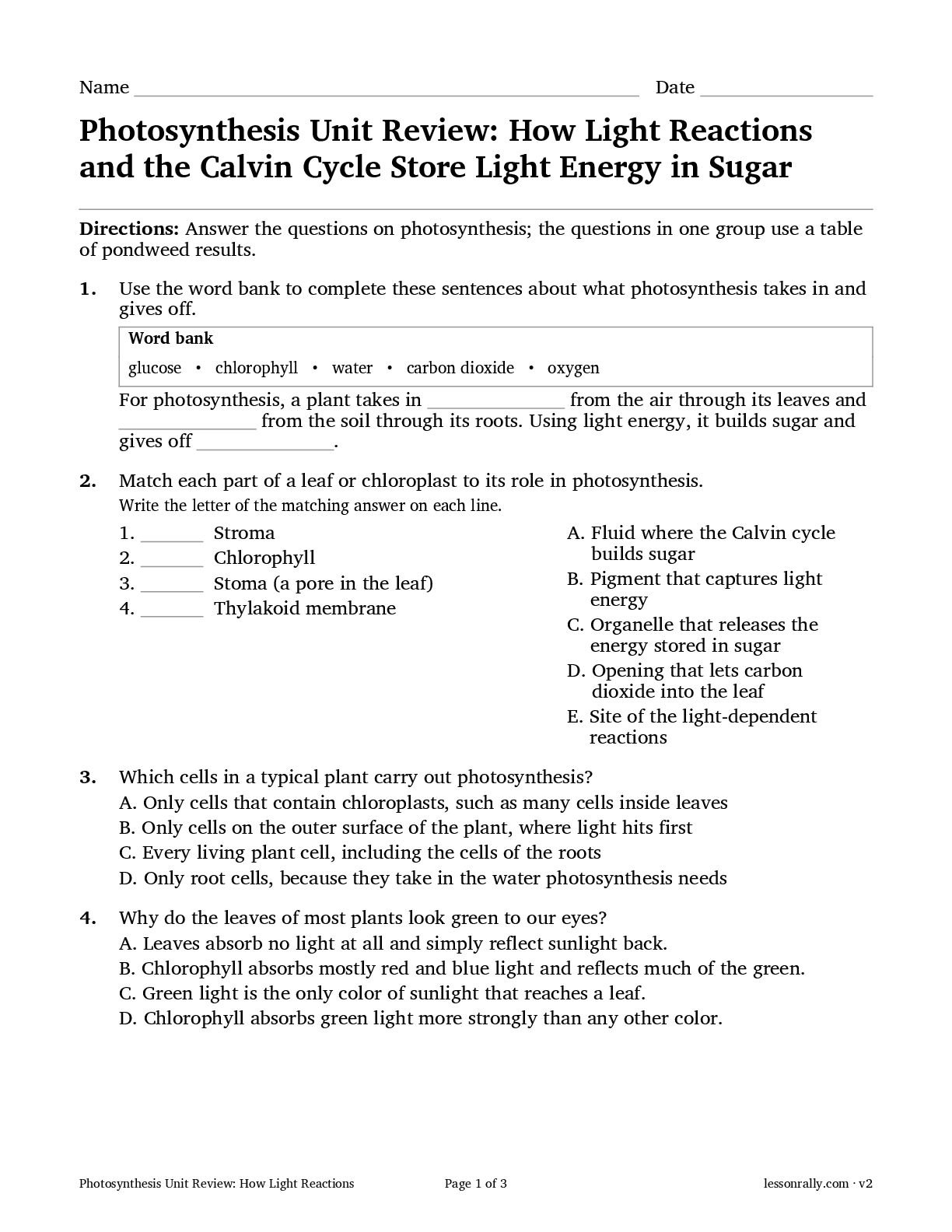
Answer the questions on photosynthesis; the questions in one group use a table of pondweed results.
Question 1
Use the word bank to complete these sentences about what photosynthesis takes in and gives off.
Fill in each blank.
For photosynthesis, a plant takes in blank 1 from the air through its leaves and blank 2 from the soil through its roots. Using light energy, it builds sugar and gives off blank 3.
Word bank
glucose
water
carbon dioxide
chlorophyll
oxygen
Question 2
Match each part of a leaf or chloroplast to its role in photosynthesis.
Match each item to an option.
Items
Stroma
Chlorophyll
Stoma (a pore in the leaf)
Thylakoid membrane
Options
Fluid where the Calvin cycle builds sugar
Opening that lets carbon dioxide into the leaf
Pigment that captures light energy
Site of the light-dependent reactions
Organelle that releases the energy stored in sugar
Question 3
Which cells in a typical plant carry out photosynthesis?
Choose one answer.
Only cells on the outer surface of the plant, where light hits first
Only root cells, because they take in the water photosynthesis needs
Only cells that contain chloroplasts, such as many cells inside leaves
Every living plant cell, including the cells of the roots
Question 4
Why do the leaves of most plants look green to our eyes?
Choose one answer.
Chlorophyll absorbs green light more strongly than any other color.
Green light is the only color of sunlight that reaches a leaf.
Chlorophyll absorbs mostly red and blue light and reflects much of the green.
Leaves absorb no light at all and simply reflect sunlight back.
Question 5
A leaf makes sugar, and some of that sugar travels to a root underground. How does the root receive energy from the light that the leaf absorbed?
Choose one answer.
As light carried by water flowing to the root.
As chemical energy carried by the sugar that reaches the root.
As heat released by sugar that stays in the leaf.
As light produced by carbon dioxide entering the root.
Question 6
In a classic experiment, algae were given water with extra heavy oxygen atoms, while their carbon dioxide had the usual mix of oxygen atoms. The oxygen gas the algae released had the same share of heavy oxygen as the water. What does this result show?
Choose one answer.
The oxygen released in photosynthesis comes from carbon dioxide.
The oxygen released in photosynthesis comes from the sugar.
The oxygen released in photosynthesis comes from the air around the algae.
The oxygen released in photosynthesis comes from water.
Question 7
Which two of these are made by the light-dependent reactions?
Choose 2 answers.
NADPH
Glucose
Starch
ATP
Carbon dioxide
Question 8
Why does the Calvin cycle of a plant moved from bright light into darkness soon slow down and stop, even though the cycle does not capture light itself?
Choose one answer.
Its chloroplasts begin making oxygen instead of sugar once it is dark.
Its stroma needs light to shine on it directly to bond carbon dioxide into sugar.
Its cells stop needing any sugar as soon as the light is gone.
It runs out of the energy carriers that the light-dependent reactions supply.
Question 9
At night, a plant takes in oxygen and gives off carbon dioxide. Which statement explains this?
Choose one answer.
It runs photosynthesis in reverse at night, turning sugar back into light.
Its chloroplasts switch to making carbon dioxide once the sun goes down.
It breathes in oxygen only at night and never uses oxygen during the day.
Its cells carry out cellular respiration day and night, but photosynthesis stops in the dark.
Question 10
A tree grows from a small seed into a plant with hundreds of kilograms of dry wood, while the soil around it loses very little mass. Where does the tree get the carbon that makes up a large share of its dry wood?
Choose one answer.
Minerals taken up from the soil
Water taken up by the roots
Carbon dioxide taken in from the air
Sunlight absorbed by the leaves
Pondweed Under a Lamp
In an investigation, a sprig of pondweed was placed in a tube of water with baking soda added to supply carbon dioxide, and a beaker of water stood between the lamp and the tube. The same sprig and water were used throughout as the lamp was set at five distances from the plant. At each distance, the bubbles rising from the cut stem were counted for 1 minute, 3 times. The bubbles are mostly oxygen.
Mean number of bubbles counted per minute from a pondweed sprig at five lamp distances (3 trials at each distance)
Distance from lamp (cm)
Mean number of bubbles counted per minute
10
36
20
30
30
19
40
11
50
6
Question 11
In this investigation, which variable was changed on purpose?
Choose one answer.
The kind of plant used in the tube
The distance between the lamp and the plant
The amount of baking soda in the water
The number of bubbles counted per minute
Question 12
What do the results show about this pondweed?
Choose one answer.
Light is the only factor that affects how fast photosynthesis happens.
Every water plant gives off 36 bubbles per minute at 10 cm from a lamp.
The plant stopped carrying out photosynthesis when the lamp was 50 cm away.
In this test, the plant gave off bubbles faster when the lamp was closer.
Question 13
Why was a beaker of water placed between the lamp and the plant?
Choose one answer.
To add carbon dioxide to the water around the plant
To give the plant more water to use in photosynthesis
To absorb heat from the lamp so that the temperature stayed about the same
To make the light reaching the plant brighter
Question 14
Suppose the test at 10 cm were repeated with no baking soda in the water, so the plant had less carbon dioxide. What is the most likely result?
Choose one answer.
More bubbles per minute, because less carbon dioxide leaves more room for oxygen
Fewer bubbles per minute, because carbon dioxide is one of the inputs of photosynthesis
The same number of bubbles, because light is the only input that matters
The same number of bubbles, because the bubbles are carbon dioxide, not oxygen