How the Circulatory and Respiratory Systems Work Together

9 questions · 9 points · Grade 7 · English · Preview the 9 questions

Made by Myra Jefferson · LessonRally (AI-assisted)

Digital classroom activity

What is a digital classroom activity?

Teachers who sign in can assign LessonRally activities to their Google Classroom classes: students open them in Classroom and answer online, and their grades go to the teacher's Classroom gradebook. Practice lets you try it first, the way students see it.

Free for teachers. Sign in to assign activities to your Google Classroom classes.

Printable worksheet

Students read about a breath test with bromothymol blue (BTB) and use a table of breathing rates and color-change times to explain how the circulatory and respiratory systems, working together, move oxygen to cells and carry carbon dioxide away. Questions cover a control, a variable, means and the claim the evidence supports.

Learning goal: Use evidence from a breath investigation to explain how the circulatory and respiratory systems work together to bring oxygen to cells and remove carbon dioxide.

Estimated reading level 7.0

  1. Grade 5Hard
  2. Grade 6Stretch
  3. Grade 7On level
  4. Grade 8Easier
  5. Grade 9Easy
About this estimate

The estimate is the middle score of five readability formulas. Their scores run from 6.1 to 8.7.

  • Flesch-Kincaid GradeSentence length and syllables per word6.1
  • Gunning Fog Middle scoreSentence length and words of three or more syllables7.0
  • Coleman-LiauLetters per word and sentences per 100 words8.7
  • Automated Readability IndexCharacters per word and words per sentence7.3
  • SMOGWords of three or more syllables, for texts of 30 sentences or more6.7
Flesch Reading Ease
77.3 on a 0 to 100 scale where higher is easier: fairly easy. Not part of the estimate.
Text measured
721 words, 30 sentences

Adapted from common readability formulas (Flesch-Kincaid, Gunning Fog, Coleman-Liau and ARI, plus SMOG for long texts), which look at sentence length and word length. Answer choices count toward word length only. Grades below the estimate will likely find the text harder, grades above it easier. It does not measure ideas, background knowledge or images.

Topics: Human Body Systems, Experimental Design Chosen by LessonRally

Question types: multiple choice, number answer.

Student preview

The questions as students see them, without the answers.

Read the passage and study the table. Then answer each question.

A Breath Test for Carbon Dioxide

Most of your body's cells release the energy in food by using oxygen. That process also makes carbon dioxide, a waste gas the body must get rid of. Two body systems share the job of moving these gases.

The respiratory system includes your nose, windpipe and lungs. Deep in the lungs are hundreds of millions of tiny air sacs, each wrapped in tiny blood vessels. There, oxygen from the air you breathe in passes into the blood. At the same time, carbon dioxide passes out of the blood into the air sacs, and you breathe it out.

The circulatory system includes your heart, blood vessels and blood. The heart pumps blood that carries oxygen from the lungs to cells all over the body. On the way back, the blood carries carbon dioxide from the cells to the lungs. When muscles work hard, their cells use more oxygen and make more carbon dioxide, so both systems speed up: you breathe faster, and your heart beats faster.

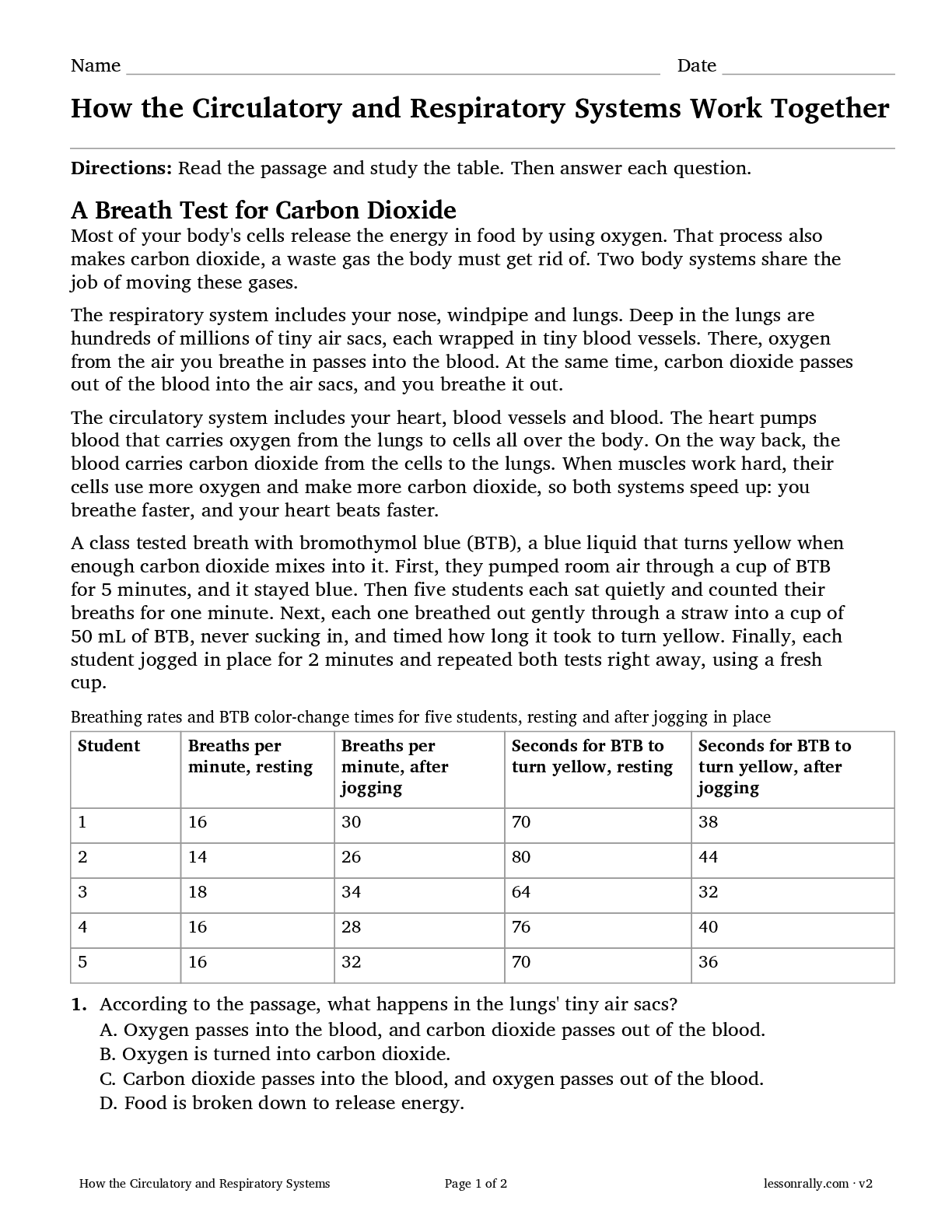
A class tested breath with bromothymol blue (BTB), a blue liquid that turns yellow when enough carbon dioxide mixes into it. First, they pumped room air through a cup of BTB for 5 minutes, and it stayed blue. Then five students each sat quietly and counted their breaths for one minute. Next, each one breathed out gently through a straw into a cup of 50 mL of BTB, never sucking in, and timed how long it took to turn yellow. Finally, each student jogged in place for 2 minutes and repeated both tests right away, using a fresh cup.


Breathing rates and BTB color-change times for five students, resting and after jogging in place
StudentBreaths per minute, restingBreaths per minute, after joggingSeconds for BTB to turn yellow, restingSeconds for BTB to turn yellow, after jogging
116307038
214268044
318346432
416287640
516327036

Question 1

According to the passage, what happens in the lungs' tiny air sacs?

Choose one answer.

  • Carbon dioxide passes into the blood, and oxygen passes out of the blood.
  • Food is broken down to release energy.
  • Oxygen passes into the blood, and carbon dioxide passes out of the blood.
  • Oxygen is turned into carbon dioxide.

Question 2

Why did the class pump room air through a cup of BTB before testing anyone's breath?

Choose one answer.

  • To see whether room air alone would turn the BTB yellow during the test
  • To make the BTB turn yellow before the test began
  • To remove the carbon dioxide that was already in the BTB
  • To warm the BTB so it would change color faster

Question 3

What did the class change on purpose between each student's first and second BTB test?

Choose one answer.

  • Whether the student had just jogged in place
  • The number of seconds the BTB took to turn yellow
  • Which student breathed into the cup
  • The amount of BTB in the cup

Question 4

What was the mean number of breaths per minute for the five students after jogging?

Enter a number.

breaths per minute

Question 5

Find the mean number of seconds for the BTB to turn yellow when the students were resting, and the mean after jogging. How many seconds shorter was the mean after jogging?

Enter a number.

seconds

Question 6

Which claim do the BTB results from this test support?

Choose one answer.

  • In this test, the students breathed out less carbon dioxide after jogging, since the BTB needed less time.
  • Room air contains more carbon dioxide than breath does.
  • Jogging made the students' lungs start making carbon dioxide.
  • In this test, the students breathed out carbon dioxide faster after jogging than when resting.

Question 7

Based on the passage, which explanation describes why the students breathed out carbon dioxide faster after jogging?

Choose one answer.

  • Their hearts turned oxygen into carbon dioxide, and their lungs stored it.
  • Jogging warmed the BTB, which made it turn yellow faster.
  • Their working muscle cells made more carbon dioxide, the blood carried it to the lungs, and faster breathing moved it out.
  • Their lungs made extra carbon dioxide, and the blood carried it to their muscles.

Question 8

The class measured breathing but not heartbeat. Based on the passage, what else most likely happened while the students jogged?

Choose one answer.

  • Their hearts beat faster, moving blood through the body more quickly.
  • Their blood stopped carrying carbon dioxide until they rested.
  • Their hearts beat slower to save oxygen.
  • Their lungs began pumping blood in place of their hearts.

Question 9

A sixth student took 24 breaths per minute after jogging. Based on the pattern in the table, how long would that student's BTB most likely take to turn yellow?

Choose one answer.

  • Between 36 and 40 seconds
  • Exactly 38 seconds, the same as the mean
  • Less than 32 seconds
  • More than 44 seconds

Reviews

No reviews yet.

Reviews come from teachers who assigned this activity to a class.

Sign in to write a review

Have a topic of your own? Make a printable worksheet and online quiz, free.

Create an activity

Answer key

Answer keys come with Premium

Print this worksheet with the correct answers marked. The key includes any explanations, sample answers, and rubrics supplied with the activity.

Answer keys aren't public: only teachers with Premium and the people who can edit an activity can download one, so students can't get a ready-to-print key from this page.

Premium includes:

  • No ads for you, and no ads for your students on the assignments you post.
  • Answer keys for printable worksheets, with the correct answers marked and any explanations, sample answers, and rubrics.
  • Create with AI: up to 100 activities a year (5 during the free trial), with every answer checked before you see the draft.

$29 a year, plus sales tax where it applies.

New Premium teachers can try it free for 7 days. A card or other payment method is needed to start. Unless you cancel before the trial ends, you are charged then and the plan renews every year.

Already have Premium or edit this activity? Sign in