Medieval Europe: Feudalism and the Manor

10 questions · 14 points · Grade 7 · English · Preview the 10 questions

Made by Owen Brackwell · LessonRally (AI-assisted)

Digital classroom activity

What is a digital classroom activity?

Teachers who sign in can assign LessonRally activities to their Google Classroom classes: students open them in Classroom and answer online, and their grades go to the teacher's Classroom gradebook. Practice lets you try it first, the way students see it.

Free for teachers. Sign in to assign activities to your Google Classroom classes.

Printable worksheet

Students read an original passage that presents the feudal pyramid as a model historians often use: kings, vassals and knights linked by fiefs and loyalty, and serfs who farmed a lord's manor. It then explains why many historians now find the model too simple. A table of what the model says each group received and gave supports questions on central ideas and summaries.

Learning goal: Determine the central ideas of a passage about feudalism and the manor, summarize what the feudal model says, and explain why historians debate it.

Estimated reading level 7.7

  1. Grade 5Hard
  2. Grade 6Stretch
  3. Grade 7On level
  4. Grade 8Easier
  5. Grade 9Easy
About this estimate

The estimate is the middle score of five readability formulas. Their scores run from 5.2 to 9.2.

  • Flesch-Kincaid GradeSentence length and syllables per word5.5
  • Gunning FogSentence length and words of three or more syllables7.8
  • Coleman-Liau Middle scoreLetters per word and sentences per 100 words7.7
  • Automated Readability IndexCharacters per word and words per sentence5.2
  • SMOGWords of three or more syllables, for texts of 30 sentences or more9.2
Flesch Reading Ease
76.0 on a 0 to 100 scale where higher is easier: fairly easy. Not part of the estimate.
Text measured
843 words, 36 sentences

Adapted from common readability formulas (Flesch-Kincaid, Gunning Fog, Coleman-Liau and ARI, plus SMOG for long texts), which look at sentence length and word length. Answer choices count toward word length only. Grades below the estimate will likely find the text harder, grades above it easier. It does not measure ideas, background knowledge or images.

Common Core

Closest anchor: CCRA.R.2 Determine central ideas or themes of a text and analyze their development; summarize the key supporting details and ideas.Anchor Standards for ReadingShow 3 matched standardsHide matched standards

Matched standards

  • RH.6-8.2

    Determine the central ideas or information of a primary or secondary source; provide an accurate summary of the source distinct from prior knowledge or opinions.

    Student preview questions 1, 3

  • RH.6-8.1

    Cite specific textual evidence to support analysis of primary and secondary sources.

    Student preview question 8

  • RH.6-8.8

    Distinguish among fact, opinion, and reasoned judgment in a text.

    Student preview question 10

Matched independently by two AI models from this activity's questions.

© Copyright 2010. National Governors Association Center for Best Practices and Council of Chief State School Officers. All rights reserved.

Topics: Main Idea and Key Details, Summarizing, Citing Text Evidence Chosen by LessonRally

Question types: multiple choice, matching, select all that apply.

Student preview

The questions as students see them, without the answers.

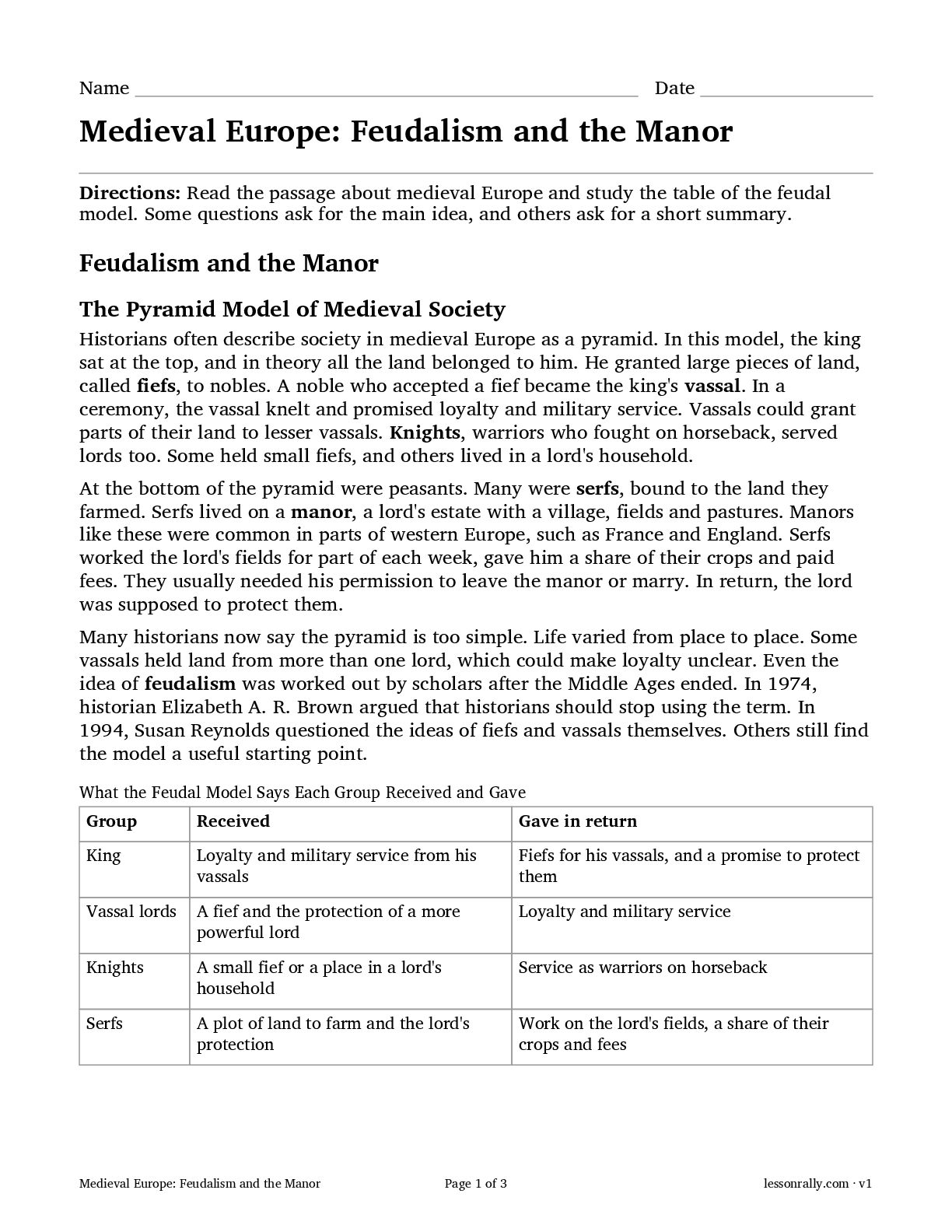
Read the passage about medieval Europe and study the table of the feudal model. Some questions ask for the main idea, and others ask for a short summary.

Feudalism and the Manor

The Pyramid Model of Medieval Society

Historians often describe society in medieval Europe as a pyramid. In this model, the king sat at the top, and in theory all the land belonged to him. He granted large pieces of land, called fiefs, to nobles. A noble who accepted a fief became the king's vassal. In a ceremony, the vassal knelt and promised loyalty and military service. Vassals could grant parts of their land to lesser vassals. Knights, warriors who fought on horseback, served lords too. Some held small fiefs, and others lived in a lord's household.

At the bottom of the pyramid were peasants. Many were serfs, bound to the land they farmed. Serfs lived on a manor, a lord's estate with a village, fields and pastures. Manors like these were common in parts of western Europe, such as France and England. Serfs worked the lord's fields for part of each week, gave him a share of their crops and paid fees. They usually needed his permission to leave the manor or marry. In return, the lord was supposed to protect them.

Many historians now say the pyramid is too simple. Life varied from place to place. Some vassals held land from more than one lord, which could make loyalty unclear. Even the idea of feudalism was worked out by scholars after the Middle Ages ended. In 1974, historian Elizabeth A. R. Brown argued that historians should stop using the term. In 1994, Susan Reynolds questioned the ideas of fiefs and vassals themselves. Others still find the model a useful starting point.


What the Feudal Model Says Each Group Received and Gave
GroupReceivedGave in return
KingLoyalty and military service from his vassalsFiefs for his vassals, and a promise to protect them
Vassal lordsA fief and the protection of a more powerful lordLoyalty and military service
KnightsA small fief or a place in a lord's householdService as warriors on horseback
SerfsA plot of land to farm and the lord's protectionWork on the lord's fields, a share of their crops and fees

Question 1

Which statement best expresses the central idea of the whole passage?

Choose one answer.

  • Historians often describe medieval society as a pyramid, but many now say the model is too simple.
  • Knights were the most powerful people in medieval Europe, even more powerful than kings.
  • The word feudalism was used by every lord and serf who lived in the Middle Ages.
  • Medieval kings owned every piece of land and ruled with no help from anyone.

Question 2

Match each term from the passage on medieval Europe to its meaning.

Match each item to an option.

Items

  1. fief
  2. vassal
  3. serf
  4. manor
  5. feudalism

Options

  1. a name scholars gave to this system after the Middle Ages
  2. a king who ruled all of Europe
  3. a person who received a fief from a lord
  4. a merchant who traveled from town to town
  5. a piece of land granted by a lord in return for loyalty and service
  6. a lord's estate with a village, fields and pastures
  7. a peasant bound to the land he or she farmed

Question 3

Which sentence best summarizes the first paragraph?

Choose one answer.

  • In the model, the king gave all of his land to the Church and kept none of it for himself.
  • In the model, the king and other lords granted land to vassals, who promised loyalty and military service.
  • In the model, knights chose the king, and then the knights ruled all of the manors together.
  • In the model, serfs owned most of the land and gave large pieces of it to the king as gifts.

Question 4

According to the table, what did knights receive?

Choose one answer.

  • A small fief or a place in a lord's household
  • Loyalty and military service from the king
  • Fees paid by the king every year
  • A whole kingdom to rule on their own

Question 5

According to the passage, a serf usually needed the lord's permission to do which two things? Select 2.

Choose 2 answers.

  • cook food for their families
  • leave the manor
  • marry
  • pray in the village church

Question 6

According to the table, what did serfs give in return for land and protection?

Choose one answer.

  • Loyalty and military service in every war
  • Service as warriors who fought on horseback
  • Fiefs for vassals and a promise to protect them
  • Work on the lord's fields, crops and fees

Question 7

According to the passage, where were manors like these common?

Choose one answer.

  • only in lands around the Black Sea
  • in parts of western Europe, such as France and England
  • in every country in the world
  • in North and South America

Question 8

Which detail from the passage supports the claim that the pyramid model is too simple?

Choose one answer.

  • Some vassals held land from more than one lord, which could make loyalty unclear.
  • In theory all the land belonged to the king.
  • Knights, warriors who fought on horseback, served lords too.
  • In a ceremony, the vassal knelt and promised loyalty and military service.

Question 9

Which statement best sums up what the table shows?

Choose one answer.

  • Only serfs owed anything to anyone in the model.
  • Knights received more land than any other group.
  • In the model, each group received something and gave something in return.
  • No one in the model received any land at all.

Question 10

A student is writing a summary of the passage. Which sentence adds an opinion that the passage does not state?

Choose one answer.

  • The pyramid was the fairest way to organize a society.
  • In the model, the king sat at the top of the pyramid.
  • In 1994, Susan Reynolds wrote about fiefs and vassals.
  • Knights were warriors who fought on horseback.

Reviews

No reviews yet.

Reviews come from teachers who assigned this activity to a class.

Sign in to write a review

Have a topic of your own? Make a printable worksheet and online quiz, free.

Create an activity

Answer key

Answer keys come with Premium

Print this worksheet with the correct answers marked. The key includes any explanations, sample answers, and rubrics supplied with the activity.

Answer keys aren't public: only teachers with Premium and the people who can edit an activity can download one, so students can't get a ready-to-print key from this page.

Premium includes:

  • No ads for you, and no ads for your students on the assignments you post.
  • Answer keys for printable worksheets, with the correct answers marked and any explanations, sample answers, and rubrics.
  • Create with AI: up to 100 activities a year (5 during the free trial), with every answer checked before you see the draft.

$29 a year, plus sales tax where it applies.

New Premium teachers can try it free for 7 days. A card or other payment method is needed to start. Unless you cancel before the trial ends, you are charged then and the plan renews every year.

Already have Premium or edit this activity? Sign in