Teachers who sign in can assign LessonRally activities to their Google Classroom classes: students open them in Classroom and answer online, and their grades go to the teacher's Classroom gradebook. Practice lets you try it first, the way students see it.
Students meet made-up claims in posts, screenshots, photos and headlines and decide what to do before sharing: pause, check the source and look for other reliable reports. They also spot warning signs such as pressure to share fast, old stories, misleading headlines, photos with the wrong caption, joke sites and posts from sellers. Media literacy practice.
Learning goal: Before sharing a claim, pause, check where it came from and look for other reliable reports, and recognize common warning signs of misinformation.
Estimated reading level6.0
Grade 4Hard
Grade 5Stretch
Grade 6On level
Grade 7Easier
Grade 8Easy
About this estimate
The estimate is the middle score of five readability formulas. Their scores run from 3.7 to 7.1.
Flesch-Kincaid GradeSentence length and syllables per word3.7
Gunning Fog Middle scoreSentence length and words of three or more syllables6.0
Coleman-LiauLetters per word and sentences per 100 words6.2
Automated Readability IndexCharacters per word and words per sentence3.8
SMOGWords of three or more syllables, for texts of 30 sentences or more7.1
Grade 181216
Flesch Reading Ease
87.8 on a 0 to 100 scale where higher is easier: easy. Not part of the estimate.
Text measured
704 words, 31 sentences
Adapted from common readability formulas (Flesch-Kincaid, Gunning Fog, Coleman-Liau and ARI, plus SMOG for long texts), which look at sentence length and word length. Answer choices count toward word length only. Grades below the estimate will likely find the text harder, grades above it easier. It does not measure ideas, background knowledge or images.
Question types: multiple choice, select all that apply.
Student preview
The questions as students see them, without the answers.
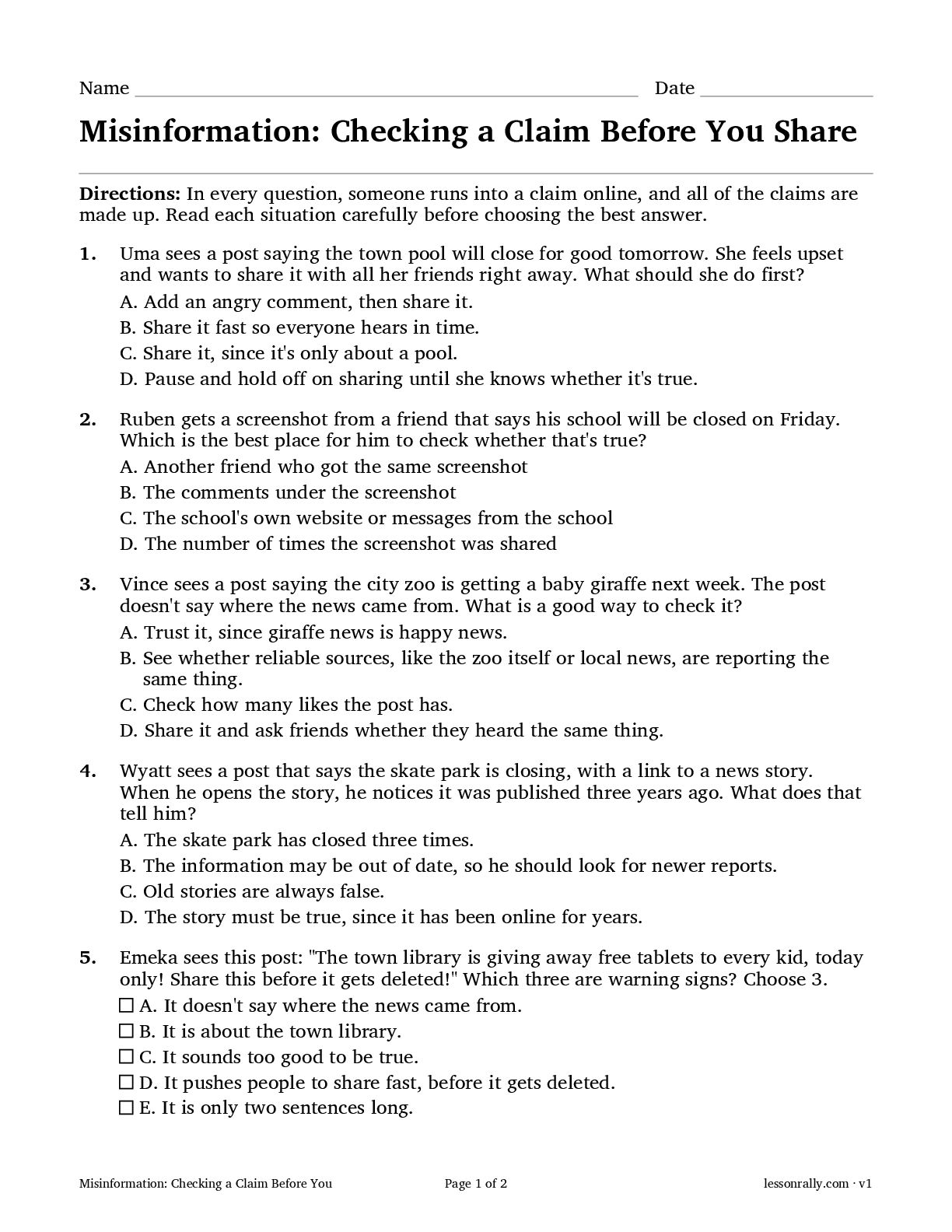
In every question, someone runs into a claim online, and all of the claims are made up. Read each situation carefully before choosing the best answer.
Question 1
Uma sees a post saying the town pool will close for good tomorrow. She feels upset and wants to share it with all her friends right away. What should she do first?
Choose one answer.
Pause and hold off on sharing until she knows whether it's true.
Share it fast so everyone hears in time.
Add an angry comment, then share it.
Share it, since it's only about a pool.
Question 2
Ruben gets a screenshot from a friend that says his school will be closed on Friday. Which is the best place for him to check whether that's true?
Choose one answer.
The school's own website or messages from the school
Another friend who got the same screenshot
The comments under the screenshot
The number of times the screenshot was shared
Question 3
Vince sees a post saying the city zoo is getting a baby giraffe next week. The post doesn't say where the news came from. What is a good way to check it?
Choose one answer.
Trust it, since giraffe news is happy news.
See whether reliable sources, like the zoo itself or local news, are reporting the same thing.
Share it and ask friends whether they heard the same thing.
Check how many likes the post has.
Question 4
Wyatt sees a post that says the skate park is closing, with a link to a news story. When he opens the story, he notices it was published three years ago. What does that tell him?
Choose one answer.
The story must be true, since it has been online for years.
Old stories are always false.
The information may be out of date, so he should look for newer reports.
The skate park has closed three times.
Question 5
Emeka sees this post: "The town library is giving away free tablets to every kid, today only! Share this before it gets deleted!" Which three are warning signs? Choose 3.
Choose 3 answers.
It pushes people to share fast, before it gets deleted.
It sounds too good to be true.
It is about the town library.
It is only two sentences long.
It doesn't say where the news came from.
Question 6
Zane sees a headline that says "Bikes Banned in Town" and wants to share it with his bike club. What should he do before sharing?
Choose one answer.
Share the headline, since headlines tell the whole story.
Share it, since most people only read headlines anyway.
Change the headline so it sounds even bigger.
Read the whole article to see what it actually says.
Question 7
Bianca sees a photo of a moose walking through a grocery store. The caption says it happened at a store in her town this morning. What is a good way to check the caption?
Choose one answer.
Check how many people liked the photo.
Share it, since a photo always shows the truth.
Search for the photo online to see where and when it first appeared.
Add a funny caption of her own and share it.
Question 8
Cyrus sees a post from a company that sells snow shovels. It says, "The biggest blizzard in 100 years hits this weekend! Buy your shovel now!" What should he do?
Choose one answer.
Trust it, since stores always know the weather.
Share it so his neighbors buy shovels too.
Buy a shovel right away, just in case.
Check a weather service's forecast, since the company may want to sell more shovels.
Question 9
Daphne sees an article titled "Local Goldfish Wins Spelling Bee" on The Chucklehorn Herald, a site that says it posts only made-up funny stories. How should she understand the article?
Choose one answer.
It means goldfish can now enter spelling bees.
She should share it as real news so others hear it.
It's true, since it looks like a news site.
It's a joke from a site that makes up funny stories, not real news.
Question 10
Tia's cousin shared a post saying the town fair is canceled. Tia checked the fair's official page, and it says the fair is still happening. What should Tia do?
Choose one answer.
Post that her cousin always gets things wrong.
Kindly tell her cousin and share the link to the official page.