Question 1
According to the passage, what is a cloud made of?
Choose one answer.
- Water vapor, a gas you cannot see
- Tiny drops of liquid water or bits of ice
- Steam that is hotter than boiling water
- Smoke that rises from the warm ocean


Teachers who sign in can assign LessonRally activities to their Google Classroom classes: students open them in Classroom and answer online, and their grades go to the teacher's Classroom gradebook. Practice lets you try it first, the way students see it.
Free for teachers. Sign in to assign activities to your Google Classroom classes.
 (opens in a new tab)
2 pages · Student copy, no answers
Print worksheet (opens in a new tab)Answer keyPremiumStudents read about rain falling at the beach and follow the water cycle (evaporation, condensation, clouds and precipitation) to explain why rain tastes fresh even though most of Earth's water is salty ocean water. Questions also ask where Earth's water is found and what clouds are made of.
Learning goal: Explain how water moves through the water cycle and why rain is fresh, and describe where most of Earth's water is found.
The estimate is halfway between the two middle scores of four readability formulas. Their scores run from 3.4 to 5.8.
Adapted from common readability formulas (Flesch-Kincaid, Gunning Fog, Coleman-Liau and ARI, plus SMOG for long texts), which look at sentence length and word length. Answer choices count toward word length only. Grades below the estimate will likely find the text harder, grades above it easier. It does not measure ideas, background knowledge or images.
Explain the relationships or interactions between two or more individuals, events, ideas, or concepts in a historical, scientific, or technical text based on specific information in the text.
Matched independently by two AI models from this activity's questions.
© Copyright 2010. National Governors Association Center for Best Practices and Council of Chief State School Officers. All rights reserved.
Topic: Water Cycle Chosen by LessonRally
Question types: multiple choice, fill in the blank.
The questions as students see them, without the answers.
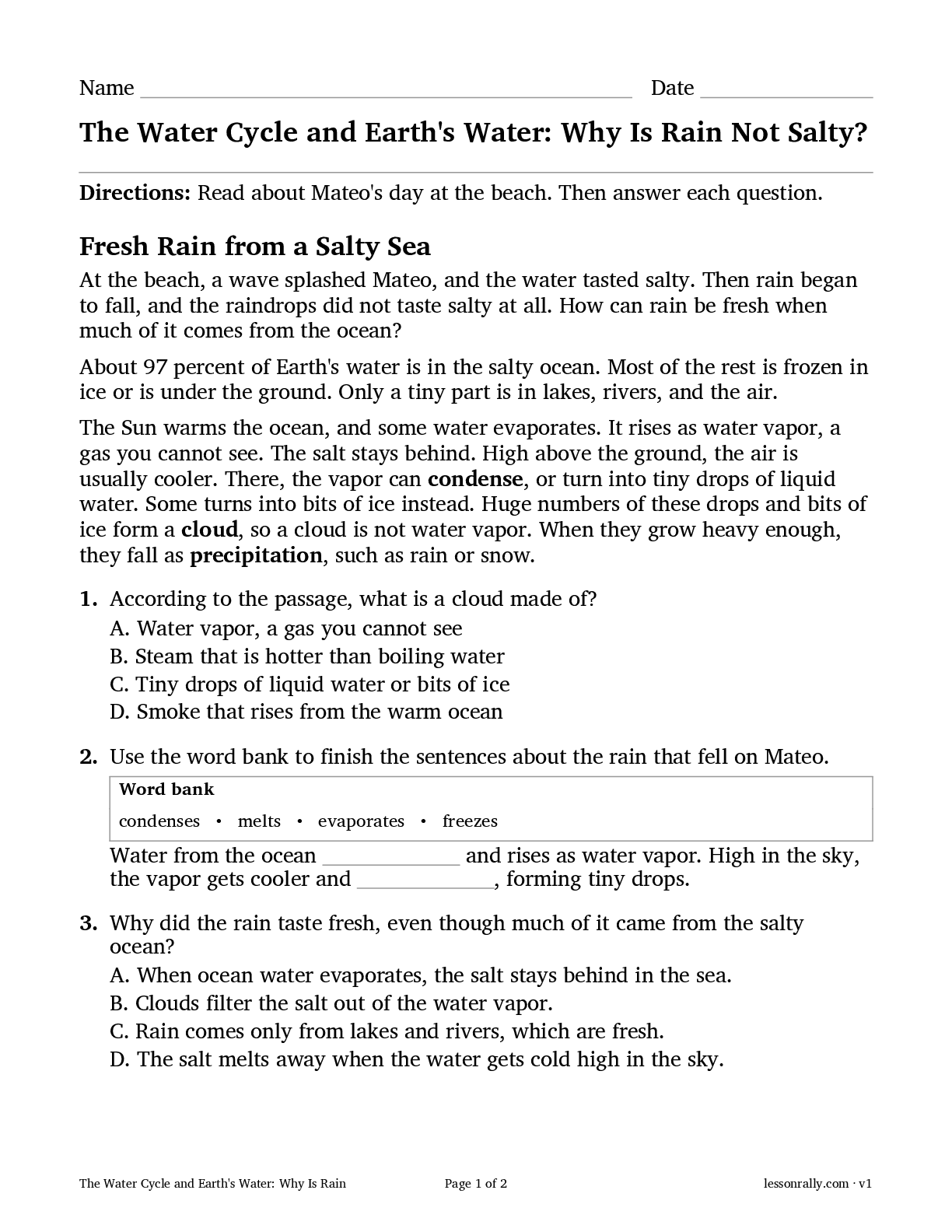
Read about Mateo's day at the beach. Then answer each question.
At the beach, a wave splashed Mateo, and the water tasted salty. Then rain began to fall, and the raindrops did not taste salty at all. How can rain be fresh when much of it comes from the ocean?
About 97 percent of Earth's water is in the salty ocean. Most of the rest is frozen in ice or is under the ground. Only a tiny part is in lakes, rivers, and the air.
The Sun warms the ocean, and some water evaporates. It rises as water vapor, a gas you cannot see. The salt stays behind. High above the ground, the air is usually cooler. There, the vapor can condense, or turn into tiny drops of liquid water. Some turns into bits of ice instead. Huge numbers of these drops and bits of ice form a cloud, so a cloud is not water vapor. When they grow heavy enough, they fall as precipitation, such as rain or snow.
According to the passage, what is a cloud made of?
Choose one answer.
Use the word bank to finish the sentences about the rain that fell on Mateo.
Fill in each blank.
Water from the ocean blank 1 and rises as water vapor. High in the sky, the vapor gets cooler and blank 2, forming tiny drops.
Word bank
Why did the rain taste fresh, even though much of it came from the salty ocean?
Choose one answer.
In the passage, what gives ocean water the energy to evaporate?
Choose one answer.
According to the passage, where is most of Earth's water?
Choose one answer.
Where is most of the water that is not in the ocean?
Choose one answer.
Which of these is an example of precipitation?
Choose one answer.
What would happen if the tiny drops in a cloud kept joining together and growing bigger?
Choose one answer.
No reviews yet.
Reviews come from teachers who assigned this activity to a class.
Have a topic of your own? Make a printable worksheet and online quiz, free.
Create an activityCommon Core RI.5.3
Made by Wes Calloway · LessonRally (AI-assisted)
Common Core RI.5.3
Made by Wes Calloway · LessonRally (AI-assisted)
Common Core RI.5.4
Made by Wes Calloway · LessonRally (AI-assisted)
Common Core RI.5.4
Made by Wes Calloway · LessonRally (AI-assisted)