Articles of Confederation: Weaknesses and Shays' Rebellion

10 questions · 14 points · Grade 8 · English · Preview the 10 questions

Made by Monica Ellison · LessonRally (AI-assisted)

Digital classroom activity

What is a digital classroom activity?

Teachers who sign in can assign LessonRally activities to their Google Classroom classes: students open them in Classroom and answer online, and their grades go to the teacher's Classroom gradebook. Practice lets you try it first, the way students see it.

Free for teachers. Sign in to assign activities to your Google Classroom classes.

Printable worksheet

Students read a passage about the Articles of Confederation and Shays' Rebellion, then find the central idea and summarize it, deciding what belongs in an objective summary. They match each weakness of the national government to its result and explain why Congress could not pay its debts, why farmers led by Daniel Shays rebelled in 1786, and what changed after the rebellion.

Learning goal: Determine the central idea of a passage about the Articles of Confederation and Shays' Rebellion, and summarize how the rebellion exposed the national government's weaknesses.

Estimated reading level 9.6

  1. Grade 7Hard
  2. Grade 8Stretch
  3. Grade 9On level
  4. Grade 10Easier
  5. Grade 11Easy
About this estimate

The estimate is the middle score of five readability formulas. Their scores run from 7.1 to 10.4.

  • Flesch-Kincaid GradeSentence length and syllables per word7.1
  • Gunning Fog Middle scoreSentence length and words of three or more syllables9.6
  • Coleman-LiauLetters per word and sentences per 100 words10.4
  • Automated Readability IndexCharacters per word and words per sentence8.0
  • SMOGWords of three or more syllables, for texts of 30 sentences or more10.2
Flesch Reading Ease
67.3 on a 0 to 100 scale where higher is easier: standard. Not part of the estimate.
Text measured
972 words, 41 sentences

Adapted from common readability formulas (Flesch-Kincaid, Gunning Fog, Coleman-Liau and ARI, plus SMOG for long texts), which look at sentence length and word length. Answer choices count toward word length only. Grades below the estimate will likely find the text harder, grades above it easier. It does not measure ideas, background knowledge or images.

Topic: U.S. Constitution Chosen by LessonRally

Question types: multiple choice, matching, fill in the blank, select all that apply.

Student preview

The questions as students see them, without the answers.

Read the passage. Then answer each question.

The Articles of Confederation and Shays' Rebellion

A Weak Union and a Farmers' Revolt

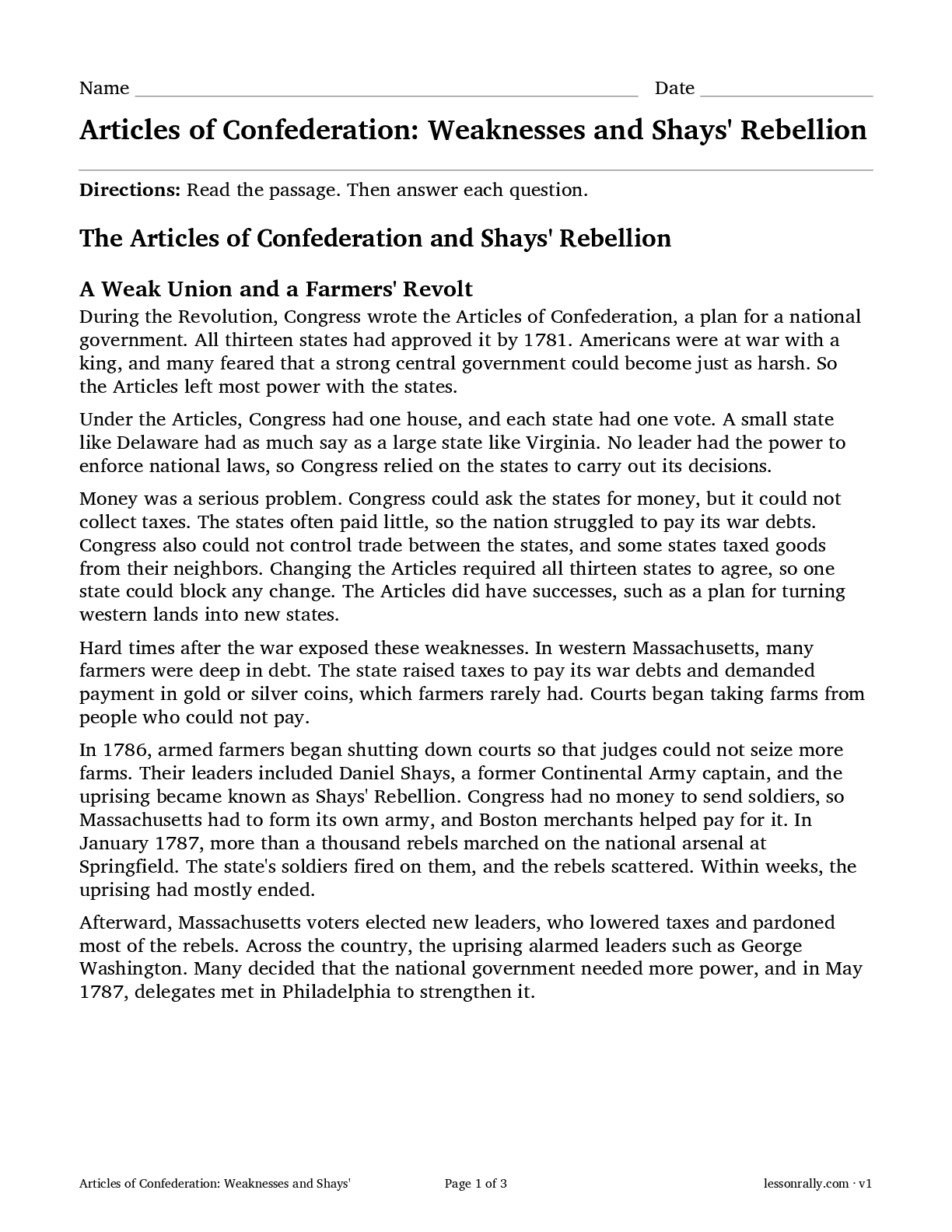
During the Revolution, Congress wrote the Articles of Confederation, a plan for a national government. All thirteen states had approved it by 1781. Americans were at war with a king, and many feared that a strong central government could become just as harsh. So the Articles left most power with the states.

Under the Articles, Congress had one house, and each state had one vote. A small state like Delaware had as much say as a large state like Virginia. No leader had the power to enforce national laws, so Congress relied on the states to carry out its decisions.

Money was a serious problem. Congress could ask the states for money, but it could not collect taxes. The states often paid little, so the nation struggled to pay its war debts. Congress also could not control trade between the states, and some states taxed goods from their neighbors. Changing the Articles required all thirteen states to agree, so one state could block any change. The Articles did have successes, such as a plan for turning western lands into new states.

Hard times after the war exposed these weaknesses. In western Massachusetts, many farmers were deep in debt. The state raised taxes to pay its war debts and demanded payment in gold or silver coins, which farmers rarely had. Courts began taking farms from people who could not pay.

In 1786, armed farmers began shutting down courts so that judges could not seize more farms. Their leaders included Daniel Shays, a former Continental Army captain, and the uprising became known as Shays' Rebellion. Congress had no money to send soldiers, so Massachusetts had to form its own army, and Boston merchants helped pay for it. In January 1787, more than a thousand rebels marched on the national arsenal at Springfield. The state's soldiers fired on them, and the rebels scattered. Within weeks, the uprising had mostly ended.

Afterward, Massachusetts voters elected new leaders, who lowered taxes and pardoned most of the rebels. Across the country, the uprising alarmed leaders such as George Washington. Many decided that the national government needed more power, and in May 1787, delegates met in Philadelphia to strengthen it.


Question 1

Which statement best expresses the central idea of the passage?

Choose one answer.

  • Shays' Rebellion succeeded in taking over the government of Massachusetts.
  • The Articles of Confederation gave the national government too much power over the states.
  • Daniel Shays had served as a captain in the Continental Army.
  • The Articles left the national government weak, and Shays' Rebellion convinced many leaders that it needed more power.

Question 2

According to the passage, why did the Articles leave most power with the states?

Choose one answer.

  • Large states wanted more votes than small states.
  • Many Americans feared that a strong central government could become as harsh as the king.
  • The states wanted Congress to collect high taxes from every citizen.
  • The Treaty of Paris required the states to stay separate.

Question 3

What made it hard for the national government to pay its war debts?

Choose one answer.

  • Congress gave the nation's money to the new western states.
  • The states sent most of their tax money to Britain.
  • Congress could ask the states for money but could not collect taxes.
  • Congress spent most of its money on a large national army.

Question 4

Match each feature of the Articles of Confederation to its result, as the passage describes it.

Match each item to an option.

Items

  1. Each state had one vote in Congress
  2. No leader had the power to enforce national laws
  3. Congress could not control trade between the states
  4. Changing the Articles required all thirteen states to agree

Options

  1. A small state had as much say as a large state
  2. Large states gained extra votes in Congress
  3. Some states taxed goods from their neighbors
  4. One state could block any change
  5. Congress relied on the states to carry out its decisions

Question 5

What was one cause of Shays' Rebellion?

Choose one answer.

  • Farmers owed high state taxes and debts, and courts were taking their farms.
  • British troops had returned to take farms in Massachusetts.
  • The new Constitution had taken away farmers' right to vote.
  • Congress had placed a heavy national tax on farmland.

Question 6

Complete the sentences with words from the word bank.

Fill in each blank.

In 1786, armed farmers began shutting down blank 1 so that judges could not seize more farms. In January 1787, more than a thousand rebels marched on the national blank 2 at Springfield.

Word bank

  • harbor
  • churches
  • courts
  • assembly
  • arsenal

Question 7

Which detail from the passage best supports the idea that the national government was too weak to deal with the uprising?

Choose one answer.

  • Massachusetts demanded tax payments in gold or silver coins.
  • Armed farmers shut down courts so judges could not seize farms.
  • Many farmers in western Massachusetts were deep in debt.
  • Congress had no money to send soldiers, so Massachusetts had to form its own army.

Question 8

What happened when the rebels marched on the arsenal at Springfield?

Choose one answer.

  • The rebels captured the weapons and took over the state government.
  • Daniel Shays was elected governor of Massachusetts.
  • Congress sent a national army that arrested every rebel.
  • The state's soldiers fired on them, and the rebels scattered.

Question 9

After the uprising ended, what happened in Massachusetts?

Choose one answer.

  • The state raised taxes again to pay for its army.
  • Massachusetts left the United States and formed its own nation.
  • Every rebel was put to death for treason.
  • Voters elected new leaders, who lowered taxes and pardoned most of the rebels.

Question 10

A student is writing an objective summary of the passage. Which two of these sentences should the student leave out because they state opinions?

Choose 2 answers.

  • The Articles of Confederation were a foolish plan that no one should have supported.
  • Congress could not collect taxes under the Articles.
  • In January 1787, state soldiers broke up the rebel march on Springfield.
  • Farmers in western Massachusetts were losing their farms to debt.
  • Daniel Shays was a hero, and the rebels were right to take up arms.

Reviews

No reviews yet.

Reviews come from teachers who assigned this activity to a class.

Sign in to write a review

Have a topic of your own? Make a printable worksheet and online quiz, free.

Create an activity

Answer key

Answer keys come with Premium

Print this worksheet with the correct answers marked. The key includes any explanations, sample answers, and rubrics supplied with the activity.

Answer keys aren't public: only teachers with Premium and the people who can edit an activity can download one, so students can't get a ready-to-print key from this page.

Premium includes:

  • No ads for you, and no ads for your students on the assignments you post.
  • Answer keys for printable worksheets, with the correct answers marked and any explanations, sample answers, and rubrics.
  • Create with AI: up to 100 activities a year (5 during the free trial), with every answer checked before you see the draft.

$29 a year, plus sales tax where it applies.

New Premium teachers can try it free for 7 days. A card or other payment method is needed to start. Unless you cancel before the trial ends, you are charged then and the plan renews every year.

Already have Premium or edit this activity? Sign in