Ancient China: Confucianism, Daoism and Legalism

10 questions · 15 points · Grade 6 · English · Preview the 10 questions

Made by Owen Brackwell · LessonRally (AI-assisted)

Digital classroom activity

What is a digital classroom activity?

Teachers who sign in can assign LessonRally activities to their Google Classroom classes: students open them in Classroom and answer online, and their grades go to the teacher's Classroom gradebook. Practice lets you try it first, the way students see it.

Free for teachers. Sign in to assign activities to your Google Classroom classes.

Printable worksheet

Students read an original passage about three schools of thought that grew out of the warring states of the late Zhou period: the teachings of Confucius, the Daoist idea of the Way, which tradition links to Laozi, and the strict laws of the Legalists, whose ideas the rulers of Qin followed. A table sets the schools side by side, and questions ask how the passage is organized and how the schools' advice to rulers compares.

Learning goal: Compare what Confucianism, Daoism and Legalism taught about how people should live and how rulers should govern, and describe how a text is organized to compare them.

Estimated reading level 8.7

  1. Grade 6Hard
  2. Grade 7Stretch
  3. Grade 8On level
  4. Grade 9Easier
  5. Grade 10Easy
About this estimate

The estimate is the middle score of five readability formulas. Their scores run from 5.7 to 9.2.

  • Flesch-Kincaid GradeSentence length and syllables per word5.7
  • Gunning Fog Middle scoreSentence length and words of three or more syllables8.7
  • Coleman-LiauLetters per word and sentences per 100 words8.8
  • Automated Readability IndexCharacters per word and words per sentence6.0
  • SMOGWords of three or more syllables, for texts of 30 sentences or more9.2
Flesch Reading Ease
73.6 on a 0 to 100 scale where higher is easier: fairly easy. Not part of the estimate.
Text measured
826 words, 39 sentences

Adapted from common readability formulas (Flesch-Kincaid, Gunning Fog, Coleman-Liau and ARI, plus SMOG for long texts), which look at sentence length and word length. Answer choices count toward word length only. Grades below the estimate will likely find the text harder, grades above it easier. It does not measure ideas, background knowledge or images.

Question types: multiple choice, matching, fill in the blank, select all that apply.

Student preview

The questions as students see them, without the answers.

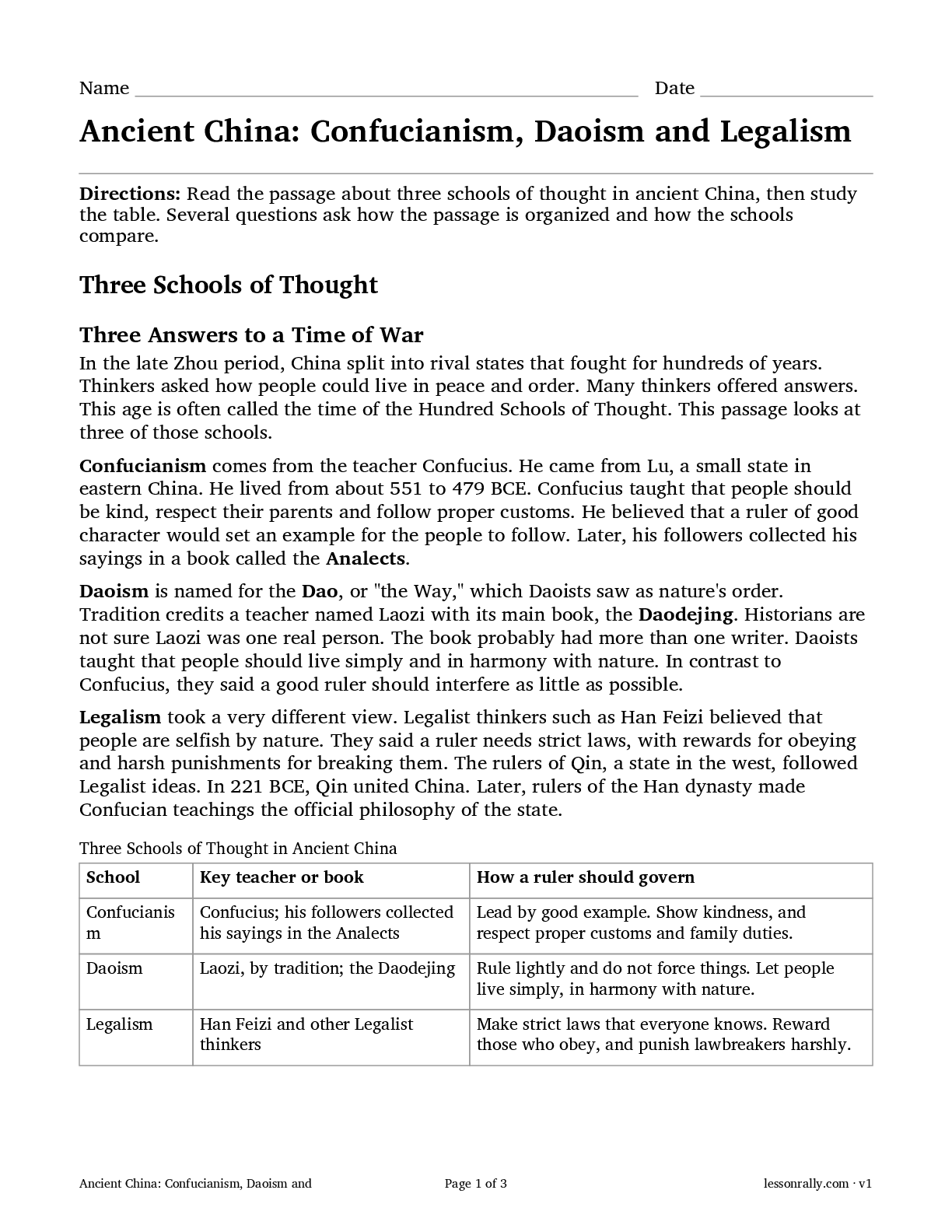
Read the passage about three schools of thought in ancient China, then study the table. Several questions ask how the passage is organized and how the schools compare.

Three Schools of Thought

Three Answers to a Time of War

In the late Zhou period, China split into rival states that fought for hundreds of years. Thinkers asked how people could live in peace and order. Many thinkers offered answers. This age is often called the time of the Hundred Schools of Thought. This passage looks at three of those schools.

Confucianism comes from the teacher Confucius. He came from Lu, a small state in eastern China. He lived from about 551 to 479 BCE. Confucius taught that people should be kind, respect their parents and follow proper customs. He believed that a ruler of good character would set an example for the people to follow. Later, his followers collected his sayings in a book called the Analects.

Daoism is named for the Dao, or "the Way," which Daoists saw as nature's order. Tradition credits a teacher named Laozi with its main book, the Daodejing. Historians are not sure Laozi was one real person. The book probably had more than one writer. Daoists taught that people should live simply and in harmony with nature. In contrast to Confucius, they said a good ruler should interfere as little as possible.

Legalism took a very different view. Legalist thinkers such as Han Feizi believed that people are selfish by nature. They said a ruler needs strict laws, with rewards for obeying and harsh punishments for breaking them. The rulers of Qin, a state in the west, followed Legalist ideas. In 221 BCE, Qin united China. Later, rulers of the Han dynasty made Confucian teachings the official philosophy of the state.


Three Schools of Thought in Ancient China
SchoolKey teacher or bookHow a ruler should govern
ConfucianismConfucius; his followers collected his sayings in the AnalectsLead by good example. Show kindness, and respect proper customs and family duties.
DaoismLaozi, by tradition; the DaodejingRule lightly and do not force things. Let people live simply, in harmony with nature.
LegalismHan Feizi and other Legalist thinkersMake strict laws that everyone knows. Reward those who obey, and punish lawbreakers harshly.

Question 1

Which choice best describes how the passage is organized?

Choose one answer.

  • It explains one cause of China's wars and then its many effects.
  • It describes a time of war. Then it explains three schools that offered answers.
  • It tells the life story of Confucius from his birth to his death.
  • It lists the events of the Qin dynasty in the order they happened.

Question 2

Match each name or term from the passage about Chinese thinkers to its description.

Match each item to an option.

Items

  1. Zhou
  2. Hundred Schools of Thought
  3. Analects
  4. Dao
  5. Han Feizi

Options

  1. the dynasty that united China in 221 BCE
  2. the Way, which Daoists saw as the natural order of the world
  3. a wall built along China's northern border
  4. a name for the age when many thinkers offered answers
  5. a book of sayings collected by followers of Confucius
  6. the dynasty in whose late period rival states fought
  7. a Legalist thinker who believed people are selfish by nature

Question 3

Which phrase from the passage signals that two schools are being compared?

Choose one answer.

  • Later, his followers collected
  • In 221 BCE
  • In contrast to Confucius
  • In the late Zhou period

Question 4

What does the passage tell you about where Confucius came from and where the Qin state was?

Choose one answer.

  • Confucius came from outside China, and Qin was in the far north.
  • Confucius came from the west, and the Qin state was in the east.
  • Confucius came from Lu, in the east, and Qin was a state in the west.
  • Confucius and the rulers of Qin came from the same small state.

Question 5

How does the table help readers?

Choose one answer.

  • It tells the full life story of Laozi from birth to old age.
  • It puts the three schools side by side so readers can compare them.
  • It gives the year each school began and the year it ended.
  • It quotes one famous saying from each of the three teachers.

Question 6

Complete the sentences about what two of the schools taught.

Fill in each blank.

Confucius taught that people should respect their blank 1. Daoists taught that a good ruler should blank 2 as little as possible.

Word bank

  • Analects
  • interfere
  • parents
  • armies

Question 7

A ruler makes strict laws, rewards people who obey them and harshly punishes people who break them. Which school's advice is this ruler following?

Choose one answer.

  • Confucianism
  • Legalism
  • Daoism

Question 8

What does the passage say about who wrote the Daodejing?

Choose one answer.

  • Han Feizi wrote it as a guide for the strict rulers of the Qin state.
  • Confucius wrote it, and his followers later added the Analects to it.
  • Historians agree that Laozi wrote every word of it by himself alone.
  • Tradition credits Laozi, but it probably had more than one writer.

Question 9

Which two statements correctly compare the schools, according to the table? Select 2.

Choose 2 answers.

  • Daoism says to rule lightly, but Confucianism says to set a good example.
  • Confucianism and Daoism both say to make strict laws that everyone knows.
  • Confucianism says to lead by good example, but Legalism says to use strict laws.
  • Daoism and Legalism both say to punish lawbreakers harshly and often.

Question 10

According to the last paragraph, what happened after the Qin united China?

Choose one answer.

  • Laozi later became the first ruler of the Han dynasty in China.
  • The Qin rulers later gave up Legalist ideas and turned to Daoism.
  • China later split again into rival states that fought for centuries.
  • Han rulers later made Confucian teachings the state's official philosophy.

Reviews

No reviews yet.

Reviews come from teachers who assigned this activity to a class.

Sign in to write a review

Have a topic of your own? Make a printable worksheet and online quiz, free.

Create an activity

Answer key

Answer keys come with Premium

Print this worksheet with the correct answers marked. The key includes any explanations, sample answers, and rubrics supplied with the activity.

Answer keys aren't public: only teachers with Premium and the people who can edit an activity can download one, so students can't get a ready-to-print key from this page.

Premium includes:

  • No ads for you, and no ads for your students on the assignments you post.
  • Answer keys for printable worksheets, with the correct answers marked and any explanations, sample answers, and rubrics.
  • Create with AI: up to 100 activities a year (5 during the free trial), with every answer checked before you see the draft.

$29 a year, plus sales tax where it applies.

New Premium teachers can try it free for 7 days. A card or other payment method is needed to start. Unless you cancel before the trial ends, you are charged then and the plan renews every year.

Already have Premium or edit this activity? Sign in