The Indus Valley: Planned Cities

10 questions · 11 points · Grade 6 · English · Preview the 10 questions

Made by Owen Brackwell · LessonRally (AI-assisted)

Digital classroom activity

What is a digital classroom activity?

Teachers who sign in can assign LessonRally activities to their Google Classroom classes: students open them in Classroom and answer online, and their grades go to the teacher's Classroom gradebook. Practice lets you try it first, the way students see it.

Free for teachers. Sign in to assign activities to your Google Classroom classes.

Printable worksheet

Students read an original passage about the Indus, or Harappan, civilization: Harappa and Mohenjo-daro, yearly floods and farming, grid streets, covered drains, and bricks and weights of standard sizes. Questions ask students to find evidence of planning and trade, keep what is known apart from what is still unknown (no one can yet read the Indus script), and state the central idea in an objective summary.

Learning goal: Describe how the cities of the Indus Valley were planned and how their people farmed and traded, and determine the central idea of a passage while keeping facts apart from guesses and opinions.

Estimated reading level 7.2

  1. Grade 5Hard
  2. Grade 6Stretch
  3. Grade 7On level
  4. Grade 8Easier
  5. Grade 9Easy
About this estimate

The estimate is the middle score of five readability formulas. Their scores run from 5.8 to 9.2.

  • Flesch-Kincaid GradeSentence length and syllables per word5.8
  • Gunning Fog Middle scoreSentence length and words of three or more syllables7.2
  • Coleman-LiauLetters per word and sentences per 100 words9.2
  • Automated Readability IndexCharacters per word and words per sentence6.3
  • SMOGWords of three or more syllables, for texts of 30 sentences or more8.3
Flesch Reading Ease
72.8 on a 0 to 100 scale where higher is easier: fairly easy. Not part of the estimate.
Text measured
758 words, 39 sentences

Adapted from common readability formulas (Flesch-Kincaid, Gunning Fog, Coleman-Liau and ARI, plus SMOG for long texts), which look at sentence length and word length. Answer choices count toward word length only. Grades below the estimate will likely find the text harder, grades above it easier. It does not measure ideas, background knowledge or images.

Topic: Ancient Civilizations Chosen by LessonRally

Question types: fill in the blank, multiple choice, select all that apply.

Student preview

The questions as students see them, without the answers.

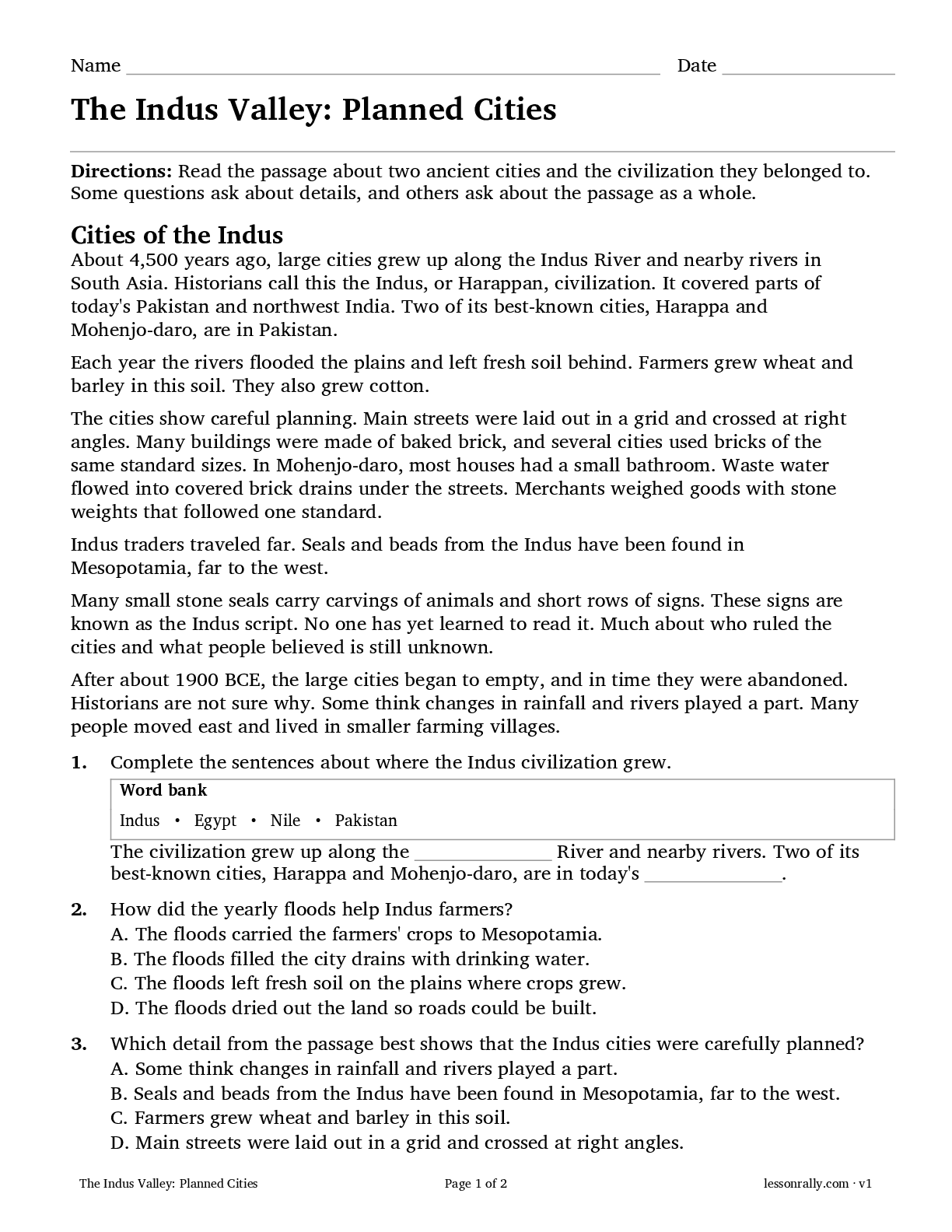
Read the passage about two ancient cities and the civilization they belonged to. Some questions ask about details, and others ask about the passage as a whole.

Cities of the Indus

About 4,500 years ago, large cities grew up along the Indus River and nearby rivers in South Asia. Historians call this the Indus, or Harappan, civilization. It covered parts of today's Pakistan and northwest India. Two of its best-known cities, Harappa and Mohenjo-daro, are in Pakistan.

Each year the rivers flooded the plains and left fresh soil behind. Farmers grew wheat and barley in this soil. They also grew cotton.

The cities show careful planning. Main streets were laid out in a grid and crossed at right angles. Many buildings were made of baked brick, and several cities used bricks of the same standard sizes. In Mohenjo-daro, most houses had a small bathroom. Waste water flowed into covered brick drains under the streets. Merchants weighed goods with stone weights that followed one standard.

Indus traders traveled far. Seals and beads from the Indus have been found in Mesopotamia, far to the west.

Many small stone seals carry carvings of animals and short rows of signs. These signs are known as the Indus script. No one has yet learned to read it. Much about who ruled the cities and what people believed is still unknown.

After about 1900 BCE, the large cities began to empty, and in time they were abandoned. Historians are not sure why. Some think changes in rainfall and rivers played a part. Many people moved east and lived in smaller farming villages.


Question 1

Complete the sentences about where the Indus civilization grew.

Fill in each blank.

The civilization grew up along the blank 1 River and nearby rivers. Two of its best-known cities, Harappa and Mohenjo-daro, are in today's blank 2.

Word bank

  • Nile
  • Indus
  • Pakistan
  • Egypt

Question 2

How did the yearly floods help Indus farmers?

Choose one answer.

  • The floods dried out the land so roads could be built.
  • The floods filled the city drains with drinking water.
  • The floods left fresh soil on the plains where crops grew.
  • The floods carried the farmers' crops to Mesopotamia.

Question 3

Which detail from the passage best shows that the Indus cities were carefully planned?

Choose one answer.

  • Main streets were laid out in a grid and crossed at right angles.
  • Some think changes in rainfall and rivers played a part.
  • Seals and beads from the Indus have been found in Mesopotamia, far to the west.
  • Farmers grew wheat and barley in this soil.

Question 4

Several Indus cities used bricks of the same standard sizes, and merchants used weights that followed one standard. What do these facts most likely suggest?

Choose one answer.

  • The Indus people did not trade with anyone.
  • The cities shared common rules for building and trade.
  • Every house in every city was exactly the same size.
  • Each city measured goods in its own way.

Question 5

What does the passage say about the signs on Indus seals?

Choose one answer.

  • No one has yet learned to read them.
  • They were copied from Egyptian hieroglyphs.
  • They list the names of the kings who ruled Harappa.
  • They explain why the cities were abandoned.

Question 6

What evidence shows that Indus traders traveled far from home?

Choose one answer.

  • Seals and beads from the Indus have been found in Mesopotamia.
  • Their farmers grew cotton.
  • Their writing lists the cities they traded with.
  • Their bricks were made in standard sizes.

Question 7

According to the passage, which of these is still unknown about the Indus civilization?

Choose one answer.

  • How waste water left houses in Mohenjo-daro
  • Who ruled the cities and what people believed
  • Where Harappa and Mohenjo-daro are today
  • What crops the farmers grew

Question 8

Which two statements about the end of the large Indus cities match the passage?

Choose 2 answers.

  • Many people moved east to smaller farming villages.
  • Historians are not sure why people left the cities.
  • A single flood wiped out every city in one year.
  • Everyone in the Indus Valley disappeared.
  • An invading army destroyed the cities in one battle.

Question 9

Which sentence best states the central idea of the passage about the Indus cities?

Choose one answer.

  • Seals from the Indus have been found in Mesopotamia.
  • The Indus people built large, carefully planned cities, but much about them is still unknown.
  • Indus farmers grew wheat, barley and cotton.
  • The Indus cities were destroyed by a great flood.

Question 10

A student wrote these sentences for a summary of the passage. Which one should be left out of an objective summary?

Choose one answer.

  • After about 1900 BCE, the large cities began to empty.
  • Seals carry carvings of animals and short rows of signs.
  • Life in the Indus cities must have been more fun than life anywhere else.
  • Most houses in Mohenjo-daro had a small bathroom.

Reviews

No reviews yet.

Reviews come from teachers who assigned this activity to a class.

Sign in to write a review

Have a topic of your own? Make a printable worksheet and online quiz, free.

Create an activity

Answer key

Answer keys come with Premium

Print this worksheet with the correct answers marked. The key includes any explanations, sample answers, and rubrics supplied with the activity.

Answer keys aren't public: only teachers with Premium and the people who can edit an activity can download one, so students can't get a ready-to-print key from this page.

Premium includes:

  • No ads for you, and no ads for your students on the assignments you post.
  • Answer keys for printable worksheets, with the correct answers marked and any explanations, sample answers, and rubrics.
  • Create with AI: up to 100 activities a year (5 during the free trial), with every answer checked before you see the draft.

$29 a year, plus sales tax where it applies.

New Premium teachers can try it free for 7 days. A card or other payment method is needed to start. Unless you cancel before the trial ends, you are charged then and the plan renews every year.

Already have Premium or edit this activity? Sign in