The Roman Republic: Patricians, Plebeians and the Senate

10 questions · 11 points · Grade 6 · English · Preview the 10 questions

Made by Owen Brackwell · LessonRally (AI-assisted)

Digital classroom activity

What is a digital classroom activity?

Teachers who sign in can assign LessonRally activities to their Google Classroom classes: students open them in Classroom and answer online, and their grades go to the teacher's Classroom gradebook. Practice lets you try it first, the way students see it.

Free for teachers. Sign in to assign activities to your Google Classroom classes.

Printable worksheet

Students read an original passage about the early Roman Republic: Rome's site on the Tiber, the end of the kings in 509 BCE by Roman tradition, consuls and the Senate, the plebeians' walkout, the Twelve Tables and the opening of the consulship to plebeians in the 300s BCE. A three-column table compares patricians and plebeians, and several questions ask students to connect the table with the passage.

Learning goal: Compare patricians and plebeians in the Roman Republic, and explain how consuls, the Senate and tribunes shared power and how the rights of plebeians changed over time.

Estimated reading level 8.6

  1. Grade 6Hard
  2. Grade 7Stretch
  3. Grade 8On level
  4. Grade 9Easier
  5. Grade 10Easy
About this estimate

The estimate is the middle score of five readability formulas. Their scores run from 6.3 to 9.2.

  • Flesch-Kincaid GradeSentence length and syllables per word6.3
  • Gunning FogSentence length and words of three or more syllables8.7
  • Coleman-Liau Middle scoreLetters per word and sentences per 100 words8.6
  • Automated Readability IndexCharacters per word and words per sentence6.3
  • SMOGWords of three or more syllables, for texts of 30 sentences or more9.2
Flesch Reading Ease
71.3 on a 0 to 100 scale where higher is easier: fairly easy. Not part of the estimate.
Text measured
720 words, 35 sentences

Adapted from common readability formulas (Flesch-Kincaid, Gunning Fog, Coleman-Liau and ARI, plus SMOG for long texts), which look at sentence length and word length. Answer choices count toward word length only. Grades below the estimate will likely find the text harder, grades above it easier. It does not measure ideas, background knowledge or images.

Question types: multiple choice, select all that apply, fill in the blank.

Student preview

The questions as students see them, without the answers.

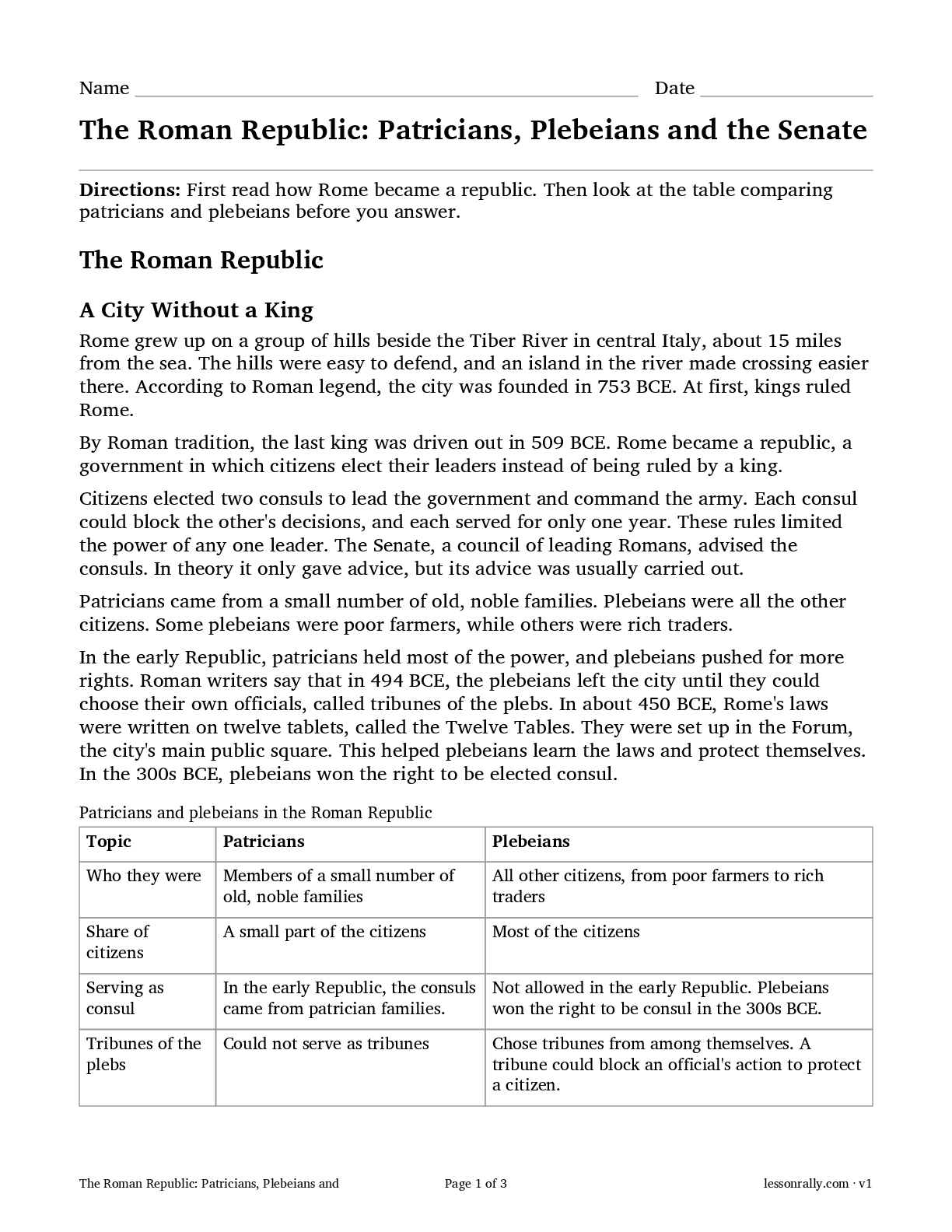
First read how Rome became a republic. Then look at the table comparing patricians and plebeians before you answer.

The Roman Republic

A City Without a King

Rome grew up on a group of hills beside the Tiber River in central Italy, about 15 miles from the sea. The hills were easy to defend, and an island in the river made crossing easier there. According to Roman legend, the city was founded in 753 BCE. At first, kings ruled Rome.

By Roman tradition, the last king was driven out in 509 BCE. Rome became a republic, a government in which citizens elect their leaders instead of being ruled by a king.

Citizens elected two consuls to lead the government and command the army. Each consul could block the other's decisions, and each served for only one year. These rules limited the power of any one leader. The Senate, a council of leading Romans, advised the consuls. In theory it only gave advice, but its advice was usually carried out.

Patricians came from a small number of old, noble families. Plebeians were all the other citizens. Some plebeians were poor farmers, while others were rich traders.

In the early Republic, patricians held most of the power, and plebeians pushed for more rights. Roman writers say that in 494 BCE, the plebeians left the city until they could choose their own officials, called tribunes of the plebs. In about 450 BCE, Rome's laws were written on twelve tablets, called the Twelve Tables. They were set up in the Forum, the city's main public square. This helped plebeians learn the laws and protect themselves. In the 300s BCE, plebeians won the right to be elected consul.


Patricians and plebeians in the Roman Republic
TopicPatriciansPlebeians
Who they wereMembers of a small number of old, noble familiesAll other citizens, from poor farmers to rich traders
Share of citizensA small part of the citizensMost of the citizens
Serving as consulIn the early Republic, the consuls came from patrician families.Not allowed in the early Republic. Plebeians won the right to be consul in the 300s BCE.
Tribunes of the plebsCould not serve as tribunesChose tribunes from among themselves. A tribune could block an official's action to protect a citizen.

Question 1

According to the passage, what made Rome's location a good place for a town?

Choose one answer.

  • It stood high in the mountains, far from any river.
  • It was surrounded by a desert that kept enemies away.
  • It sat right on the seashore beside a large harbor.
  • Its hills were easy to defend, and an island made the river easier to cross.

Question 2

What does the word republic mean in the passage about Rome?

Choose one answer.

  • A government in which citizens elect their leaders instead of having a king
  • A government led by one family of kings
  • A set of laws set up in the Forum
  • A council of leading Romans that gave advice

Question 3

Which two rules about Rome's consuls limited the power of any one leader?

Choose 2 answers.

  • Each consul served for only one year.
  • Each consul could block the other's decisions.
  • Consuls led the government.
  • Consuls commanded the army.

Question 4

What did the Senate do, according to the passage?

Choose one answer.

  • It commanded the army in every war.
  • It advised the consuls, and its advice was usually carried out.
  • It blocked any action that harmed plebeians.
  • It chose a new king every year.

Question 5

According to the table, how were patricians and plebeians different?

Choose one answer.

  • Patricians were a small group of old families, while plebeians were most of the citizens.
  • Patricians could serve as tribunes, but plebeians could not.
  • Patricians were poor farmers, while plebeians were nobles.
  • There were many more patricians than plebeians.

Question 6

The passage says that in the early Republic, patricians held most of the power. Which detail from the table supports this?

Choose one answer.

  • Plebeians ranged from poor farmers to rich traders.
  • Plebeians chose tribunes from among themselves.
  • In the early Republic, the consuls came from patrician families.
  • Plebeians were most of the citizens.

Question 7

Which statement about plebeians is supported by both the passage and the table?

Choose one answer.

  • Plebeians came from a few old, noble families.
  • Plebeians could serve as consul from the start of the Republic.
  • Plebeians were a small part of Rome's citizens.
  • Not all plebeians were poor.

Question 8

According to the table, what could a tribune of the plebs do?

Choose one answer.

  • Turn a plebeian family into a patrician family
  • Block an official's action to protect a citizen
  • Command the army in place of the consuls
  • Choose the next king of Rome

Question 9

Complete the sentences about how Rome's government changed over time.

Fill in each blank.

By Roman tradition, the Republic began in blank 1 BCE. Much later, in the blank 2 BCE, plebeians won the right to be elected consul.
Word bank

  • 494
  • 300s
  • 509
  • 753

Question 10

How did writing the laws on the Twelve Tables help plebeians?

Choose one answer.

  • It ended the Senate.
  • It made every plebeian a patrician.
  • It let them become consuls right away.
  • It helped them learn the laws and protect themselves.

Reviews

No reviews yet.

Reviews come from teachers who assigned this activity to a class.

Sign in to write a review

Have a topic of your own? Make a printable worksheet and online quiz, free.

Create an activity

Answer key

Answer keys come with Premium

Print this worksheet with the correct answers marked. The key includes any explanations, sample answers, and rubrics supplied with the activity.

Answer keys aren't public: only teachers with Premium and the people who can edit an activity can download one, so students can't get a ready-to-print key from this page.

Premium includes:

  • No ads for you, and no ads for your students on the assignments you post.
  • Answer keys for printable worksheets, with the correct answers marked and any explanations, sample answers, and rubrics.
  • Create with AI: up to 100 activities a year (5 during the free trial), with every answer checked before you see the draft.

$29 a year, plus sales tax where it applies.

New Premium teachers can try it free for 7 days. A card or other payment method is needed to start. Unless you cancel before the trial ends, you are charged then and the plan renews every year.

Already have Premium or edit this activity? Sign in