Ancient Greece: Mountains, Sea and Colonies

10 questions · 15 points · Grade 6 · English · Preview the 10 questions

Made by Owen Brackwell · LessonRally (AI-assisted)

Digital classroom activity

What is a digital classroom activity?

Teachers who sign in can assign LessonRally activities to their Google Classroom classes: students open them in Classroom and answer online, and their grades go to the teacher's Classroom gradebook. Practice lets you try it first, the way students see it.

Free for teachers. Sign in to assign activities to your Google Classroom classes.

Printable worksheet

Students read an original passage on how Greece's mountains, small farming areas and long coastlines shaped its many city-states, their trade and their colonies, and on the language, gods and Olympic Games that Greeks shared. A table of four colonies, from Syracuse to Massalia, supports questions that ask students to find and judge evidence in the passage and the table.

Learning goal: Use evidence from a passage and a table to explain how geography shaped the city-states, trade and colonies of ancient Greece, and what Greeks in different city-states shared.

Estimated reading level 8.5

  1. Grade 6Hard
  2. Grade 7Stretch
  3. Grade 8On level
  4. Grade 9Easier
  5. Grade 10Easy
About this estimate

The estimate is the middle score of five readability formulas. Their scores run from 6.0 to 9.1.

  • Flesch-Kincaid GradeSentence length and syllables per word6.0
  • Gunning Fog Middle scoreSentence length and words of three or more syllables8.5
  • Coleman-LiauLetters per word and sentences per 100 words8.6
  • Automated Readability IndexCharacters per word and words per sentence6.4
  • SMOGWords of three or more syllables, for texts of 30 sentences or more9.1
Flesch Reading Ease
74.9 on a 0 to 100 scale where higher is easier: fairly easy. Not part of the estimate.
Text measured
813 words, 35 sentences

Adapted from common readability formulas (Flesch-Kincaid, Gunning Fog, Coleman-Liau and ARI, plus SMOG for long texts), which look at sentence length and word length. Answer choices count toward word length only. Grades below the estimate will likely find the text harder, grades above it easier. It does not measure ideas, background knowledge or images.

Topics: Ancient Civilizations, Geography and Map Skills Chosen by LessonRally

Question types: multiple choice, matching, fill in the blank, select all that apply.

Student preview

The questions as students see them, without the answers.

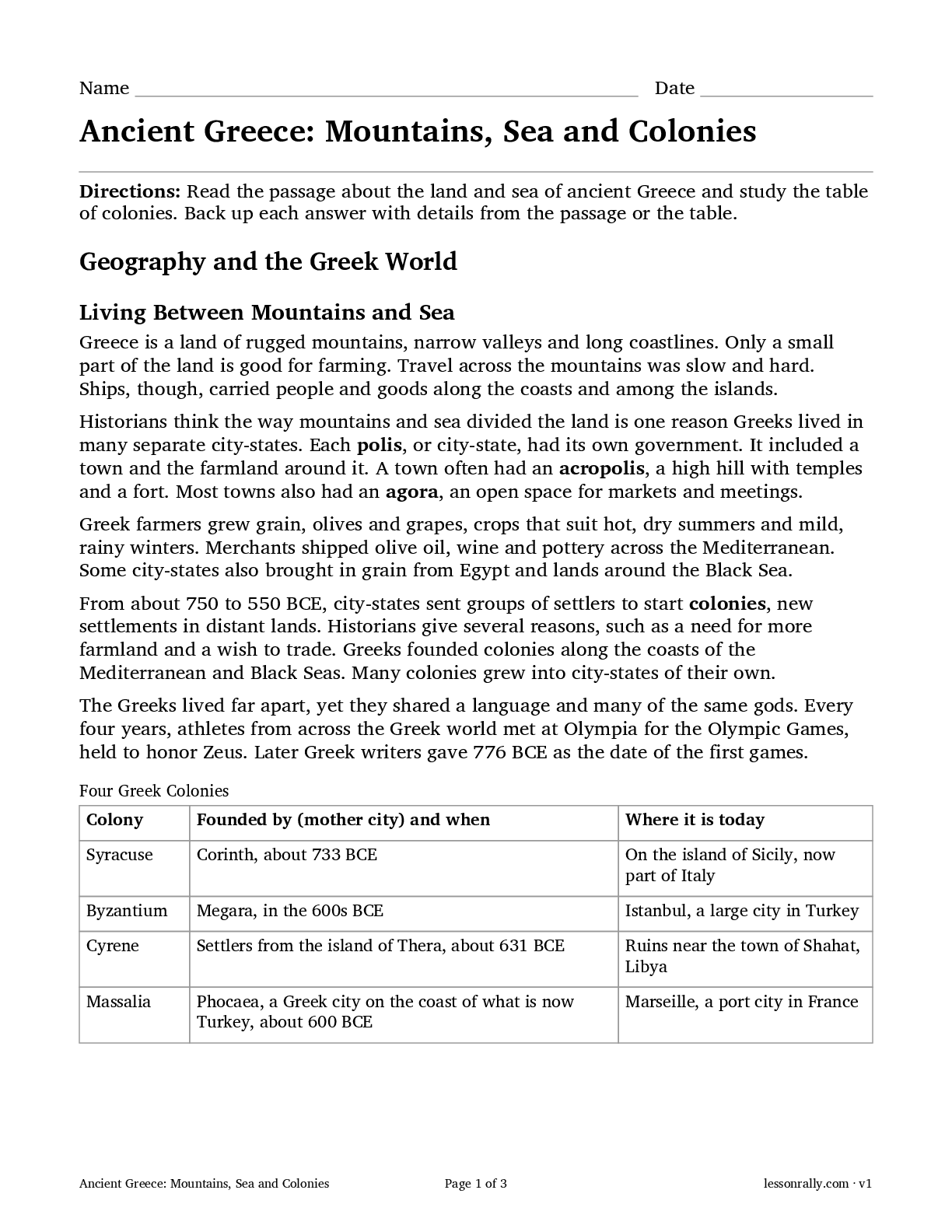
Read the passage about the land and sea of ancient Greece and study the table of colonies. Back up each answer with details from the passage or the table.

Geography and the Greek World

Living Between Mountains and Sea

Greece is a land of rugged mountains, narrow valleys and long coastlines. Only a small part of the land is good for farming. Travel across the mountains was slow and hard. Ships, though, carried people and goods along the coasts and among the islands.

Historians think the way mountains and sea divided the land is one reason Greeks lived in many separate city-states. Each polis, or city-state, had its own government. It included a town and the farmland around it. A town often had an acropolis, a high hill with temples and a fort. Most towns also had an agora, an open space for markets and meetings.

Greek farmers grew grain, olives and grapes, crops that suit hot, dry summers and mild, rainy winters. Merchants shipped olive oil, wine and pottery across the Mediterranean. Some city-states also brought in grain from Egypt and lands around the Black Sea.

From about 750 to 550 BCE, city-states sent groups of settlers to start colonies, new settlements in distant lands. Historians give several reasons, such as a need for more farmland and a wish to trade. Greeks founded colonies along the coasts of the Mediterranean and Black Seas. Many colonies grew into city-states of their own.

The Greeks lived far apart, yet they shared a language and many of the same gods. Every four years, athletes from across the Greek world met at Olympia for the Olympic Games, held to honor Zeus. Later Greek writers gave 776 BCE as the date of the first games.


Four Greek Colonies
ColonyFounded by (mother city) and whenWhere it is today
SyracuseCorinth, about 733 BCEOn the island of Sicily, now part of Italy
ByzantiumMegara, in the 600s BCEIstanbul, a large city in Turkey
CyreneSettlers from the island of Thera, about 631 BCERuins near the town of Shahat, Libya
MassaliaPhocaea, a Greek city on the coast of what is now Turkey, about 600 BCEMarseille, a port city in France

Question 1

Which sentence from the passage best supports the idea that farming was hard in much of Greece?

Choose one answer.

  • Every four years, athletes from across the Greek world met at Olympia for the Olympic Games, held to honor Zeus.
  • Ships, though, carried people and goods along the coasts and among the islands.
  • Many colonies grew into city-states of their own.
  • Only a small part of the land is good for farming.

Question 2

Match each term from the passage about the Greek world to its meaning.

Match each item to an option.

Items

  1. polis
  2. acropolis
  3. agora
  4. colony
  5. Olympia

Options

  1. the place where athletes met every four years to honor Zeus
  2. a ship that carried soldiers to war
  3. an open space for markets and meetings
  4. a king who ruled all of the city-states
  5. a high hill with temples and a fort
  6. a city-state made up of a town and the farmland around it
  7. a new settlement started in a distant land

Question 3

Which detail from the passage shows that the sea linked Greek city-states to faraway lands?

Choose one answer.

  • Some city-states brought in grain from Egypt and from lands near the Black Sea.
  • Greek farmers grew grain, olives and grapes.
  • Later Greek writers gave 776 BCE as the date of the first games.
  • Travel across the mountains was slow and hard.

Question 4

According to the table, which colony was founded first?

Choose one answer.

  • Cyrene
  • Byzantium
  • Syracuse
  • Massalia

Question 5

Complete the sentences about farming and trade in ancient Greece.

Fill in each blank.

Greek farmers grew crops that suit hot, dry summers and mild, rainy blank 1. Merchants shipped olive oil, wine and blank 2, made of baked clay, across the Mediterranean.

Word bank

  • winters
  • colonies
  • mountains
  • pottery

Question 6

What does the table show about where Greek colonies were founded?

Choose one answer.

  • They were all founded inside what is now Greece.
  • They were all built on small islands close to Corinth.
  • They were spread far apart, from what is now France to Libya and Turkey.
  • They were all founded far inland, away from any coast.

Question 7

Which two details from the passage show that Greeks in different city-states shared a common culture? Select 2.

Choose 2 answers.

  • Athletes from across the Greek world met at Olympia for the games.
  • Travel across the mountains was slow and hard.
  • Only a small part of the land is good for farming.
  • They shared a language and many of the same gods.

Question 8

Which claim can you support using only the table?

Choose one answer.

  • Corinth founded the colony of Syracuse.
  • Megara founded the colony of Massalia.
  • Cyrene was founded before Syracuse.
  • Settlers from Thera founded Massalia.

Question 9

Why did Greek city-states start colonies, according to the passage?

Choose one answer.

  • because the Olympic Games could be held only in faraway colonies
  • for several reasons, such as a need for farmland and a wish to trade
  • because one king who ruled all of the Greek city-states ordered it
  • because mountains forced every single Greek family to leave home

Question 10

The passage says later Greek writers gave 776 BCE as the date of the first Olympic Games. Why does the author tell readers where the date comes from?

Choose one answer.

  • to prove that nothing at all is known about the games
  • to show that the date is a traditional one and may not be exact
  • to prove that the games were held only one time
  • to show that the games honored a god of the sea

Reviews

No reviews yet.

Reviews come from teachers who assigned this activity to a class.

Sign in to write a review

Have a topic of your own? Make a printable worksheet and online quiz, free.

Create an activity

Answer key

Answer keys come with Premium

Print this worksheet with the correct answers marked. The key includes any explanations, sample answers, and rubrics supplied with the activity.

Answer keys aren't public: only teachers with Premium and the people who can edit an activity can download one, so students can't get a ready-to-print key from this page.

Premium includes:

  • No ads for you, and no ads for your students on the assignments you post.
  • Answer keys for printable worksheets, with the correct answers marked and any explanations, sample answers, and rubrics.
  • Create with AI: up to 100 activities a year (5 during the free trial), with every answer checked before you see the draft.

$29 a year, plus sales tax where it applies.

New Premium teachers can try it free for 7 days. A card or other payment method is needed to start. Unless you cancel before the trial ends, you are charged then and the plan renews every year.

Already have Premium or edit this activity? Sign in