Question 1
Complete the sentences with years from the passage.
Fill in each blank.
Julius Caesar was killed in blank 1 BCE. Octavian received the title Augustus in blank 2 BCE.
Word bank
- 180
- 44
- 49
- 27


Teachers who sign in can assign LessonRally activities to their Google Classroom classes: students open them in Classroom and answer online, and their grades go to the teacher's Classroom gradebook. Practice lets you try it first, the way students see it.
Free for teachers. Sign in to assign activities to your Google Classroom classes.
 (opens in a new tab)
3 pages · Student copy, no answers
Print worksheet (opens in a new tab)Answer keyPremiumStudents read an original passage about the end of the Roman Republic: Julius Caesar's civil war, his time as dictator and his assassination in 44 BCE, and Octavian's rise to become Augustus, Rome's first emperor, in 27 BCE. Six bold terms (civil war, dictator, assassinated, emperor, princeps and Pax Romana) are matched to their meanings and then applied, and one question checks the common mistake of calling Caesar an emperor.
Learning goal: Use key terms such as dictator, civil war, emperor and Pax Romana to explain how Rome changed from a republic to an empire under Julius Caesar and Augustus.
The estimate is the middle score of five readability formulas. Their scores run from 5.7 to 10.0.
Adapted from common readability formulas (Flesch-Kincaid, Gunning Fog, Coleman-Liau and ARI, plus SMOG for long texts), which look at sentence length and word length. Answer choices count toward word length only. Grades below the estimate will likely find the text harder, grades above it easier. It does not measure ideas, background knowledge or images.
© Copyright 2010. National Governors Association Center for Best Practices and Council of Chief State School Officers. All rights reserved.
Topic: Ancient Civilizations Chosen by LessonRally
Question types: fill in the blank, matching, multiple choice.
The questions as students see them, without the answers.
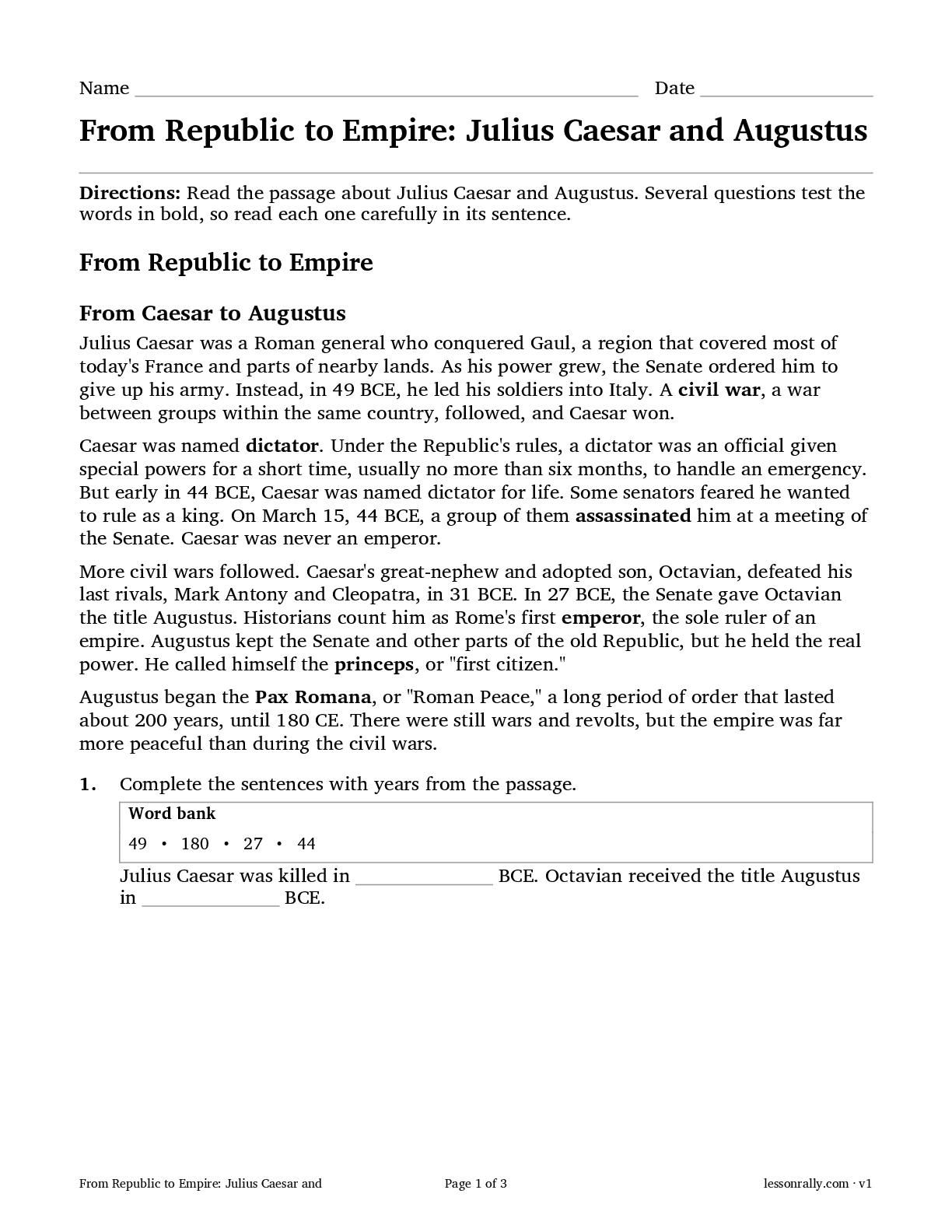
Read the passage about Julius Caesar and Augustus. Several questions test the words in bold, so read each one carefully in its sentence.
From Caesar to Augustus
Julius Caesar was a Roman general who conquered Gaul, a region that covered most of today's France and parts of nearby lands. As his power grew, the Senate ordered him to give up his army. Instead, in 49 BCE, he led his soldiers into Italy. A civil war, a war between groups within the same country, followed, and Caesar won.
Caesar was named dictator. Under the Republic's rules, a dictator was an official given special powers for a short time, usually no more than six months, to handle an emergency. But early in 44 BCE, Caesar was named dictator for life. Some senators feared he wanted to rule as a king. On March 15, 44 BCE, a group of them assassinated him at a meeting of the Senate. Caesar was never an emperor.
More civil wars followed. Caesar's great-nephew and adopted son, Octavian, defeated his last rivals, Mark Antony and Cleopatra, in 31 BCE. In 27 BCE, the Senate gave Octavian the title Augustus. Historians count him as Rome's first emperor, the sole ruler of an empire. Augustus kept the Senate and other parts of the old Republic, but he held the real power. He called himself the princeps, or "first citizen."
Augustus began the Pax Romana, or "Roman Peace," a long period of order that lasted about 200 years, until 180 CE. There were still wars and revolts, but the empire was far more peaceful than during the civil wars.
Complete the sentences with years from the passage.
Fill in each blank.
Julius Caesar was killed in blank 1 BCE. Octavian received the title Augustus in blank 2 BCE.
Word bank
Match each bold term from the passage about Caesar and Augustus to its meaning.
Match each item to an option.
Items
Options
Who was Rome's first emperor?
Choose one answer.
Why was it unusual for Caesar to be named dictator for life?
Choose one answer.
Why did some senators turn against Caesar?
Choose one answer.
What happened in Rome after Caesar was assassinated?
Choose one answer.
Which of these events in the story of Caesar and Augustus happened first?
Choose one answer.
How did Augustus hold power while keeping the look of the old Republic?
Choose one answer.
Which statement about the Pax Romana matches the passage?
Choose one answer.
Where was Gaul, the region Caesar conquered?
Choose one answer.
No reviews yet.
Reviews come from teachers who assigned this activity to a class.
Have a topic of your own? Make a printable worksheet and online quiz, free.
Create an activityMade by Owen Brackwell · LessonRally (AI-assisted)
Made by Owen Brackwell · LessonRally (AI-assisted)
Made by Owen Brackwell · LessonRally (AI-assisted)
Made by Owen Brackwell · LessonRally (AI-assisted)