The Silk Road: Goods and Ideas on the Move

10 questions · 11 points · Grade 7 · English · Preview the 10 questions

Made by Owen Brackwell · LessonRally (AI-assisted)

Digital classroom activity

What is a digital classroom activity?

Teachers who sign in can assign LessonRally activities to their Google Classroom classes: students open them in Classroom and answer online, and their grades go to the teacher's Classroom gradebook. Practice lets you try it first, the way students see it.

Free for teachers. Sign in to assign activities to your Google Classroom classes.

Printable worksheet

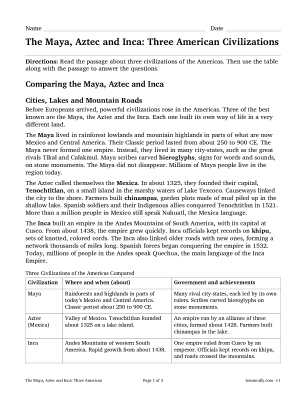
Students read an original passage about the Silk Road, a network of land and sea routes whose modern name a German geographer made popular in 1877, and which grew as the Han dynasty built trade ties with western lands. Goods passed from hand to hand rather than traveling with one trader, and ideas moved too, as Buddhism spread into China and papermaking moved west. Questions ask students to find main ideas, summarize the passage and judge which details matter most.

Learning goal: Explain how goods and ideas such as Buddhism and papermaking moved along the Silk Road, and determine the central ideas of a passage to write an accurate summary.

Estimated reading level 6.9

  1. Grade 4Hard
  2. Grade 5Stretch
  3. Grade 6On level
  4. Grade 7Easier
  5. Grade 8Easy
About this estimate

The estimate is the middle score of five readability formulas. Their scores run from 5.4 to 8.4.

  • Flesch-Kincaid GradeSentence length and syllables per word5.4
  • Gunning Fog Middle scoreSentence length and words of three or more syllables6.9
  • Coleman-LiauLetters per word and sentences per 100 words8.4
  • Automated Readability IndexCharacters per word and words per sentence5.9
  • SMOGWords of three or more syllables, for texts of 30 sentences or more7.9
Flesch Reading Ease
76.7 on a 0 to 100 scale where higher is easier: fairly easy. Not part of the estimate.
Text measured
723 words, 36 sentences

Adapted from common readability formulas (Flesch-Kincaid, Gunning Fog, Coleman-Liau and ARI, plus SMOG for long texts), which look at sentence length and word length. Answer choices count toward word length only. Grades below the estimate will likely find the text harder, grades above it easier. It does not measure ideas, background knowledge or images.

Common Core

Closest anchor: CCRA.R.2 Determine central ideas or themes of a text and analyze their development; summarize the key supporting details and ideas.Anchor Standards for ReadingShow 1 matched standardHide matched standard

Matched standard

  • RI.7.2

    Determine two or more central ideas in a text and analyze their development over the course of the text; provide an objective summary of the text.

    Student preview questions 5, 9, 10

Matched independently by two AI models from this activity's questions.

© Copyright 2010. National Governors Association Center for Best Practices and Council of Chief State School Officers. All rights reserved.

Topic: Ancient Civilizations Chosen by LessonRally

Question types: multiple choice, fill in the blank.

Student preview

The questions as students see them, without the answers.

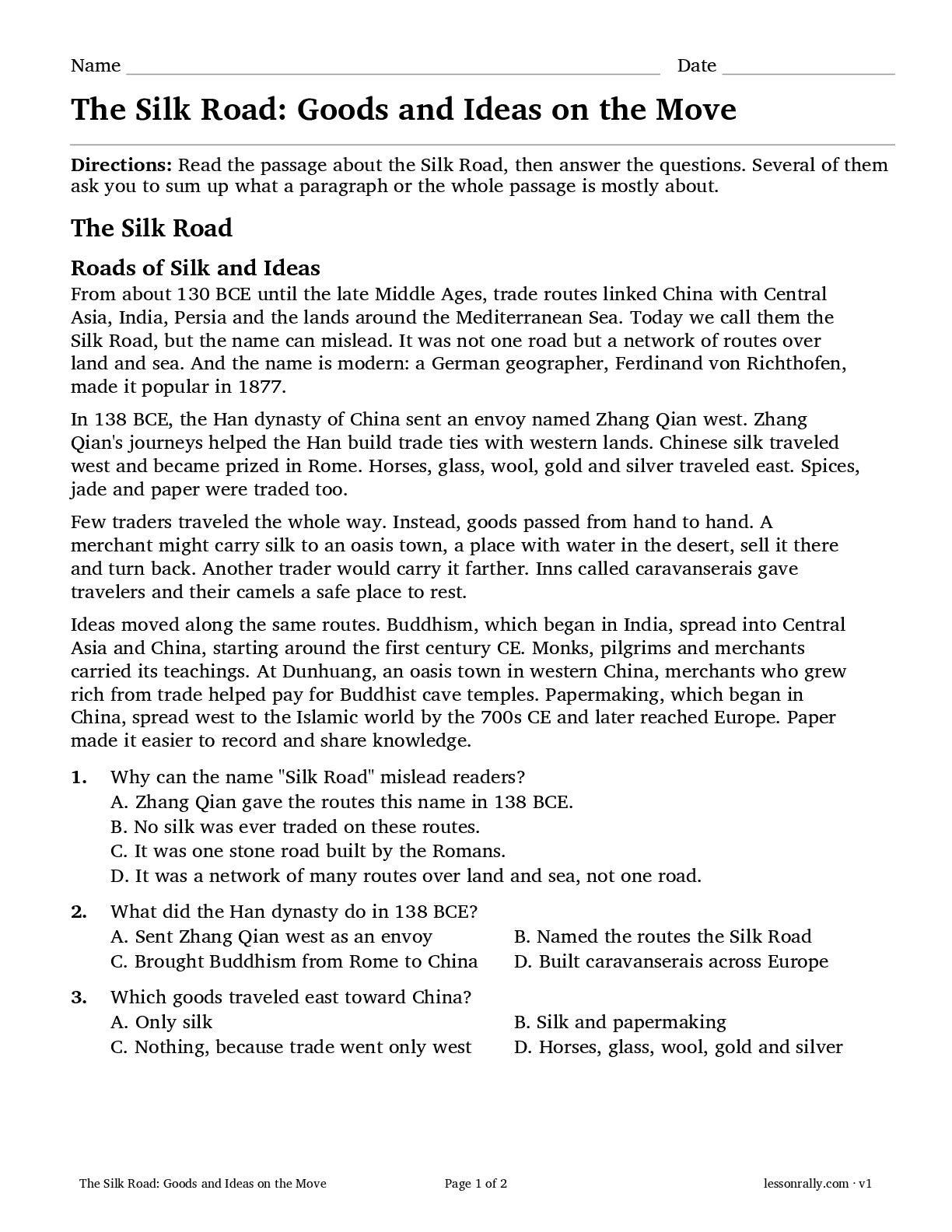
Read the passage about the Silk Road, then answer the questions. Several of them ask you to sum up what a paragraph or the whole passage is mostly about.

The Silk Road

Roads of Silk and Ideas

From about 130 BCE until the late Middle Ages, trade routes linked China with Central Asia, India, Persia and the lands around the Mediterranean Sea. Today we call them the Silk Road, but the name can mislead. It was not one road but a network of routes over land and sea. And the name is modern: a German geographer, Ferdinand von Richthofen, made it popular in 1877.

In 138 BCE, the Han dynasty of China sent an envoy named Zhang Qian west. Zhang Qian's journeys helped the Han build trade ties with western lands. Chinese silk traveled west and became prized in Rome. Horses, glass, wool, gold and silver traveled east. Spices, jade and paper were traded too.

Few traders traveled the whole way. Instead, goods passed from hand to hand. A merchant might carry silk to an oasis town, a place with water in the desert, sell it there and turn back. Another trader would carry it farther. Inns called caravanserais gave travelers and their camels a safe place to rest.

Ideas moved along the same routes. Buddhism, which began in India, spread into Central Asia and China, starting around the first century CE. Monks, pilgrims and merchants carried its teachings. At Dunhuang, an oasis town in western China, merchants who grew rich from trade helped pay for Buddhist cave temples. Papermaking, which began in China, spread west to the Islamic world by the 700s CE and later reached Europe. Paper made it easier to record and share knowledge.


Question 1

Why can the name "Silk Road" mislead readers?

Choose one answer.

  • It was one stone road built by the Romans.
  • No silk was ever traded on these routes.
  • It was a network of many routes over land and sea, not one road.
  • Zhang Qian gave the routes this name in 138 BCE.

Question 2

What did the Han dynasty do in 138 BCE?

Choose one answer.

  • Built caravanserais across Europe
  • Named the routes the Silk Road
  • Brought Buddhism from Rome to China
  • Sent Zhang Qian west as an envoy

Question 3

Which goods traveled east toward China?

Choose one answer.

  • Silk and papermaking
  • Nothing, because trade went only west
  • Horses, glass, wool, gold and silver
  • Only silk

Question 4

Why were oasis towns important places along the routes?

Choose one answer.

  • They were where the routes got the name Silk Road.
  • They were the only places where silk was made.
  • They had water in the desert and were places where goods changed hands.
  • They were ports where ships from Rome landed.

Question 5

What is the main point of the paragraph that begins "Few traders traveled the whole way"?

Choose one answer.

  • Goods usually passed through many traders instead of one trader carrying them all the way.
  • Caravanserais were the largest buildings in Asia.
  • Silk was sold only in oasis towns.
  • Camels were the only animals that could cross deserts.

Question 6

Complete the sentences about where two ideas began.

Fill in each blank.

Buddhism began in blank 1 and spread into China. Papermaking began in blank 2 and spread west.

Word bank

  • Rome
  • India
  • Persia
  • China

Question 7

At Dunhuang, merchants who grew rich from trade helped pay for Buddhist cave temples. What does this detail best show?

Choose one answer.

  • Buddhism began at Dunhuang.
  • Dunhuang was a city in the Roman Empire.
  • Trade and religion were connected along the routes.
  • Merchants had no interest in religion.

Question 8

According to the passage, why did the spread of papermaking matter?

Choose one answer.

  • Paper was first made in Europe.
  • Paper made it easier to record and share knowledge.
  • Paper ended the need for trade.
  • Paper replaced silk as China's most valuable good.

Question 9

Which summary of the passage is the most complete and accurate?

Choose one answer.

  • The Silk Road was the most exciting thing in history, and every trader loved it.
  • One Chinese road carried silk straight to Rome, where Buddhism began.
  • A German geographer made the name Silk Road popular in 1877.
  • From about 130 BCE, a network of routes linked China with lands to the west. Goods passed through many traders, and ideas such as Buddhism and papermaking spread along the way.

Question 10

A student is writing a short summary of the passage. Which detail is least important to include?

Choose one answer.

  • Buddhism and papermaking spread along the routes.
  • Inns along the routes were called caravanserais.
  • The routes linked China with lands to the west.
  • Few traders traveled the whole way.

Reviews

No reviews yet.

Reviews come from teachers who assigned this activity to a class.

Sign in to write a review

Have a topic of your own? Make a printable worksheet and online quiz, free.

Create an activity

Answer key

Answer keys come with Premium

Print this worksheet with the correct answers marked. The key includes any explanations, sample answers, and rubrics supplied with the activity.

Answer keys aren't public: only teachers with Premium and the people who can edit an activity can download one, so students can't get a ready-to-print key from this page.

Premium includes:

  • No ads for you, and no ads for your students on the assignments you post.
  • Answer keys for printable worksheets, with the correct answers marked and any explanations, sample answers, and rubrics.
  • Create with AI: up to 100 activities a year (5 during the free trial), with every answer checked before you see the draft.

$29 a year, plus sales tax where it applies.

New Premium teachers can try it free for 7 days. A card or other payment method is needed to start. Unless you cancel before the trial ends, you are charged then and the plan renews every year.

Already have Premium or edit this activity? Sign in