Feudal Japan: Shoguns, Daimyo and Samurai

11 questions · 16 points · Grade 7 · English · Preview the 11 questions

Made by Owen Brackwell · LessonRally (AI-assisted)

Digital classroom activity

What is a digital classroom activity?

Teachers who sign in can assign LessonRally activities to their Google Classroom classes: students open them in Classroom and answer online, and their grades go to the teacher's Classroom gradebook. Practice lets you try it first, the way students see it.

Free for teachers. Sign in to assign activities to your Google Classroom classes.

Printable worksheet

Students read an original passage about the military rulers who usually held the real power in Japan from the late 1100s to 1867 while the emperor kept his title: the shoguns, the daimyo lords and the samurai who served them, the long Tokugawa peace, bushido as an ideal that writers described mostly later, and the Meiji Restoration of 1868. A table of the three shogunates supports questions on key terms and people.

Learning goal: Use key terms such as shogun, shogunate, daimyo, samurai, bushido and Meiji Restoration to explain who held power in Japan from the late 1100s to 1868.

Estimated reading level 8.0

  1. Grade 6Hard
  2. Grade 7Stretch
  3. Grade 8On level
  4. Grade 9Easier
  5. Grade 10Easy
About this estimate

The estimate is the middle score of five readability formulas. Their scores run from 5.9 to 9.6.

  • Flesch-Kincaid GradeSentence length and syllables per word7.0
  • Gunning FogSentence length and words of three or more syllables9.6
  • Coleman-Liau Middle scoreLetters per word and sentences per 100 words8.0
  • Automated Readability IndexCharacters per word and words per sentence5.9
  • SMOGWords of three or more syllables, for texts of 30 sentences or more9.6
Flesch Reading Ease
65.7 on a 0 to 100 scale where higher is easier: standard. Not part of the estimate.
Text measured
765 words, 37 sentences

Adapted from common readability formulas (Flesch-Kincaid, Gunning Fog, Coleman-Liau and ARI, plus SMOG for long texts), which look at sentence length and word length. Answer choices count toward word length only. Grades below the estimate will likely find the text harder, grades above it easier. It does not measure ideas, background knowledge or images.

Common Core

Closest anchor: CCRA.R.4 Interpret words and phrases as they are used in a text, including determining technical, connotative, and figurative meanings, and analyze how specific word choices shape meaning or tone.Anchor Standards for ReadingShow 1 matched standardHide matched standard

Matched standard

  • RH.6-8.4

    Determine the meaning of words and phrases as they are used in a text, including vocabulary specific to domains related to history/social studies.

    Student preview questions 2, 3, 5, 10

Matched independently by two AI models from this activity's questions.

© Copyright 2010. National Governors Association Center for Best Practices and Council of Chief State School Officers. All rights reserved.

Question types: multiple choice, matching, select all that apply.

Student preview

The questions as students see them, without the answers.

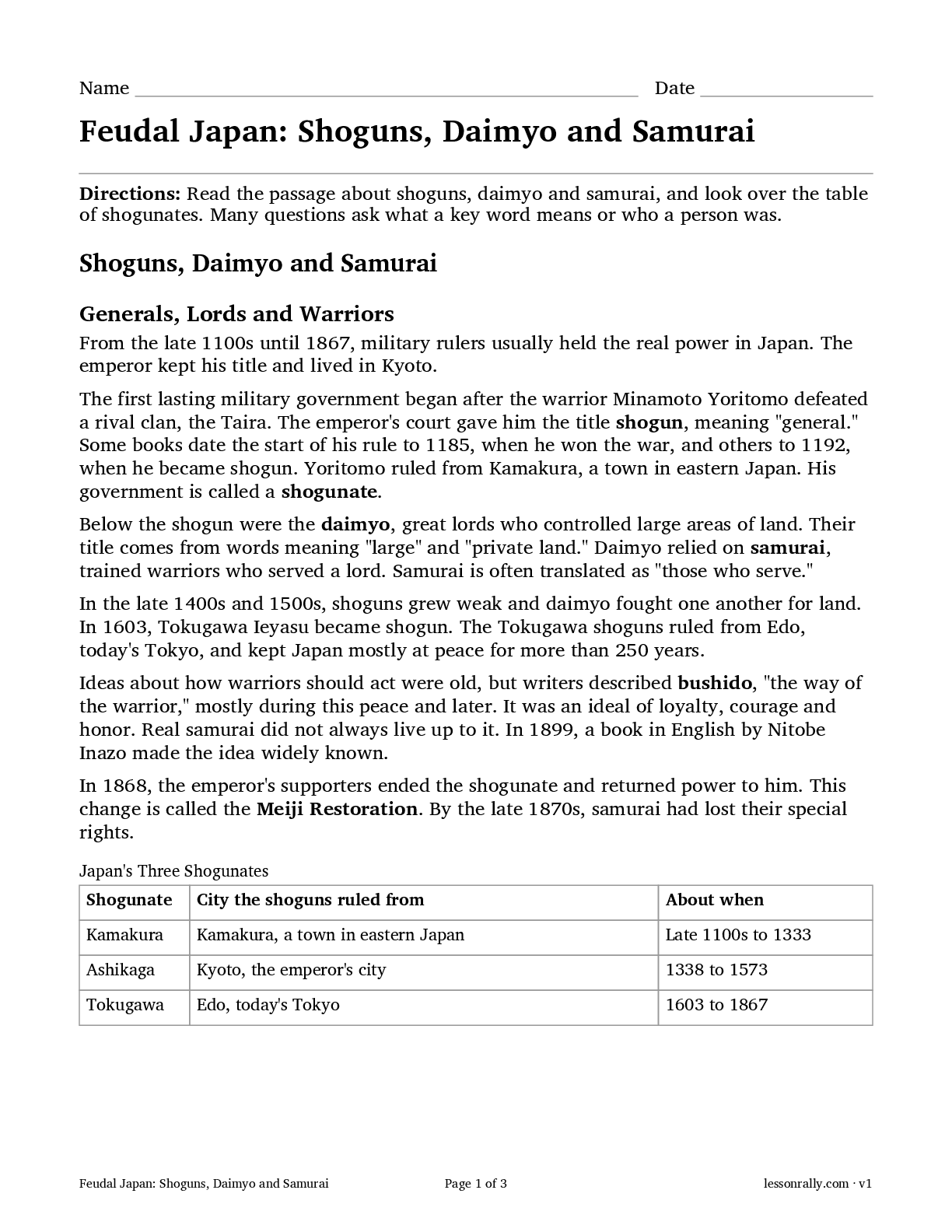
Read the passage about shoguns, daimyo and samurai, and look over the table of shogunates. Many questions ask what a key word means or who a person was.

Shoguns, Daimyo and Samurai

Generals, Lords and Warriors

From the late 1100s until 1867, military rulers usually held the real power in Japan. The emperor kept his title and lived in Kyoto.

The first lasting military government began after the warrior Minamoto Yoritomo defeated a rival clan, the Taira. The emperor's court gave him the title shogun, meaning "general." Some books date the start of his rule to 1185, when he won the war, and others to 1192, when he became shogun. Yoritomo ruled from Kamakura, a town in eastern Japan. His government is called a shogunate.

Below the shogun were the daimyo, great lords who controlled large areas of land. Their title comes from words meaning "large" and "private land." Daimyo relied on samurai, trained warriors who served a lord. Samurai is often translated as "those who serve."

In the late 1400s and 1500s, shoguns grew weak and daimyo fought one another for land. In 1603, Tokugawa Ieyasu became shogun. The Tokugawa shoguns ruled from Edo, today's Tokyo, and kept Japan mostly at peace for more than 250 years.

Ideas about how warriors should act were old, but writers described bushido, "the way of the warrior," mostly during this peace and later. It was an ideal of loyalty, courage and honor. Real samurai did not always live up to it. In 1899, a book in English by Nitobe Inazo made the idea widely known.

In 1868, the emperor's supporters ended the shogunate and returned power to him. This change is called the Meiji Restoration. By the late 1870s, samurai had lost their special rights.


Japan's Three Shogunates
ShogunateCity the shoguns ruled fromAbout when
KamakuraKamakura, a town in eastern JapanLate 1100s to 1333
AshikagaKyoto, the emperor's city1338 to 1573
TokugawaEdo, today's Tokyo1603 to 1867

Question 1

Which statement describes the emperor's place in Japan from the late 1100s until 1867?

Choose one answer.

  • There was no emperor in Japan at any time during these years.
  • The emperor kept his title, but military rulers usually held the real power.
  • The emperor and the shogun were always one and the same person.
  • The emperor ruled alone, and military rulers had no power at all.

Question 2

Match each name or term from the passage about Japan to its description.

Match each item to an option.

Items

  1. shogun
  2. shogunate
  3. Taira
  4. Tokugawa Ieyasu
  5. Edo
  6. Kyoto

Options

  1. a temple where monks lived and prayed
  2. the city now called Tokyo
  3. the title, meaning general, held by Japan's top military ruler
  4. a farmer who paid rice to a lord
  5. the city where the emperor lived
  6. the government run by a shogun
  7. a rival clan defeated by Minamoto Yoritomo
  8. the leader who became shogun in 1603

Question 3

The title daimyo comes from words meaning "large" and "private land." How do these word parts fit the daimyo?

Choose one answer.

  • They were priests who lived in very large temples.
  • They were farmers who rented small plots from a lord.
  • They were sailors who traded with lands overseas.
  • They were great lords who controlled large areas of land.

Question 4

According to the table, from which city did the first shogunate rule?

Choose one answer.

  • Kyoto
  • Nara
  • Edo
  • Kamakura

Question 5

Samurai is often translated as "those who serve." Which detail from the passage fits this meaning?

Choose one answer.

  • Samurai each had their own emperor.
  • Samurai were trained warriors who served a lord.
  • Samurai ruled the whole country from Edo.
  • Samurai wrote every book about bushido.

Question 6

What does the passage say about bushido?

Choose one answer.

  • It was a new idea that a writer in England made up from nothing in 1899.
  • It was a strict written law that every single samurai obeyed at all times.
  • It was a special kind of sword that only the shoguns were allowed to carry.
  • It was an ideal, described mostly later, that real samurai did not always meet.

Question 7

According to the passage, which two values were part of the bushido ideal? Select 2.

Choose 2 answers.

  • luxury
  • wealth
  • honor
  • loyalty

Question 8

Using the table, which shogunate lasted the longest?

Choose one answer.

  • Tokugawa
  • Kamakura
  • Ashikaga
  • They all lasted about the same time.

Question 9

The passage says shoguns grew weak in the late 1400s and 1500s. According to the table, which shogunate held power then?

Choose one answer.

  • Kamakura
  • Tokugawa
  • Ashikaga
  • Meiji

Question 10

In the term Meiji Restoration, what does restoration mean?

Choose one answer.

  • the building of a brand-new capital city
  • the end of all fighting everywhere in the world
  • the return of power to the emperor
  • the start of a new and stronger shogunate

Question 11

Why do books give two different years for the start of Yoritomo's rule?

Choose one answer.

  • Two different men named Yoritomo ruled Japan.
  • The emperor himself became shogun in one of those years.
  • They count from two different events in Yoritomo's rise to power.
  • Japan used no calendar of any kind at that time.

Reviews

No reviews yet.

Reviews come from teachers who assigned this activity to a class.

Sign in to write a review

Have a topic of your own? Make a printable worksheet and online quiz, free.

Create an activity

Answer key

Answer keys come with Premium

Print this worksheet with the correct answers marked. The key includes any explanations, sample answers, and rubrics supplied with the activity.

Answer keys aren't public: only teachers with Premium and the people who can edit an activity can download one, so students can't get a ready-to-print key from this page.

Premium includes:

  • No ads for you, and no ads for your students on the assignments you post.
  • Answer keys for printable worksheets, with the correct answers marked and any explanations, sample answers, and rubrics.
  • Create with AI: up to 100 activities a year (5 during the free trial), with every answer checked before you see the draft.

$29 a year, plus sales tax where it applies.

New Premium teachers can try it free for 7 days. A card or other payment method is needed to start. Unless you cancel before the trial ends, you are charged then and the plan renews every year.

Already have Premium or edit this activity? Sign in