Question 1
Using the dates in the table, which list puts the civilizations in order from the earliest date shown to the latest?
Choose one answer.
- Aztec, Inca, Maya
- Maya, Aztec, Inca
- Aztec, Maya, Inca
- Inca, Aztec, Maya


Teachers who sign in can assign LessonRally activities to their Google Classroom classes: students open them in Classroom and answer online, and their grades go to the teacher's Classroom gradebook. Practice lets you try it first, the way students see it.
Free for teachers. Sign in to assign activities to your Google Classroom classes.
 (opens in a new tab)
3 pages · Student copy, no answers
Print worksheet (opens in a new tab)Answer keyPremiumStudents read an original passage about the Maya city-states and their hieroglyphs, the Mexica capital of Tenochtitlan and its lake gardens, and the Inca empire in the Andes with its khipu records and mountain roads. A comparison table gives the place, dates and government of each. Questions ask students to combine the table with the passage. The passage also notes that millions of Maya people and speakers of Nahuatl and Quechua live in these lands today.
Learning goal: Compare the Maya, Aztec and Inca civilizations by combining information from a table with information in a passage.
The estimate is the middle score of five readability formulas. Their scores run from 6.1 to 9.1.
Adapted from common readability formulas (Flesch-Kincaid, Gunning Fog, Coleman-Liau and ARI, plus SMOG for long texts), which look at sentence length and word length. Answer choices count toward word length only. Grades below the estimate will likely find the text harder, grades above it easier. It does not measure ideas, background knowledge or images.
Integrate visual information (e.g., in charts, graphs, photographs, videos, or maps) with other information in print and digital texts.
Determine the meaning of words and phrases as they are used in a text, including vocabulary specific to domains related to history/social studies.
Matched independently by two AI models from this activity's questions.
© Copyright 2010. National Governors Association Center for Best Practices and Council of Chief State School Officers. All rights reserved.
Topic: Ancient Civilizations Chosen by LessonRally
Question types: multiple choice, matching, select all that apply.
The questions as students see them, without the answers.
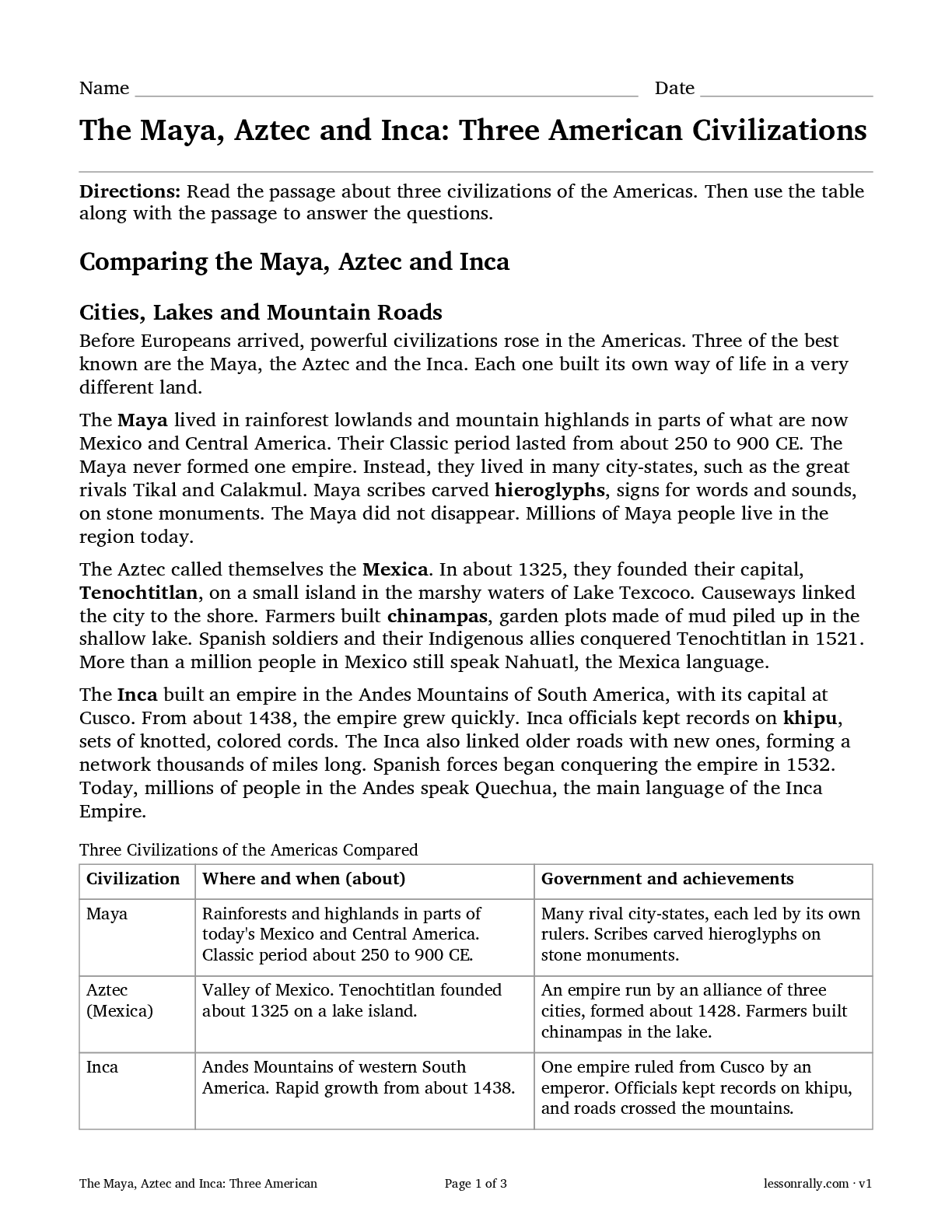
Read the passage about three civilizations of the Americas. Then use the table along with the passage to answer the questions.
Cities, Lakes and Mountain Roads
Before Europeans arrived, powerful civilizations rose in the Americas. Three of the best known are the Maya, the Aztec and the Inca. Each one built its own way of life in a very different land.
The Maya lived in rainforest lowlands and mountain highlands in parts of what are now Mexico and Central America. Their Classic period lasted from about 250 to 900 CE. The Maya never formed one empire. Instead, they lived in many city-states, such as the great rivals Tikal and Calakmul. Maya scribes carved hieroglyphs, signs for words and sounds, on stone monuments. The Maya did not disappear. Millions of Maya people live in the region today.
The Aztec called themselves the Mexica. In about 1325, they founded their capital, Tenochtitlan, on a small island in the marshy waters of Lake Texcoco. Causeways linked the city to the shore. Farmers built chinampas, garden plots made of mud piled up in the shallow lake. Spanish soldiers and their Indigenous allies conquered Tenochtitlan in 1521. More than a million people in Mexico still speak Nahuatl, the Mexica language.
The Inca built an empire in the Andes Mountains of South America, with its capital at Cusco. From about 1438, the empire grew quickly. Inca officials kept records on khipu, sets of knotted, colored cords. The Inca also linked older roads with new ones, forming a network thousands of miles long. Spanish forces began conquering the empire in 1532. Today, millions of people in the Andes speak Quechua, the main language of the Inca Empire.
| Civilization | Where and when (about) | Government and achievements |
|---|---|---|
| Maya | Rainforests and highlands in parts of today's Mexico and Central America. Classic period about 250 to 900 CE. | Many rival city-states, each led by its own rulers. Scribes carved hieroglyphs on stone monuments. |
| Aztec (Mexica) | Valley of Mexico. Tenochtitlan founded about 1325 on a lake island. | An empire run by an alliance of three cities, formed about 1428. Farmers built chinampas in the lake. |
| Inca | Andes Mountains of western South America. Rapid growth from about 1438. | One empire ruled from Cusco by an emperor. Officials kept records on khipu, and roads crossed the mountains. |
Using the dates in the table, which list puts the civilizations in order from the earliest date shown to the latest?
Choose one answer.
Match each term from the passage about the Americas to its meaning.
Match each item to an option.
Items
Options
According to the table, how did the governments of the three civilizations differ?
Choose one answer.
What does the passage say about Maya people today?
Choose one answer.
Using the table, which civilization lived the farthest south?
Choose one answer.
Which two achievements belong to the Inca, according to the passage and the table? Select 2.
Choose 2 answers.
Who conquered Tenochtitlan in 1521, according to the passage?
Choose one answer.
The passage says the Inca "linked older roads with new ones." What does this tell you about the Inca road network?
Choose one answer.
The table says the Inca empire grew quickly from about 1438. The passage says Spanish forces began conquering it in 1532. About how long did the empire grow before the Spanish came?
Choose one answer.
Which fact can you find in the table but not in the passage?
Choose one answer.
No reviews yet.
Reviews come from teachers who assigned this activity to a class.
Have a topic of your own? Make a printable worksheet and online quiz, free.
Create an activityCommon Core RH.6-8.4
Made by Owen Brackwell · LessonRally (AI-assisted)
Common Core RH.6-8.5
Made by Owen Brackwell · LessonRally (AI-assisted)
Common Core RI.7.2
Made by Owen Brackwell · LessonRally (AI-assisted)
Common Core RH.6-8.1
Made by Owen Brackwell · LessonRally (AI-assisted)