Question 1
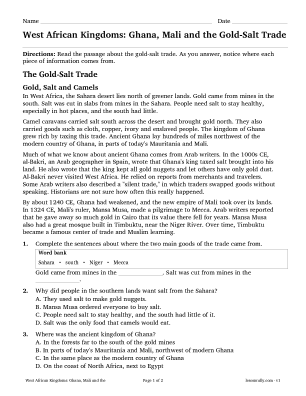
Complete the sentences about the eastern half of the Roman Empire.
Fill in each blank.
Today the eastern half is often called the blank 1 Empire. It was ruled from blank 2.
Word bank
- Vandal
- Rome
- Constantinople
- Byzantine


Teachers who sign in can assign LessonRally activities to their Google Classroom classes: students open them in Classroom and answer online, and their grades go to the teacher's Classroom gradebook. Practice lets you try it first, the way students see it.
Free for teachers. Sign in to assign activities to your Google Classroom classes.
 (opens in a new tab)
2 pages · Student copy, no answers
Print worksheet (opens in a new tab)Answer keyPremiumStudents read an original passage about why the Western Roman Empire fell: unstable government, money trouble, the empire's size, and pressure from the Huns, Goths and Vandals, ending with Odoacer in 476 CE. Questions ask students to follow the passage's cause-and-effect structure, sort problems inside the empire from pressure outside it, and see that only the West fell, since the eastern (Byzantine) half lasted until 1453.
Learning goal: Explain several causes historians give for the fall of the Western Roman Empire, analyze how a passage presents causes and effects, and explain why the Eastern Roman Empire lasted until 1453.
The estimate is the middle score of five readability formulas. Their scores run from 5.7 to 8.9.
Adapted from common readability formulas (Flesch-Kincaid, Gunning Fog, Coleman-Liau and ARI, plus SMOG for long texts), which look at sentence length and word length. Answer choices count toward word length only. Grades below the estimate will likely find the text harder, grades above it easier. It does not measure ideas, background knowledge or images.
© Copyright 2010. National Governors Association Center for Best Practices and Council of Chief State School Officers. All rights reserved.
Question types: fill in the blank, multiple choice, select all that apply.
The questions as students see them, without the answers.
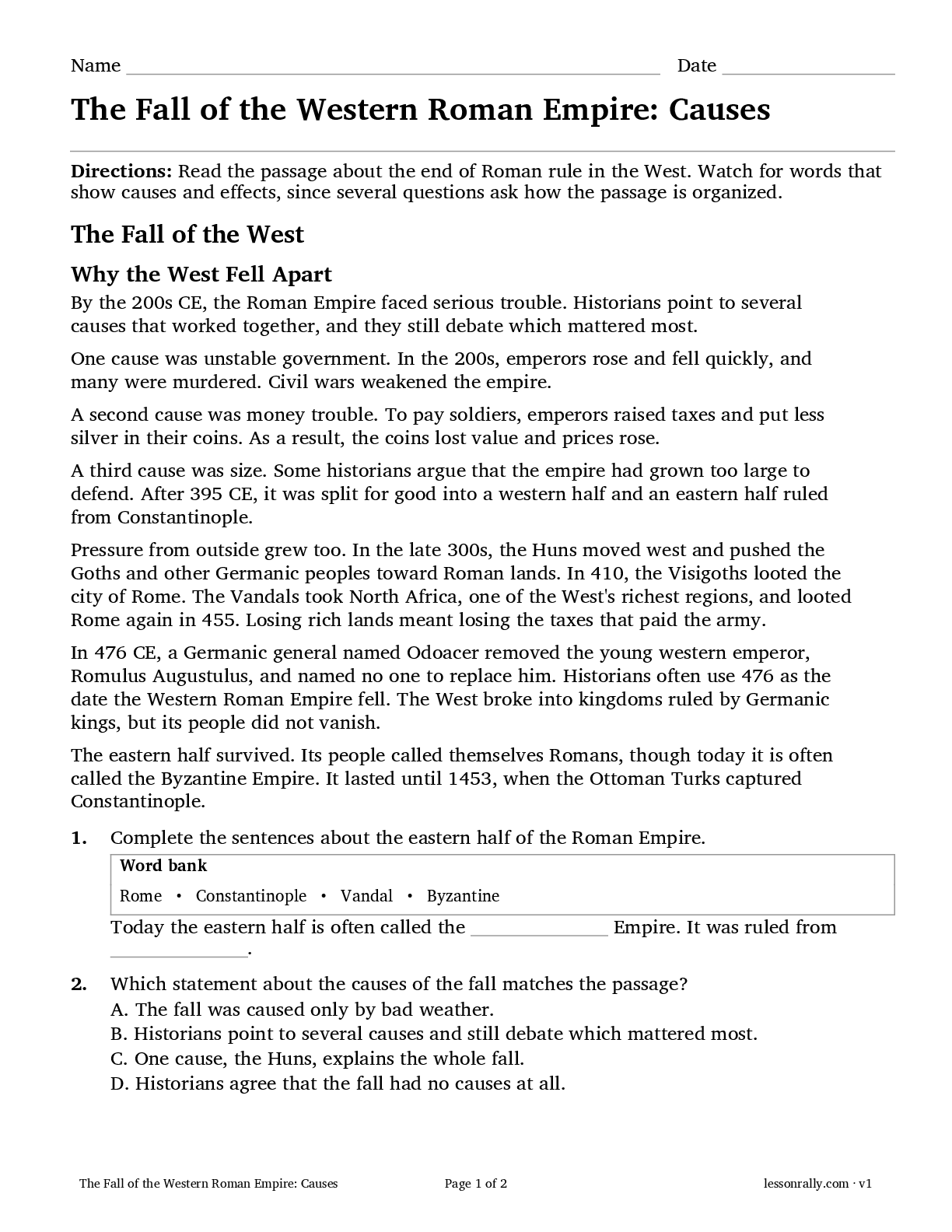
Read the passage about the end of Roman rule in the West. Watch for words that show causes and effects, since several questions ask how the passage is organized.
Why the West Fell Apart
By the 200s CE, the Roman Empire faced serious trouble. Historians point to several causes that worked together, and they still debate which mattered most.
One cause was unstable government. In the 200s, emperors rose and fell quickly, and many were murdered. Civil wars weakened the empire.
A second cause was money trouble. To pay soldiers, emperors raised taxes and put less silver in their coins. As a result, the coins lost value and prices rose.
A third cause was size. Some historians argue that the empire had grown too large to defend. After 395 CE, it was split for good into a western half and an eastern half ruled from Constantinople.
Pressure from outside grew too. In the late 300s, the Huns moved west and pushed the Goths and other Germanic peoples toward Roman lands. In 410, the Visigoths looted the city of Rome. The Vandals took North Africa, one of the West's richest regions, and looted Rome again in 455. Losing rich lands meant losing the taxes that paid the army.
In 476 CE, a Germanic general named Odoacer removed the young western emperor, Romulus Augustulus, and named no one to replace him. Historians often use 476 as the date the Western Roman Empire fell. The West broke into kingdoms ruled by Germanic kings, but its people did not vanish.
The eastern half survived. Its people called themselves Romans, though today it is often called the Byzantine Empire. It lasted until 1453, when the Ottoman Turks captured Constantinople.
Complete the sentences about the eastern half of the Roman Empire.
Fill in each blank.
Today the eastern half is often called the blank 1 Empire. It was ruled from blank 2.
Word bank
Which statement about the causes of the fall matches the passage?
Choose one answer.
How is most of the passage organized?
Choose one answer.
According to the passage, which two problems came from the Roman government itself?
Choose 2 answers.
Which words from the passage most clearly signal a cause-and-effect link?
Choose one answer.
How did the movement of the Huns affect the Roman Empire?
Choose one answer.
According to the passage, what was one result of losing rich regions such as North Africa?
Choose one answer.
Which event happened between the split of 395 CE and the end of the West in 476 CE?
Choose one answer.
Why do historians often use 476 CE as the date the Western Roman Empire fell?
Choose one answer.
Why does the passage end with a paragraph about the eastern half of the empire?
Choose one answer.
No reviews yet.
Reviews come from teachers who assigned this activity to a class.
Have a topic of your own? Make a printable worksheet and online quiz, free.
Create an activityCommon Core RH.6-8.7
Made by Owen Brackwell · LessonRally (AI-assisted)
Common Core RH.6-8.4
Made by Owen Brackwell · LessonRally (AI-assisted)
Common Core RI.7.2
Made by Owen Brackwell · LessonRally (AI-assisted)
Common Core RH.6-8.1
Made by Owen Brackwell · LessonRally (AI-assisted)