Question 1
Complete the sentences about where the two main goods of the trade came from.
Fill in each blank.
Gold came from mines in the blank 1. Salt was cut from mines in the blank 2.
Word bank
- Niger
- Mecca
- south
- Sahara


Teachers who sign in can assign LessonRally activities to their Google Classroom classes: students open them in Classroom and answer online, and their grades go to the teacher's Classroom gradebook. Practice lets you try it first, the way students see it.
Free for teachers. Sign in to assign activities to your Google Classroom classes.
 (opens in a new tab)
2 pages · Student copy, no answers
Print worksheet (opens in a new tab)Answer keyPremiumStudents read an original passage about the gold-salt trade of West Africa: gold from the south, salt from the Sahara, camel caravans, the kingdom of Ghana (northwest of the modern country), the empire of Mali, Mansa Musa's pilgrimage in 1324 CE and Timbuktu. Questions ask students to cite evidence from the passage and to notice which facts come from Arab writers, including the story of the silent trade.
Learning goal: Explain how the gold-salt trade made Ghana and Mali rich, and cite evidence from a passage while noting which accounts come from Arab writers who described West Africa.
The estimate is the middle score of five readability formulas. Their scores run from 5.4 to 8.4.
Adapted from common readability formulas (Flesch-Kincaid, Gunning Fog, Coleman-Liau and ARI, plus SMOG for long texts), which look at sentence length and word length. Answer choices count toward word length only. Grades below the estimate will likely find the text harder, grades above it easier. It does not measure ideas, background knowledge or images.
© Copyright 2010. National Governors Association Center for Best Practices and Council of Chief State School Officers. All rights reserved.
Topic: Ancient Civilizations Chosen by LessonRally
Question types: fill in the blank, multiple choice, select all that apply.
The questions as students see them, without the answers.
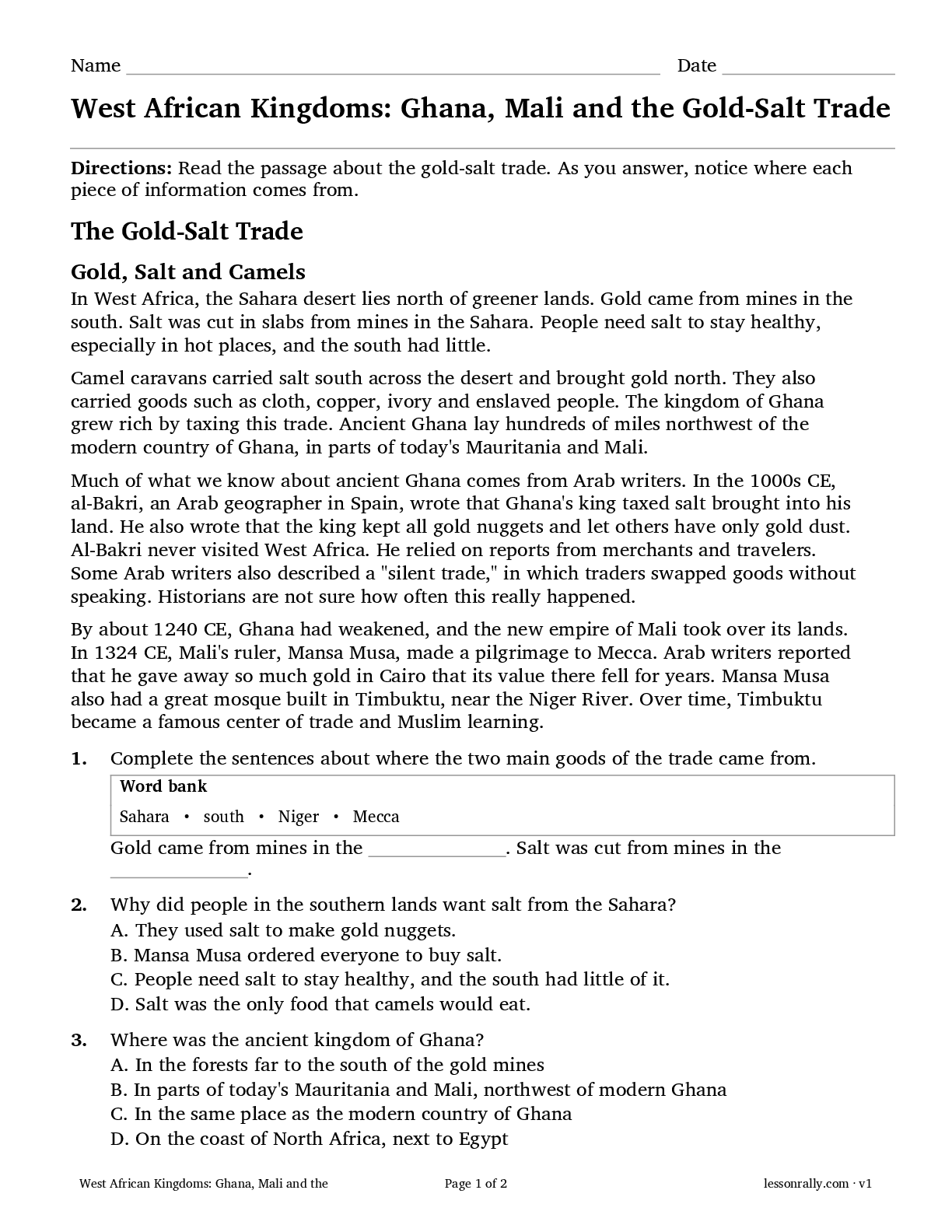
Read the passage about the gold-salt trade. As you answer, notice where each piece of information comes from.
Gold, Salt and Camels
In West Africa, the Sahara desert lies north of greener lands. Gold came from mines in the south. Salt was cut in slabs from mines in the Sahara. People need salt to stay healthy, especially in hot places, and the south had little.
Camel caravans carried salt south across the desert and brought gold north. They also carried goods such as cloth, copper, ivory and enslaved people. The kingdom of Ghana grew rich by taxing this trade. Ancient Ghana lay hundreds of miles northwest of the modern country of Ghana, in parts of today's Mauritania and Mali.
Much of what we know about ancient Ghana comes from Arab writers. In the 1000s CE, al-Bakri, an Arab geographer in Spain, wrote that Ghana's king taxed salt brought into his land. He also wrote that the king kept all gold nuggets and let others have only gold dust. Al-Bakri never visited West Africa. He relied on reports from merchants and travelers. Some Arab writers also described a "silent trade," in which traders swapped goods without speaking. Historians are not sure how often this really happened.
By about 1240 CE, Ghana had weakened, and the new empire of Mali took over its lands. In 1324 CE, Mali's ruler, Mansa Musa, made a pilgrimage to Mecca. Arab writers reported that he gave away so much gold in Cairo that its value there fell for years. Mansa Musa also had a great mosque built in Timbuktu, near the Niger River. Over time, Timbuktu became a famous center of trade and Muslim learning.
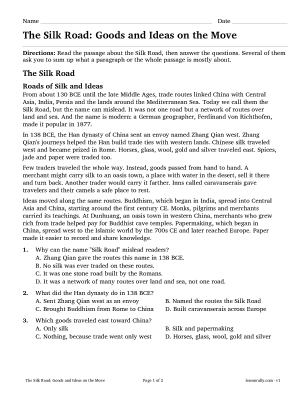
Complete the sentences about where the two main goods of the trade came from.
Fill in each blank.
Gold came from mines in the blank 1. Salt was cut from mines in the blank 2.
Word bank
Why did people in the southern lands want salt from the Sahara?
Choose one answer.
Where was the ancient kingdom of Ghana?
Choose one answer.
According to the passage, how did the kingdom of Ghana grow rich?
Choose one answer.
How did al-Bakri learn about Ghana?
Choose one answer.
Which detail from al-Bakri's account shows that Ghana's king controlled the supply of gold?
Choose one answer.
How does the passage present the story of the "silent trade"?
Choose one answer.
Which two statements about the empire of Mali are supported by the passage?
Choose 2 answers.
According to Arab writers, what happened when Mansa Musa was in Cairo?
Choose one answer.
Which sentence from the passage best supports the idea that Mali's ruler helped Timbuktu grow?
Choose one answer.
No reviews yet.
Reviews come from teachers who assigned this activity to a class.
Have a topic of your own? Make a printable worksheet and online quiz, free.
Create an activityCommon Core RH.6-8.7
Made by Owen Brackwell · LessonRally (AI-assisted)
Common Core RH.6-8.4
Made by Owen Brackwell · LessonRally (AI-assisted)
Common Core RH.6-8.5
Made by Owen Brackwell · LessonRally (AI-assisted)
Common Core RI.7.2
Made by Owen Brackwell · LessonRally (AI-assisted)