Teachers who sign in can assign LessonRally activities to their Google Classroom classes: students open them in Classroom and answer online, and their grades go to the teacher's Classroom gradebook. Practice lets you try it first, the way students see it.
Students use the terms diploid, haploid and homologous, put the events of meiosis I and meiosis II in order, then answer questions about DNA copying, crossing over, independent assortment, how meiosis differs from mitosis, why gametes are haploid, and a table of chromosome combinations from independent assortment.
Learning goal: Put the events of meiosis I and meiosis II in order and explain how crossing over and independent assortment produce genetically different haploid cells.
Estimated reading level10.6
Grade 8Hard
Grade 9Stretch
Grade 10On level
Grade 11Easier
Grade 12Easy
About this estimate
The estimate is halfway between the two middle scores of four readability formulas. Their scores run from 9.6 to 12.4.
Flesch-Kincaid GradeSentence length and syllables per word9.6
Gunning FogSentence length and words of three or more syllables12.4
Coleman-Liau Middle scoreLetters per word and sentences per 100 words10.9
Automated Readability Index Middle scoreCharacters per word and words per sentence10.3
Grade 181216
Flesch Reading Ease
57.8 on a 0 to 100 scale where higher is easier: fairly difficult. Not part of the estimate.
Text measured
711 words, 19 sentences
Adapted from common readability formulas (Flesch-Kincaid, Gunning Fog, Coleman-Liau and ARI, plus SMOG for long texts), which look at sentence length and word length. Answer choices count toward word length only. Grades below the estimate will likely find the text harder, grades above it easier. It does not measure ideas, background knowledge or images.
Question types: fill in the blank, matching, multiple choice.
Student preview
The questions as students see them, without the answers.
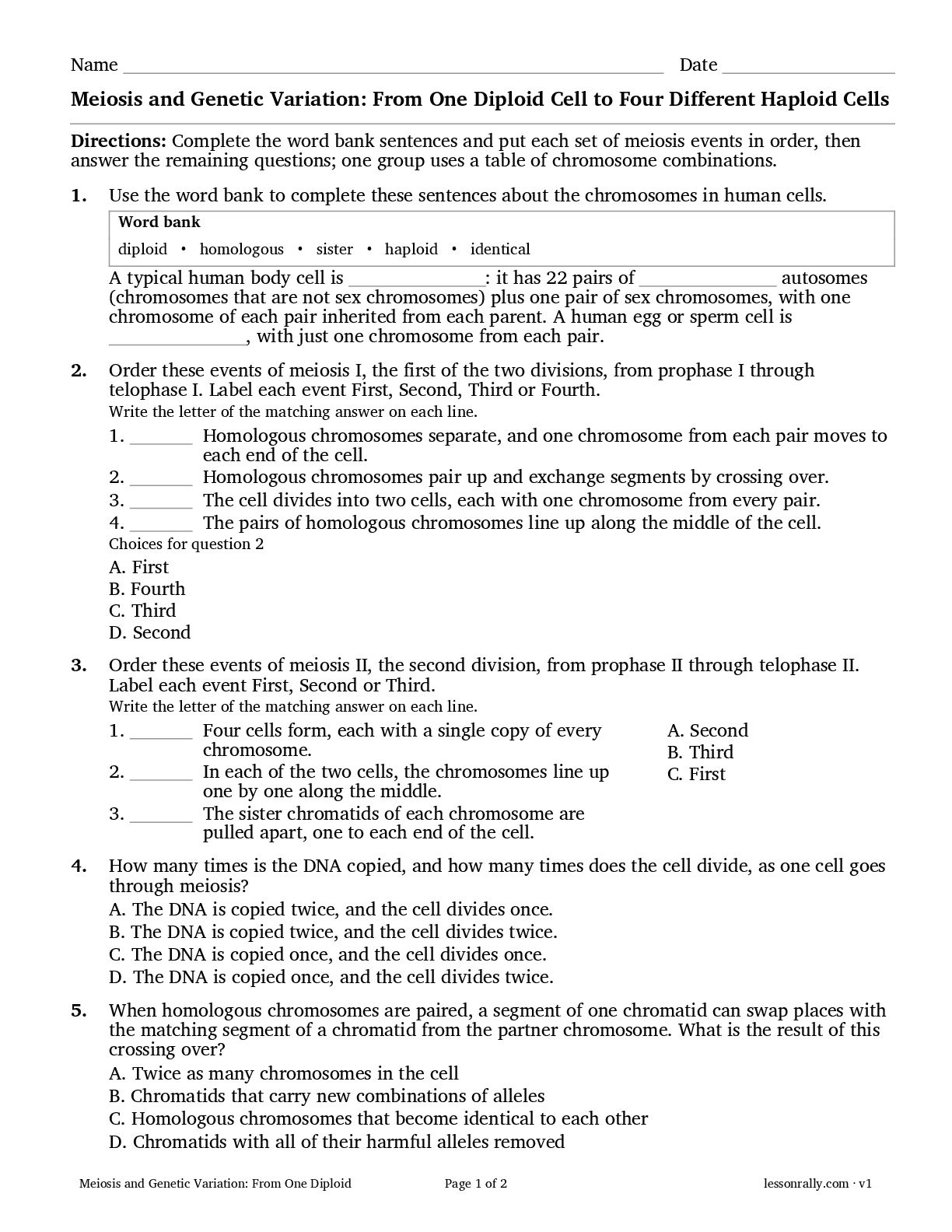
Complete the word bank sentences and put each set of meiosis events in order, then answer the remaining questions; one group uses a table of chromosome combinations.
Question 1
Use the word bank to complete these sentences about the chromosomes in human cells.
Fill in each blank.
A typical human body cell is blank 1: it has 22 pairs of blank 2 autosomes (chromosomes that are not sex chromosomes) plus one pair of sex chromosomes, with one chromosome of each pair inherited from each parent. A human egg or sperm cell is blank 3, with just one chromosome from each pair.
Word bank
identical
homologous
sister
diploid
haploid
Question 2
Order these events of meiosis I, the first of the two divisions, from prophase I through telophase I. Label each event First, Second, Third or Fourth.
Match each item to an option.
Items
Homologous chromosomes separate, and one chromosome from each pair moves to each end of the cell.
Homologous chromosomes pair up and exchange segments by crossing over.
The cell divides into two cells, each with one chromosome from every pair.
The pairs of homologous chromosomes line up along the middle of the cell.
Options
Fourth
First
Second
Third
Question 3
Order these events of meiosis II, the second division, from prophase II through telophase II. Label each event First, Second or Third.
Match each item to an option.
Items
Four cells form, each with a single copy of every chromosome.
In each of the two cells, the chromosomes line up one by one along the middle.
The sister chromatids of each chromosome are pulled apart, one to each end of the cell.
Options
First
Third
Second
Question 4
How many times is the DNA copied, and how many times does the cell divide, as one cell goes through meiosis?
Choose one answer.
The DNA is copied twice, and the cell divides once.
The DNA is copied once, and the cell divides once.
The DNA is copied once, and the cell divides twice.
The DNA is copied twice, and the cell divides twice.
Question 5
When homologous chromosomes are paired, a segment of one chromatid can swap places with the matching segment of a chromatid from the partner chromosome. What is the result of this crossing over?
Choose one answer.
Homologous chromosomes that become identical to each other
Chromatids that carry new combinations of alleles
Chromatids with all of their harmful alleles removed
Twice as many chromosomes in the cell
Question 6
Each pair of homologous chromosomes lines up at the middle of the cell with either partner facing either end, no matter how the other pairs line up. What does this independent assortment produce?
Choose one answer.
Gametes with many different mixtures of chromosomes from the two parents
Every gamete receives only chromosomes that the individual inherited from their mother
Gametes that carry two copies of each chromosome
Gametes that are all genetically identical to one another
Question 7
A human skin cell divides by mitosis, and a cell in a human testis divides by meiosis. How do the cells they produce compare?
Choose one answer.
Both cells make 2 identical diploid cells, but the testis cells are smaller.
The skin cell makes 2 identical diploid cells; the testis cell makes 4 haploid cells that can differ genetically.
The skin cell makes 4 genetically different haploid cells; the testis cell makes 2 identical diploid cells.
Both cells make 4 haploid cells, but only the testis cells can become sperm.
Question 8
Why does it matter that human egg and sperm cells carry only 23 chromosomes each, half the number in body cells?
Choose one answer.
When an egg and a sperm join, the zygote has 46 chromosomes, the normal number.
Cells with 23 chromosomes can go through meiosis again to make more eggs and sperm.
Cells with 23 chromosomes live longer than body cells, so they last until fertilization.
When an egg and a sperm join, the zygote has 92 chromosomes, which it needs to grow.
Counting Chromosome Combinations
The table shows how many different combinations of chromosomes one gamete could receive if only independent assortment is counted, for different numbers of chromosome pairs.
Number of different chromosome combinations one gamete can receive from independent assortment alone
Number of chromosome pairs
Possible combinations in one gamete
1
2
2
4
3
8
4 (fruit fly)
16
7 (pea plant)
128
23 (human)
8,388,608 (about 8.4 million)
Question 9
Based on the pattern in the table, how many combinations could independent assortment alone produce in a species with 5 pairs of chromosomes?
Choose one answer.
64
25
32
10
Question 10
The table counts only independent assortment. Which process during meiosis would make the real number of genetically different gametes even larger?
Choose one answer.
The nuclear envelope forming again around each new nucleus
Crossing over between homologous chromosomes
Cytokinesis dividing the cytoplasm into separate cells