Made by Nathan Kessler · LessonRally (AI-assisted)
Digital classroom activity
What is a digital classroom activity?
Teachers who sign in can assign LessonRally activities to their Google Classroom classes: students open them in Classroom and answer online, and their grades go to the teacher's Classroom gradebook. Practice lets you try it first, the way students see it.
Students match popular sovereignty, the rule of law and limited government to plain-language definitions, then decide which principle each invented situation or founding text shows most directly: a vote on a new constitution, a mayor's parking ticket, the First Amendment's limits on Congress, voters replacing a legislature, a ban on secret laws, a rule for taking land and the Preamble. Federalism and separation of powers appear only as wrong choices.
Learning goal: Distinguish popular sovereignty, the rule of law and limited government, and identify which principle an invented situation or a founding text shows most directly.
Estimated reading level9.4
Grade 7Hard
Grade 8Stretch
Grade 9On level
Grade 10Easier
Grade 11Easy
About this estimate
The estimate is halfway between the two middle scores of four readability formulas. Their scores run from 7.5 to 12.6.
Flesch-Kincaid Grade Middle scoreSentence length and syllables per word8.1
Gunning FogSentence length and words of three or more syllables12.6
Coleman-Liau Middle scoreLetters per word and sentences per 100 words10.7
Automated Readability IndexCharacters per word and words per sentence7.5
Grade 181216
Flesch Reading Ease
56.3 on a 0 to 100 scale where higher is easier: fairly difficult. Not part of the estimate.
Text measured
460 words, 27 sentences
Adapted from common readability formulas (Flesch-Kincaid, Gunning Fog, Coleman-Liau and ARI, plus SMOG for long texts), which look at sentence length and word length. Answer choices count toward word length only. Grades below the estimate will likely find the text harder, grades above it easier. It does not measure ideas, background knowledge or images.
The questions as students see them, without the answers.
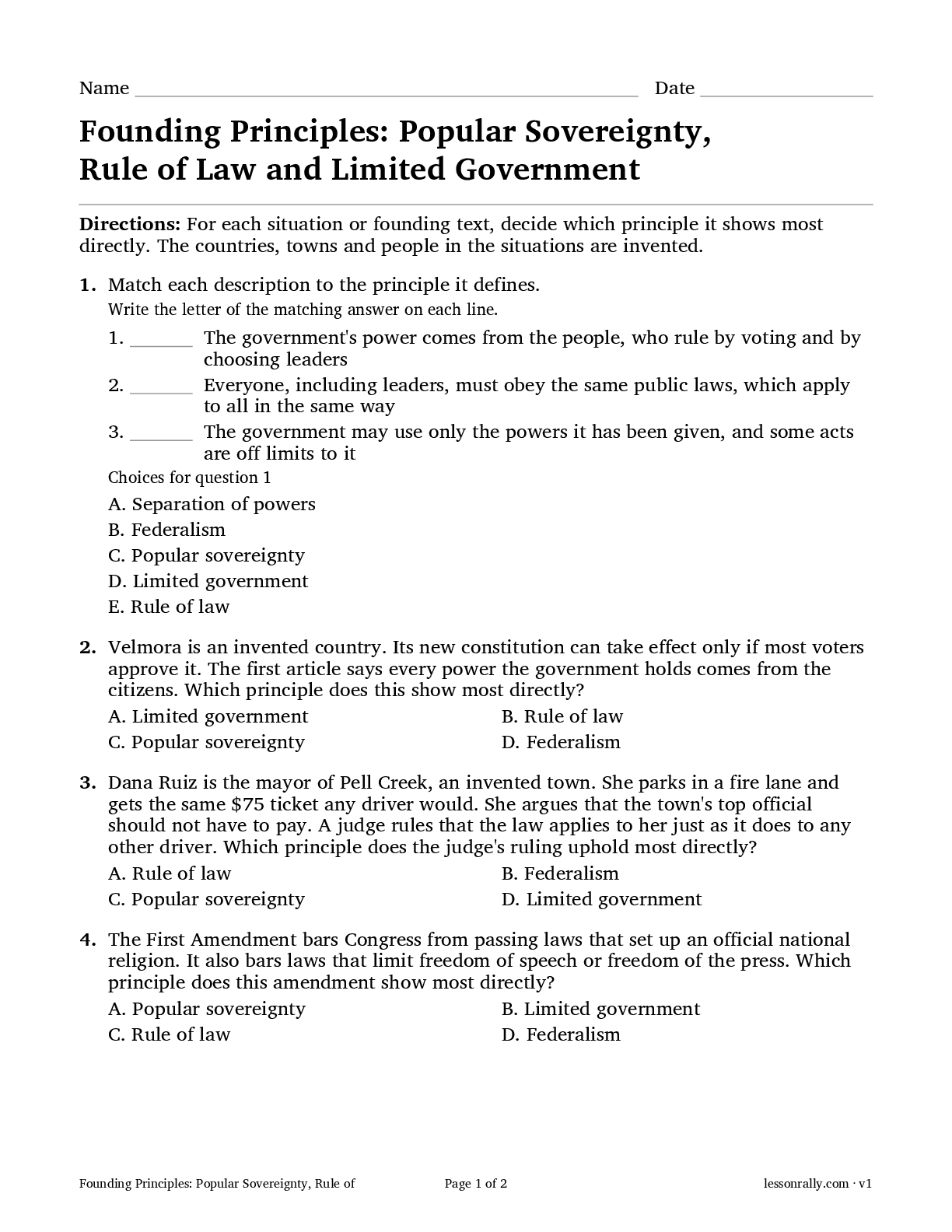
For each situation or founding text, decide which principle it shows most directly. The countries, towns and people in the situations are invented.
Question 1
Match each description to the principle it defines.
Match each item to an option.
Items
The government's power comes from the people, who rule by voting and by choosing leaders
Everyone, including leaders, must obey the same public laws, which apply to all in the same way
The government may use only the powers it has been given, and some acts are off limits to it
Options
Popular sovereignty
Rule of law
Limited government
Separation of powers
Federalism
Question 2
Velmora is an invented country. Its new constitution can take effect only if most voters approve it. The first article says every power the government holds comes from the citizens. Which principle does this show most directly?
Choose one answer.
Rule of law
Popular sovereignty
Federalism
Limited government
Question 3
Dana Ruiz is the mayor of Pell Creek, an invented town. She parks in a fire lane and gets the same $75 ticket any driver would. She argues that the town's top official should not have to pay. A judge rules that the law applies to her just as it does to any other driver. Which principle does the judge's ruling uphold most directly?
Choose one answer.
Federalism
Limited government
Popular sovereignty
Rule of law
Question 4
The First Amendment bars Congress from passing laws that set up an official national religion. It also bars laws that limit freedom of speech or freedom of the press. Which principle does this amendment show most directly?
Choose one answer.
Limited government
Popular sovereignty
Rule of law
Federalism
Question 5
Which of these situations shows popular sovereignty most directly?
Choose one answer.
A nation's central and regional governments each collect their own taxes
A court rules that lawmakers must pay the same taxes as everyone else
A constitution lists the only subjects on which lawmakers may pass laws
Voters elect a new legislature after the old one ignored what most people wanted
Question 6
Officials in Talmora, an invented country, once punished people under rules they kept secret. A new reform changes that. Now no one may be punished under a law unless it was first published for anyone to read. Which principle does the reform protect most directly?
Choose one answer.
Popular sovereignty
Rule of law
Separation of powers
Federalism
Question 7
Dornia is an invented country. Its constitution says the government may take private land only for a public purpose, such as building a road. Even then, it must pay the owner a fair price. Which principle does this rule show most directly?
Choose one answer.
Separation of powers
Limited government
Popular sovereignty
Federalism
Question 8
The Preamble is the opening of the U.S. Constitution. It names the American people as the ones who create and set up the Constitution. Which principle does that opening show most directly?