Made by Nathan Kessler · LessonRally (AI-assisted)
Digital classroom activity
What is a digital classroom activity?
Teachers who sign in can assign LessonRally activities to their Google Classroom classes: students open them in Classroom and answer online, and their grades go to the teacher's Classroom gradebook. Practice lets you try it first, the way students see it.
Students separate physical capital from money, match examples to land, labor, physical capital and entrepreneurship, define labor productivity and pick changes that raise output per hour. A table for an invented bakery has them compute loaves per hour, a percent change and loaves per baker, then explain how a new mixer and a fifth baker changed output. A last question connects productivity to living standards.
Learning goal: Identify the four factors of production, distinguish physical capital from money, compute labor productivity, and predict how changes in capital, skills and hiring affect productivity.
Estimated reading level9.3
Grade 7Hard
Grade 8Stretch
Grade 9On level
Grade 10Easier
Grade 11Easy
About this estimate
The estimate is halfway between the two middle scores of four readability formulas. Their scores run from 8.2 to 11.1.
Flesch-Kincaid Grade Middle scoreSentence length and syllables per word8.4
Gunning FogSentence length and words of three or more syllables11.1
Coleman-Liau Middle scoreLetters per word and sentences per 100 words10.2
Automated Readability IndexCharacters per word and words per sentence8.2
Grade 181216
Flesch Reading Ease
59.0 on a 0 to 100 scale where higher is easier: fairly difficult. Not part of the estimate.
Text measured
593 words, 20 sentences
Adapted from common readability formulas (Flesch-Kincaid, Gunning Fog, Coleman-Liau and ARI, plus SMOG for long texts), which look at sentence length and word length. Answer choices count toward word length only. Grades below the estimate will likely find the text harder, grades above it easier. It does not measure ideas, background knowledge or images.
Question types: multiple choice, matching, select all that apply, number answer.
Student preview
The questions as students see them, without the answers.
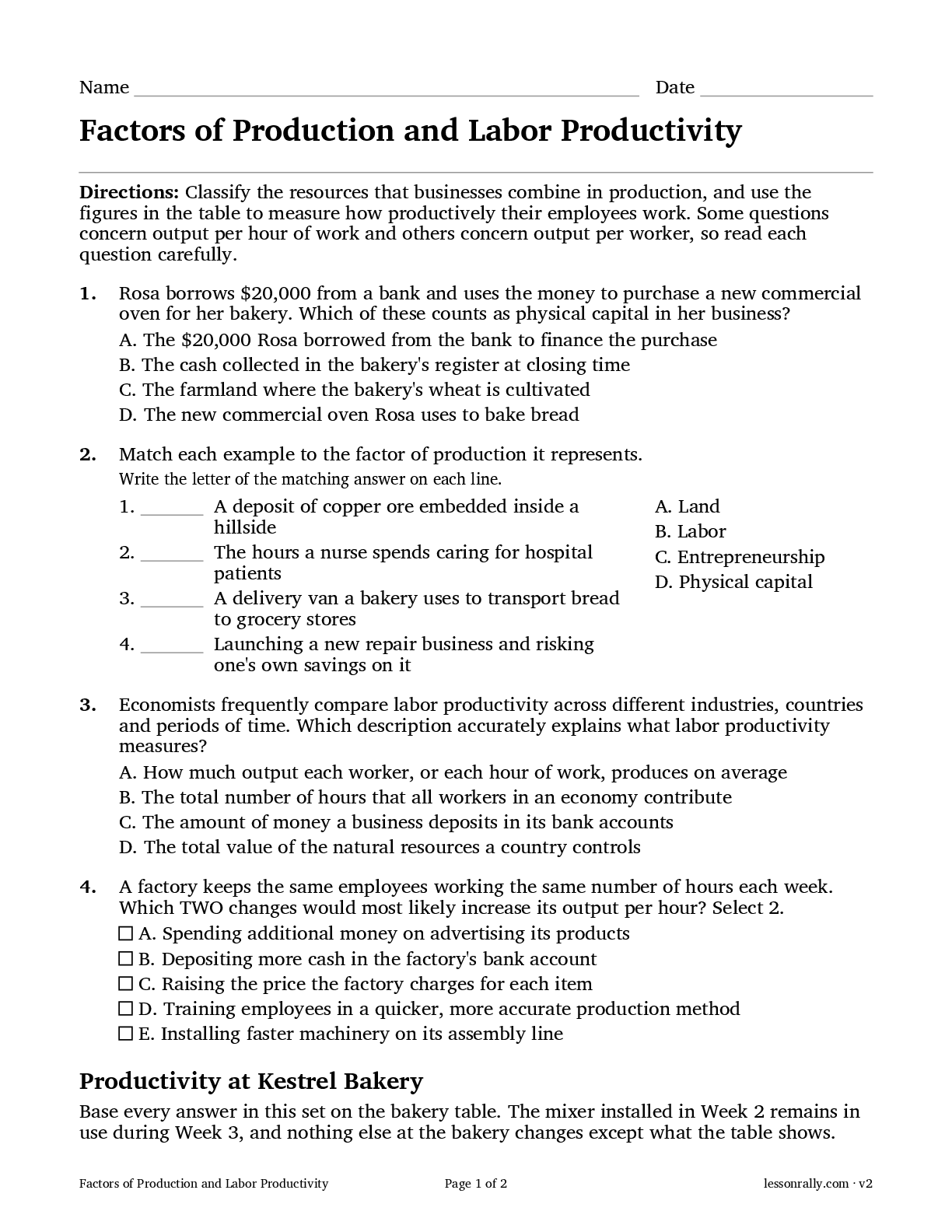
Classify the resources that businesses combine in production, and use the figures in the table to measure how productively their employees work. Some questions concern output per hour of work and others concern output per worker, so read each question carefully.
Question 1
Rosa borrows $20,000 from a bank and uses the money to purchase a new commercial oven for her bakery. Which of these counts as physical capital in her business?
Choose one answer.
The new commercial oven Rosa uses to bake bread
The farmland where the bakery's wheat is cultivated
The cash collected in the bakery's register at closing time
The $20,000 Rosa borrowed from the bank to finance the purchase
Question 2
Match each example to the factor of production it represents.
Match each item to an option.
Items
A deposit of copper ore embedded inside a hillside
The hours a nurse spends caring for hospital patients
A delivery van a bakery uses to transport bread to grocery stores
Launching a new repair business and risking one's own savings on it
Options
Labor
Physical capital
Entrepreneurship
Land
Question 3
Economists frequently compare labor productivity across different industries, countries and periods of time. Which description accurately explains what labor productivity measures?
Choose one answer.
The total value of the natural resources a country controls
The amount of money a business deposits in its bank accounts
How much output each worker, or each hour of work, produces on average
The total number of hours that all workers in an economy contribute
Question 4
A factory keeps the same employees working the same number of hours each week. Which TWO changes would most likely increase its output per hour? Select 2.
Choose 2 answers.
Training employees in a quicker, more accurate production method
Depositing more cash in the factory's bank account
Installing faster machinery on its assembly line
Raising the price the factory charges for each item
Spending additional money on advertising its products
Productivity at Kestrel Bakery
Base every answer in this set on the bakery table. The mixer installed in Week 2 remains in use during Week 3, and nothing else at the bakery changes except what the table shows.
Weekly output at Kestrel Bakery
Week
Bakers
Total hours worked
Loaves baked
Week 1
4
160
2,560
Week 2 (new mixer installed)
4
160
3,200
Week 3 (fifth baker hired)
5
200
3,800
Question 5
Using the table, calculate Kestrel Bakery's output per hour of work in Week 1, measured in loaves.
Enter a number.
loaves per hour
Question 6
By what percent did the bakery's output per hour of work increase from Week 1 to Week 2?
Enter a number.
percent
Question 7
The same four bakers worked the same total of 160 hours in Week 1 and in Week 2. What best explains the increase in output per hour?
Choose one answer.
The price of a loaf increased, so each hour of work became more valuable.
The bakers worked considerably longer hours in Week 2 than in Week 1.
The bakery hired additional bakers to share the work in Week 2.
The new mixer provided each baker with more physical capital.
Question 8
Calculate the bakery's average output per baker in Week 3, measured in loaves.
Enter a number.
loaves per baker
Question 9
Compare the bakery's results in Week 3 with its results in Week 2. Which statement about the bakery's output is accurate?
Choose one answer.
Total loaves decreased, but loaves per hour of work increased.
Total loaves increased, but loaves per hour of work decreased.
Total loaves and loaves per hour of work both increased.
Total loaves and loaves per hour of work remained the same.
Question 10
Why do economists pay such close attention to growth in labor productivity across an entire economy?
Choose one answer.
It reveals how much new money the government prints and circulates each year.
Greater output per hour lets an economy produce more for each person, which can raise living standards.
It measures how many people in the economy are employed or actively seeking work.
It matters only to companies that sell their goods to customers in other countries.