Made by Nathan Kessler · LessonRally (AI-assisted)
Digital classroom activity
What is a digital classroom activity?
Teachers who sign in can assign LessonRally activities to their Google Classroom classes: students open them in Classroom and answer online, and their grades go to the teacher's Classroom gradebook. Practice lets you try it first, the way students see it.
Students match each example to the kind of power it shows: expressed, reserved, concurrent or denied powers. Then they apply federalism to invented situations involving the national government and the states, including the Tenth Amendment, implied powers, the Supremacy Clause, limits on what a state can do, and the Full Faith and Credit Clause.
Learning goal: Classify government powers as expressed, reserved, concurrent or denied, and apply the Constitution's division of power between the national government and the states to invented situations.
Estimated reading level9.2
Grade 7Hard
Grade 8Stretch
Grade 9On level
Grade 10Easier
Grade 11Easy
About this estimate
The estimate is halfway between the two middle scores of four readability formulas. Their scores run from 7.6 to 10.8.
Flesch-Kincaid GradeSentence length and syllables per word7.6
Gunning Fog Middle scoreSentence length and words of three or more syllables10.3
Coleman-LiauLetters per word and sentences per 100 words10.8
Automated Readability Index Middle scoreCharacters per word and words per sentence8.1
Grade 181216
Flesch Reading Ease
63.0 on a 0 to 100 scale where higher is easier: standard. Not part of the estimate.
Text measured
545 words, 22 sentences
Adapted from common readability formulas (Flesch-Kincaid, Gunning Fog, Coleman-Liau and ARI, plus SMOG for long texts), which look at sentence length and word length. Answer choices count toward word length only. Grades below the estimate will likely find the text harder, grades above it easier. It does not measure ideas, background knowledge or images.
Question types: matching, multiple choice, select all that apply.
Student preview
The questions as students see them, without the answers.
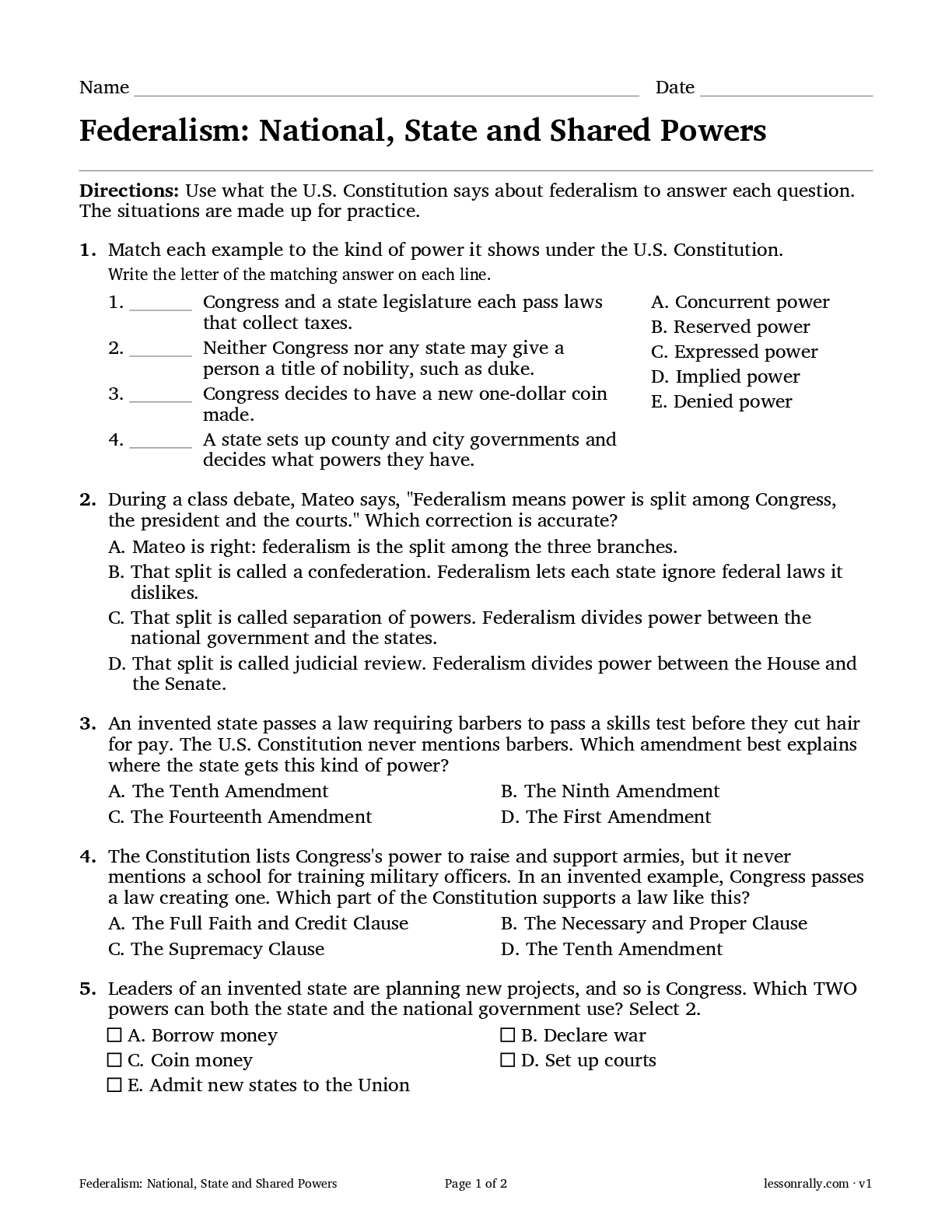
Use what the U.S. Constitution says about federalism to answer each question. The situations are made up for practice.
Question 1
Match each example to the kind of power it shows under the U.S. Constitution.
Match each item to an option.
Items
Congress and a state legislature each pass laws that collect taxes.
Neither Congress nor any state may give a person a title of nobility, such as duke.
Congress decides to have a new one-dollar coin made.
A state sets up county and city governments and decides what powers they have.
Options
Reserved power
Expressed power
Implied power
Concurrent power
Denied power
Question 2
During a class debate, Mateo says, "Federalism means power is split among Congress, the president and the courts." Which correction is accurate?
Choose one answer.
Mateo is right: federalism is the split among the three branches.
That split is called judicial review. Federalism divides power between the House and the Senate.
That split is called a confederation. Federalism lets each state ignore federal laws it dislikes.
That split is called separation of powers. Federalism divides power between the national government and the states.
Question 3
An invented state passes a law requiring barbers to pass a skills test before they cut hair for pay. The U.S. Constitution never mentions barbers. Which amendment best explains where the state gets this kind of power?
Choose one answer.
The Fourteenth Amendment
The Ninth Amendment
The Tenth Amendment
The First Amendment
Question 4
The Constitution lists Congress's power to raise and support armies, but it never mentions a school for training military officers. In an invented example, Congress passes a law creating one. Which part of the Constitution supports a law like this?
Choose one answer.
The Necessary and Proper Clause
The Supremacy Clause
The Full Faith and Credit Clause
The Tenth Amendment
Question 5
Leaders of an invented state are planning new projects, and so is Congress. Which TWO powers can both the state and the national government use? Select 2.
Choose 2 answers.
Admit new states to the Union
Coin money
Declare war
Borrow money
Set up courts
Question 6
Congress passes a valid law that sets a national safety standard for bicycle helmets and forbids selling helmets that fail it. An invented state then passes a law allowing those failing helmets to be sold within its borders. Which law controls?
Choose one answer.
The state law, but only inside that state's borders
The state law, because the Tenth Amendment reserves this power to the states
Whichever law was passed more recently
The federal law, because of the Supremacy Clause
Question 7
Leaders of an invented state want to sign a formal treaty with a neighboring country about fishing in a lake the two share. What does the Constitution say about this plan?
Choose one answer.
The state may sign it, as long as the state's highest court approves.
The state may not sign it, because the Constitution forbids states to make treaties.
The state may sign it, as long as the governor approves.
The state may sign it, because the Tenth Amendment reserves treaty-making to the states.
Question 8
A court in one invented state orders a moving company to pay a customer $800 for broken furniture. The company then moves its business to another state, hoping to avoid paying. Which provision of the Constitution requires the second state to respect the first state's court judgment?