Made by Nathan Kessler · LessonRally (AI-assisted)
Digital classroom activity
What is a digital classroom activity?
Teachers who sign in can assign LessonRally activities to their Google Classroom classes: students open them in Classroom and answer online, and their grades go to the teacher's Classroom gradebook. Practice lets you try it first, the way students see it.
Students apply due process and the rights of people accused of crimes to invented situations: fair procedures before a state takes away a license, the right not to testify against oneself, what a search warrant requires, the exclusionary rule from Mapp v. Ohio, the right to a lawyer from Gideon v. Wainwright, the Miranda warnings and when custody requires them, and the rights to question and call witnesses.
Learning goal: Apply due process and the constitutional rights of the accused, including the rules from Mapp v. Ohio, Gideon v. Wainwright and Miranda v. Arizona, to invented situations.
Estimated reading level9.2
Grade 7Hard
Grade 8Stretch
Grade 9On level
Grade 10Easier
Grade 11Easy
About this estimate
The estimate is halfway between the two middle scores of four readability formulas. Their scores run from 7.9 to 11.4.
Flesch-Kincaid GradeSentence length and syllables per word7.9
Gunning FogSentence length and words of three or more syllables11.4
Coleman-Liau Middle scoreLetters per word and sentences per 100 words10.3
Automated Readability Index Middle scoreCharacters per word and words per sentence8.1
Grade 181216
Flesch Reading Ease
62.8 on a 0 to 100 scale where higher is easier: standard. Not part of the estimate.
Text measured
811 words, 23 sentences
Adapted from common readability formulas (Flesch-Kincaid, Gunning Fog, Coleman-Liau and ARI, plus SMOG for long texts), which look at sentence length and word length. Answer choices count toward word length only. Grades below the estimate will likely find the text harder, grades above it easier. It does not measure ideas, background knowledge or images.
Question types: multiple choice, select all that apply.
Student preview
The questions as students see them, without the answers.
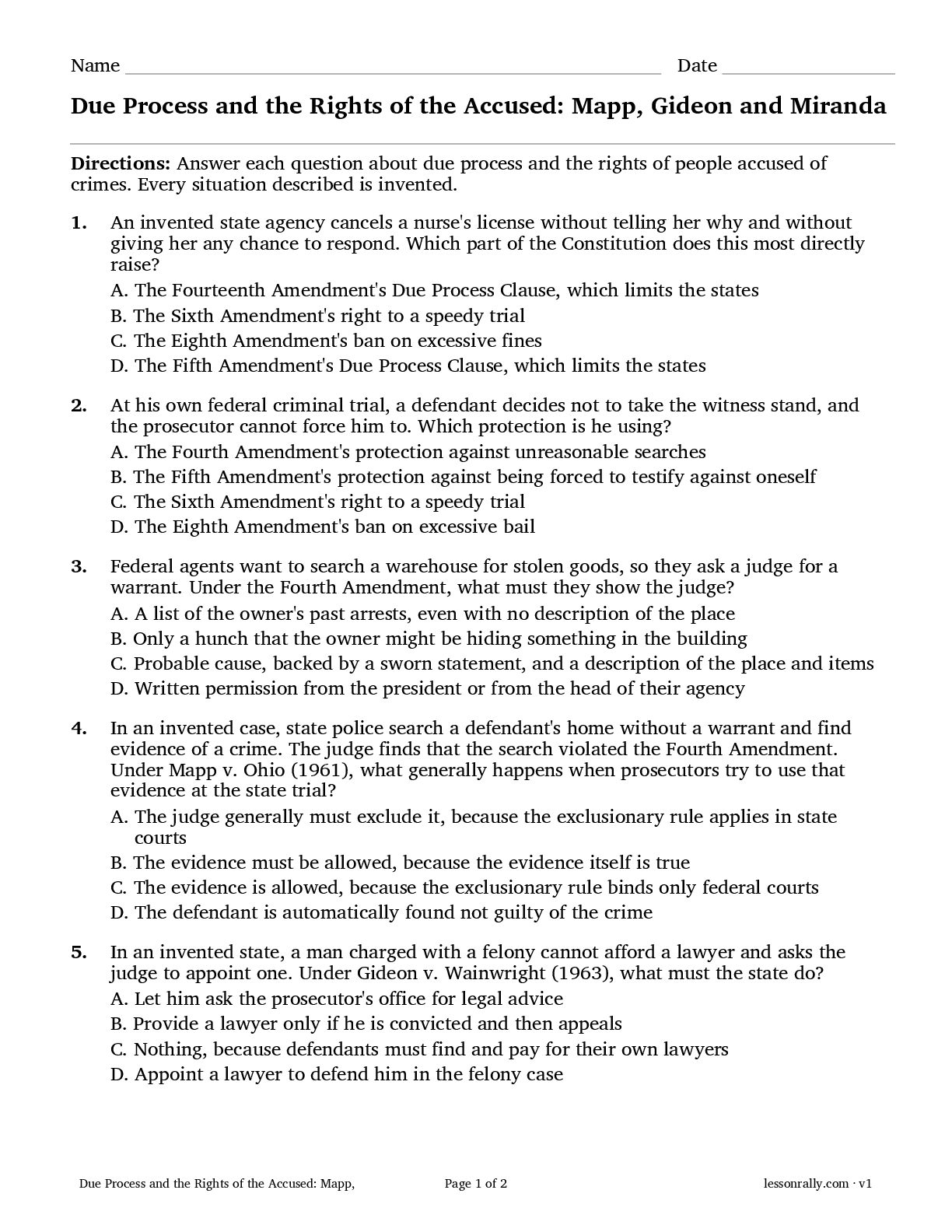
Answer each question about due process and the rights of people accused of crimes. Every situation described is invented.
Question 1
An invented state agency cancels a nurse's license without telling her why and without giving her any chance to respond. Which part of the Constitution does this most directly raise?
Choose one answer.
The Eighth Amendment's ban on excessive fines
The Fourteenth Amendment's Due Process Clause, which limits the states
The Fifth Amendment's Due Process Clause, which limits the states
The Sixth Amendment's right to a speedy trial
Question 2
At his own federal criminal trial, a defendant decides not to take the witness stand, and the prosecutor cannot force him to. Which protection is he using?
Choose one answer.
The Fourth Amendment's protection against unreasonable searches
The Fifth Amendment's protection against being forced to testify against oneself
The Sixth Amendment's right to a speedy trial
The Eighth Amendment's ban on excessive bail
Question 3
Federal agents want to search a warehouse for stolen goods, so they ask a judge for a warrant. Under the Fourth Amendment, what must they show the judge?
Choose one answer.
A list of the owner's past arrests, even with no description of the place
Probable cause, backed by a sworn statement, and a description of the place and items
Only a hunch that the owner might be hiding something in the building
Written permission from the president or from the head of their agency
Question 4
In an invented case, state police search a defendant's home without a warrant and find evidence of a crime. The judge finds that the search violated the Fourth Amendment. Under Mapp v. Ohio (1961), what generally happens when prosecutors try to use that evidence at the state trial?
Choose one answer.
The evidence is allowed, because the exclusionary rule binds only federal courts
The judge generally must exclude it, because the exclusionary rule applies in state courts
The evidence must be allowed, because the evidence itself is true
The defendant is automatically found not guilty of the crime
Question 5
In an invented state, a man charged with a felony cannot afford a lawyer and asks the judge to appoint one. Under Gideon v. Wainwright (1963), what must the state do?
Choose one answer.
Appoint a lawyer to defend him in the felony case
Nothing, because defendants must find and pay for their own lawyers
Let him ask the prosecutor's office for legal advice
Provide a lawyer only if he is convicted and then appeals
Question 6
A student writing a report on Miranda v. Arizona (1966) lists the warnings the case requires. Which item belongs on the list?
Choose one answer.
You must answer every question the officers ask, or you will face another charge.
You may refuse to answer questions, and prosecutors may use your statements as evidence against you at trial.
You have the right to choose the judge who will hear your case at trial.
You will be released right away if you answer every question truthfully.
Question 7
In which two of these invented situations do police generally need to give Miranda warnings before asking questions? Select 2.
Choose 2 answers.
A woman walks into a police station and, before anyone asks her anything, says she took a bike.
After arresting a suspect, officers take her to the station and ask her about the crime.
Officers arrest a man, handcuff him, place him in the back of a patrol car and ask him where he was when the robbery happened.
A detective phones a neighbor to ask whether she heard anything unusual last night.
An officer asks people on a sidewalk whether they saw which way a speeding car went.
Question 8
In an invented case, police question a suspect in custody without giving the Miranda warnings, and he confesses. What generally happens when prosecutors try to use the confession to prove his guilt?
Choose one answer.
The court generally must keep it out as proof of guilt.
The confession must be used, because he said it himself.
The whole case is dismissed automatically.
The confession is allowed, because Miranda applies only to federal agents.
Question 9
At an invented federal trial, the defendant's lawyer wants to question the main witness against him in the courtroom. Which right is the lawyer relying on?
Choose one answer.
The Fifth Amendment's protection against being tried twice for the same crime
The Sixth Amendment's right to face and question the witnesses who testify against him
The Seventh Amendment's right to have a jury decide the facts in a civil lawsuit
The Fourth Amendment's protection against unreasonable searches of homes and property
Question 10
A defendant in an invented federal trial needs a witness who refuses to come to court voluntarily. Which right lets him have the court order the witness to appear?
Choose one answer.
The Eighth Amendment's ban on fines far larger than the offense calls for
The First Amendment's right to petition the government to fix a problem
The Sixth Amendment's right to have the court bring in witnesses for the defense
The Fifth Amendment's protection against being tried twice for the same crime