Made by Nathan Kessler · LessonRally (AI-assisted)
Digital classroom activity
What is a digital classroom activity?
Teachers who sign in can assign LessonRally activities to their Google Classroom classes: students open them in Classroom and answer online, and their grades go to the teacher's Classroom gradebook. Practice lets you try it first, the way students see it.
Students match traditional, command, market and mixed economies to the way each one decides what to produce, identify the system in invented countries, predict how a market economy responds when demand for a product increases, recognize an economy shifting toward the market end, name the three questions every economic system must answer and describe how real economies are organized.
Learning goal: Identify traditional, command, market and mixed economic systems by who makes the main economic decisions, and apply these systems to invented countries.
Estimated reading level10.5
Grade 8Hard
Grade 9Stretch
Grade 10On level
Grade 11Easier
Grade 12Easy
About this estimate
The estimate is halfway between the two middle scores of four readability formulas. Their scores run from 8.9 to 12.1.
Flesch-Kincaid GradeSentence length and syllables per word8.9
Gunning Fog Middle scoreSentence length and words of three or more syllables11.8
Coleman-LiauLetters per word and sentences per 100 words12.1
Automated Readability Index Middle scoreCharacters per word and words per sentence9.1
Grade 181216
Flesch Reading Ease
53.7 on a 0 to 100 scale where higher is easier: fairly difficult. Not part of the estimate.
Text measured
634 words, 21 sentences
Adapted from common readability formulas (Flesch-Kincaid, Gunning Fog, Coleman-Liau and ARI, plus SMOG for long texts), which look at sentence length and word length. Answer choices count toward word length only. Grades below the estimate will likely find the text harder, grades above it easier. It does not measure ideas, background knowledge or images.
Question types: matching, multiple choice, select all that apply.
Student preview
The questions as students see them, without the answers.
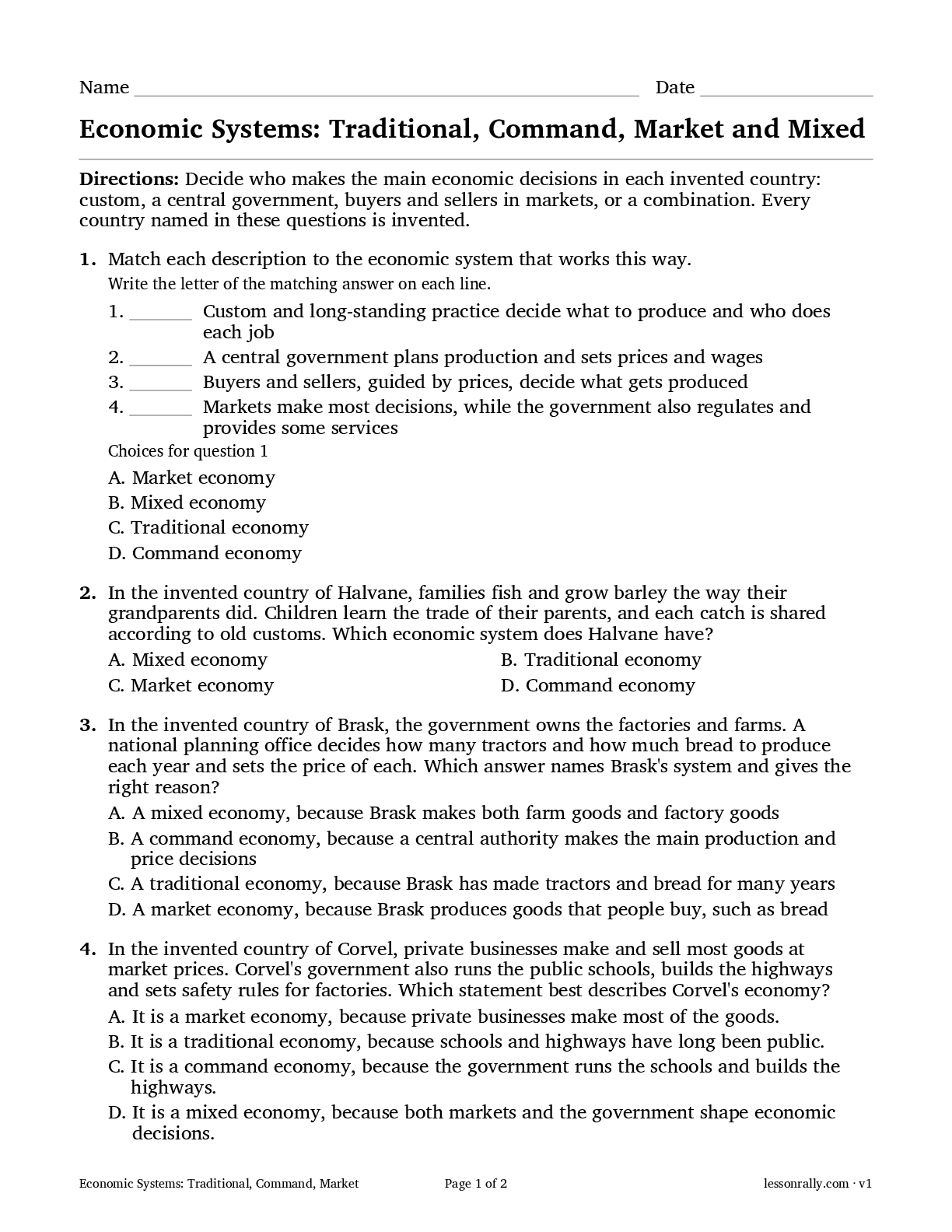
Decide who makes the main economic decisions in each invented country: custom, a central government, buyers and sellers in markets, or a combination. Every country named in these questions is invented.
Question 1
Match each description to the economic system that works this way.
Match each item to an option.
Items
Custom and long-standing practice decide what to produce and who does each job
A central government plans production and sets prices and wages
Buyers and sellers, guided by prices, decide what gets produced
Markets make most decisions, while the government also regulates and provides some services
Options
Mixed economy
Market economy
Traditional economy
Command economy
Question 2
In the invented country of Halvane, families fish and grow barley the way their grandparents did. Children learn the trade of their parents, and each catch is shared according to old customs. Which economic system does Halvane have?
Choose one answer.
Mixed economy
Traditional economy
Command economy
Market economy
Question 3
In the invented country of Brask, the government owns the factories and farms. A national planning office decides how many tractors and how much bread to produce each year and sets the price of each. Which answer names Brask's system and gives the right reason?
Choose one answer.
A market economy, because Brask produces goods that people buy, such as bread
A command economy, because a central authority makes the main production and price decisions
A traditional economy, because Brask has made tractors and bread for many years
A mixed economy, because Brask makes both farm goods and factory goods
Question 4
In the invented country of Corvel, private businesses make and sell most goods at market prices. Corvel's government also runs the public schools, builds the highways and sets safety rules for factories. Which statement best describes Corvel's economy?
Choose one answer.
It is a market economy, because private businesses make most of the goods.
It is a traditional economy, because schools and highways have long been public.
It is a command economy, because the government runs the schools and builds the highways.
It is a mixed economy, because both markets and the government shape economic decisions.
Question 5
In the invented country of Ostemar, private businesses decide what to make, and buyers and sellers set prices with no government role in pricing or production. A fad makes electric scooters popular, and the demand for scooters increases. What is the most likely result?
Choose one answer.
The price of scooters falls, because more people now want to buy them.
The price of scooters rises, and businesses respond by producing more of them.
Scooter makers keep the same output, because custom sets how many are made.
A government office orders factories to make more scooters at a fixed price.
Question 6
The invented country of Velis sells its government-owned factories to private owners, stops setting prices and closes its central planning office. How is the economy of Velis changing?
Choose one answer.
It is not changing, because selling factories does not affect who makes decisions.
It is becoming a traditional economy, as old customs replace the central plan.
It is moving toward the market end, as private owners and prices take over decisions.
It is moving toward the command end, as the government gains control of production.
Question 7
Because resources are scarce, every economic system must answer the same basic questions. Which THREE are they? Select 3.
Choose 3 answers.
Which language should the government use for its laws?
What goods and services should be produced?
Who will receive the goods and services that are produced?
Who should be allowed to vote in national elections?
How should those goods and services be produced?
Question 8
Which statement best describes how the economies of real countries are organized today?
Choose one answer.
Most are traditional economies in which custom decides what to produce.
Most combine market decisions with government action, so they are mixed economies.
Most are pure command economies in which the government makes every decision.
Most are pure market economies in which the government plays no economic role.