Made by Nathan Kessler · LessonRally (AI-assisted)
Digital classroom activity
What is a digital classroom activity?
Teachers who sign in can assign LessonRally activities to their Google Classroom classes: students open them in Classroom and answer online, and their grades go to the teacher's Classroom gradebook. Practice lets you try it first, the way students see it.
Students match Electoral College terms (elector, winner-take-all, majority and popular vote) to examples, then apply them: how many electors a state gets, Washington, D.C.'s three electors, the 270 electoral votes needed out of 538, state control over choosing electors, who may not serve as an elector, where electors vote, and how the House chooses a president when no candidate has a majority.
Learning goal: Identify how the Electoral College chooses the president, including how electors are assigned, how many electoral votes make a majority, and what happens when no candidate reaches one.
Estimated reading level9.5
Grade 7Hard
Grade 8Stretch
Grade 9On level
Grade 10Easier
Grade 11Easy
About this estimate
The estimate is halfway between the two middle scores of four readability formulas. Their scores run from 8.1 to 13.0.
Flesch-Kincaid GradeSentence length and syllables per word8.1
Gunning FogSentence length and words of three or more syllables13.0
Coleman-Liau Middle scoreLetters per word and sentences per 100 words10.8
Automated Readability Index Middle scoreCharacters per word and words per sentence8.1
Grade 181216
Flesch Reading Ease
59.2 on a 0 to 100 scale where higher is easier: fairly difficult. Not part of the estimate.
Text measured
427 words, 16 sentences
Adapted from common readability formulas (Flesch-Kincaid, Gunning Fog, Coleman-Liau and ARI, plus SMOG for long texts), which look at sentence length and word length. Answer choices count toward word length only. Grades below the estimate will likely find the text harder, grades above it easier. It does not measure ideas, background knowledge or images.
Question types: matching, number answer, multiple choice.
Student preview
The questions as students see them, without the answers.
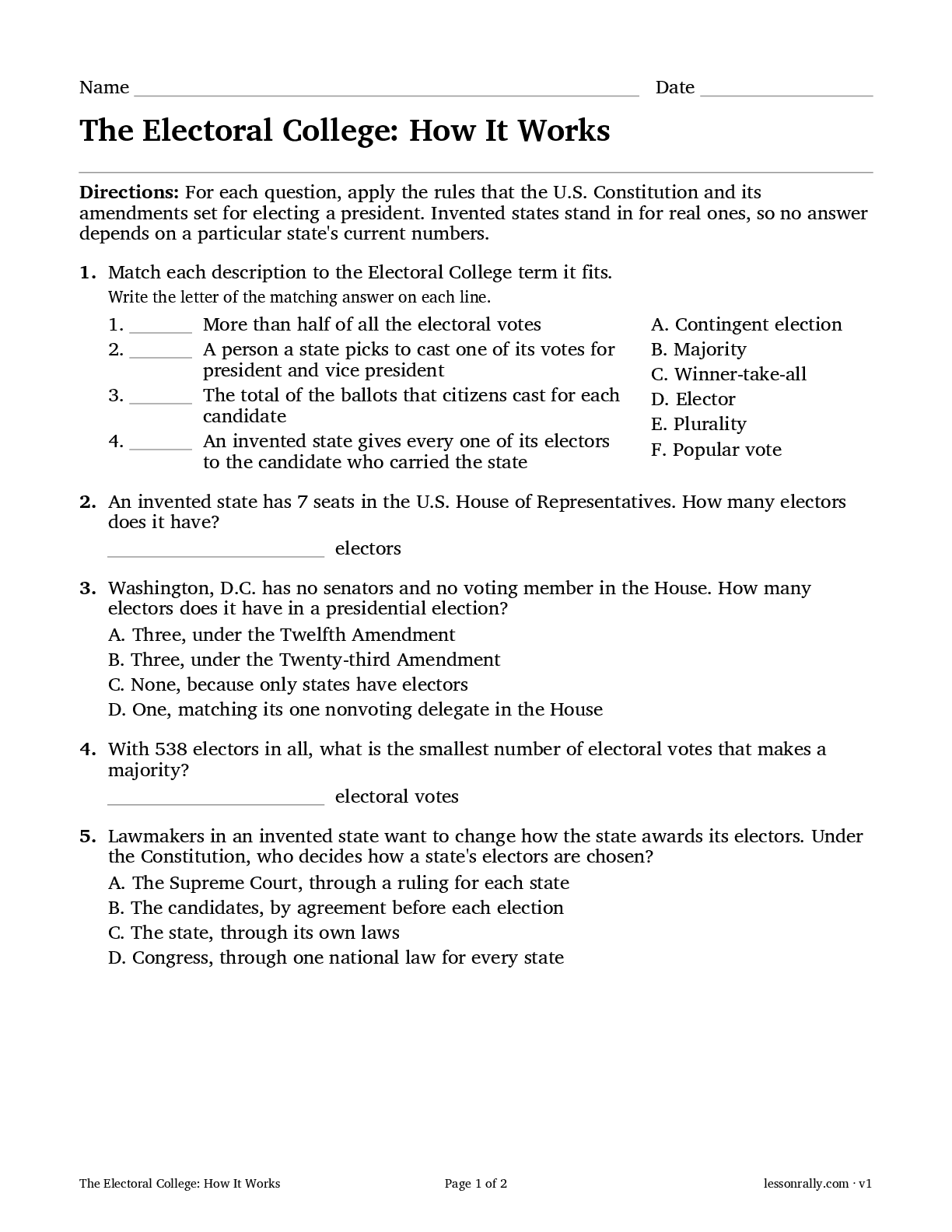
For each question, apply the rules that the U.S. Constitution and its amendments set for electing a president. Invented states stand in for real ones, so no answer depends on a particular state's current numbers.
Question 1
Match each description to the Electoral College term it fits.
Match each item to an option.
Items
More than half of all the electoral votes
A person a state picks to cast one of its votes for president and vice president
The total of the ballots that citizens cast for each candidate
An invented state gives every one of its electors to the candidate who carried the state
Options
Plurality
Elector
Winner-take-all
Majority
Contingent election
Popular vote
Question 2
An invented state has 7 seats in the U.S. House of Representatives. How many electors does it have?
Enter a number.
electors
Question 3
Washington, D.C. has no senators and no voting member in the House. How many electors does it have in a presidential election?
Choose one answer.
Three, under the Twenty-third Amendment
None, because only states have electors
Three, under the Twelfth Amendment
One, matching its one nonvoting delegate in the House
Question 4
With 538 electors in all, what is the smallest number of electoral votes that makes a majority?
Enter a number.
electoral votes
Question 5
Lawmakers in an invented state want to change how the state awards its electors. Under the Constitution, who decides how a state's electors are chosen?
Choose one answer.
The candidates, by agreement before each election
Congress, through one national law for every state
The state, through its own laws
The Supreme Court, through a ruling for each state
Question 6
In an invented election, no candidate wins a majority of the electoral votes. Under the Twelfth Amendment, how does the House of Representatives choose the president?
Choose one answer.
From the two candidates with the most popular votes, with each state's House delegation casting one vote
From the three candidates with the most electoral votes, with each state's House delegation casting one vote
From the three candidates with the most electoral votes, with each representative casting one vote
From all the candidates, with each representative casting one vote
Question 7
Supporters of a candidate in an invented state want to name one of the state's U.S. representatives as an elector. What does the Constitution say about this?
Choose one answer.
Any adult may serve, including members of Congress.
Members of Congress cannot serve as electors.
A member of Congress may serve if the governor approves.
Only members of Congress may serve as electors.
Question 8
After a presidential election, an invented state's electors get ready to cast their votes. Where do they meet to vote?