The First Amendment: Five Freedoms and Their Limits

10 questions · 14 points · Grades 8–9 · English · Preview the 10 questions

Made by Nathan Kessler · LessonRally (AI-assisted)

Digital classroom activity

What is a digital classroom activity?

Teachers who sign in can assign LessonRally activities to their Google Classroom classes: students open them in Classroom and answer online, and their grades go to the teacher's Classroom gradebook. Practice lets you try it first, the way students see it.

Free for teachers. Sign in to assign activities to your Google Classroom classes.

Printable worksheet

Students match situations to the five freedoms of the First Amendment (religion, speech, press, assembly and petition), then decide in invented situations whether a government action crosses the line. Questions cover whom the amendment limits, student speech at public schools, the freedom not to speak, prior restraint, and long-settled limits on speech: true threats, incitement and defamation.

Learning goal: Identify the five freedoms of the First Amendment and decide whether a government action in an invented situation violates them, using the amendment's long-settled limits.

Estimated reading level 7.9

  1. Grade 5Hard
  2. Grade 6Stretch
  3. Grade 7On level
  4. Grade 8Easier
  5. Grade 9Easy
About this estimate

The estimate is halfway between the two middle scores of four readability formulas. Their scores run from 6.5 to 9.2.

  • Flesch-Kincaid Grade Middle scoreSentence length and syllables per word6.8
  • Gunning Fog Middle scoreSentence length and words of three or more syllables9.0
  • Coleman-LiauLetters per word and sentences per 100 words9.2
  • Automated Readability IndexCharacters per word and words per sentence6.5
Flesch Reading Ease
66.8 on a 0 to 100 scale where higher is easier: standard. Not part of the estimate.
Text measured
910 words, 29 sentences

Adapted from common readability formulas (Flesch-Kincaid, Gunning Fog, Coleman-Liau and ARI, plus SMOG for long texts), which look at sentence length and word length. Answer choices count toward word length only. Grades below the estimate will likely find the text harder, grades above it easier. It does not measure ideas, background knowledge or images.

Topic: Government and Citizenship Chosen by LessonRally

Question types: matching, multiple choice, select all that apply.

Student preview

The questions as students see them, without the answers.

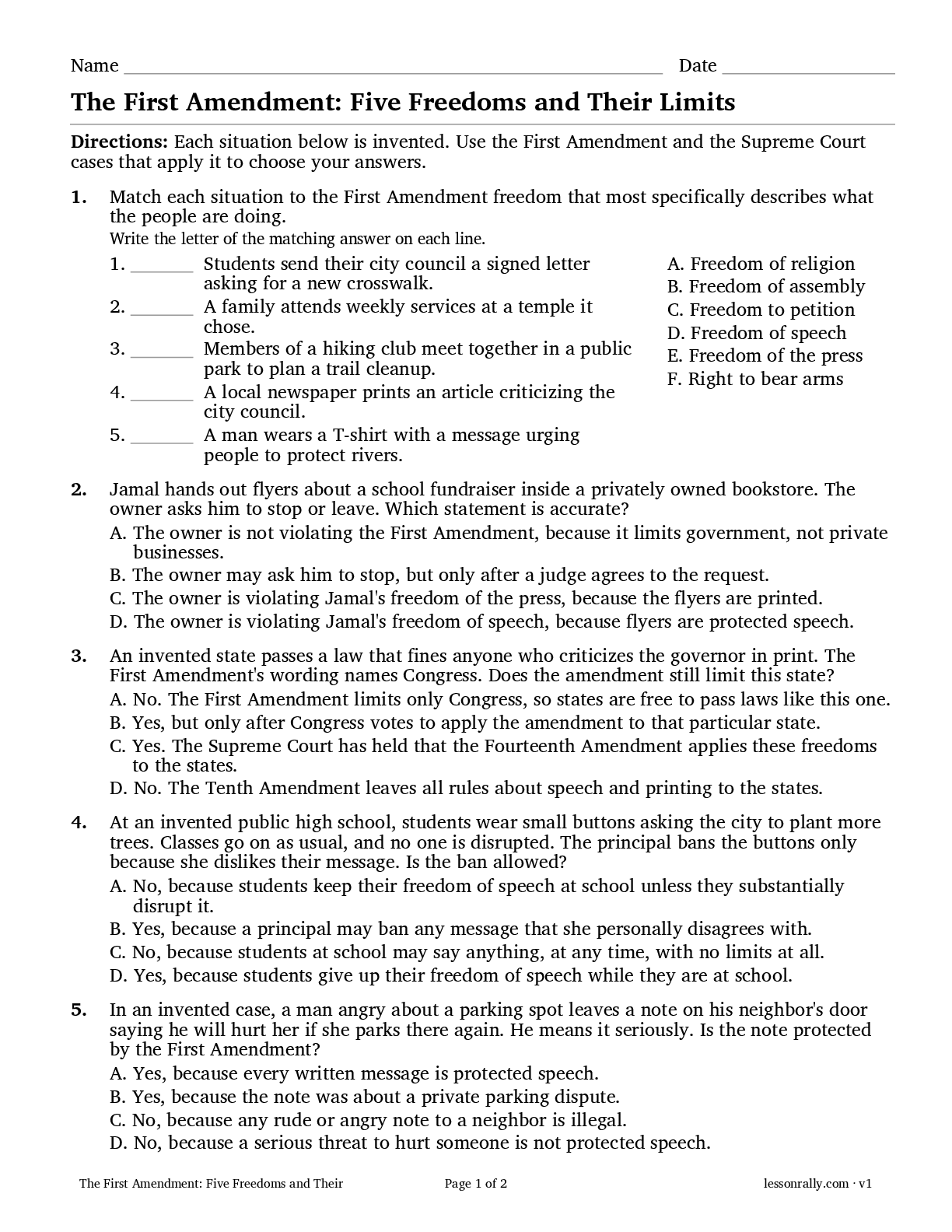
Each situation below is invented. Use the First Amendment and the Supreme Court cases that apply it to choose your answers.

Question 1

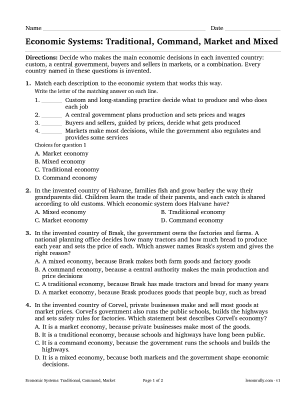
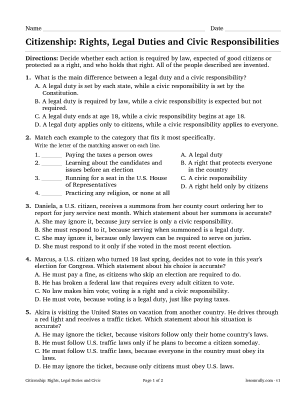
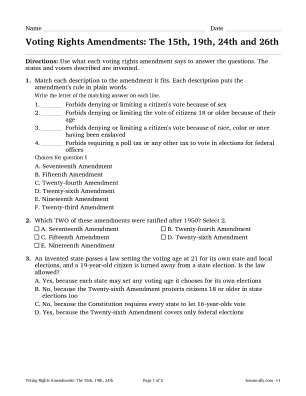
Match each situation to the First Amendment freedom that most specifically describes what the people are doing.

Match each item to an option.

Items

  1. Students send their city council a signed letter asking for a new crosswalk.
  2. A family attends weekly services at a temple it chose.
  3. Members of a hiking club meet together in a public park to plan a trail cleanup.
  4. A local newspaper prints an article criticizing the city council.
  5. A man wears a T-shirt with a message urging people to protect rivers.

Options
  1. Freedom to petition
  2. Freedom of the press
  3. Freedom of religion
  4. Freedom of assembly
  5. Freedom of speech
  6. Right to bear arms

Question 2

Jamal hands out flyers about a school fundraiser inside a privately owned bookstore. The owner asks him to stop or leave. Which statement is accurate?

Choose one answer.

  • The owner is violating Jamal's freedom of the press, because the flyers are printed.
  • The owner is violating Jamal's freedom of speech, because flyers are protected speech.
  • The owner may ask him to stop, but only after a judge agrees to the request.
  • The owner is not violating the First Amendment, because it limits government, not private businesses.

Question 3

An invented state passes a law that fines anyone who criticizes the governor in print. The First Amendment's wording names Congress. Does the amendment still limit this state?

Choose one answer.

  • Yes, but only after Congress votes to apply the amendment to that particular state.
  • No. The Tenth Amendment leaves all rules about speech and printing to the states.
  • Yes. The Supreme Court has held that the Fourteenth Amendment applies these freedoms to the states.
  • No. The First Amendment limits only Congress, so states are free to pass laws like this one.

Question 4

At an invented public high school, students wear small buttons asking the city to plant more trees. Classes go on as usual, and no one is disrupted. The principal bans the buttons only because she dislikes their message. Is the ban allowed?

Choose one answer.

  • Yes, because students give up their freedom of speech while they are at school.
  • No, because students keep their freedom of speech at school unless they substantially disrupt it.
  • Yes, because a principal may ban any message that she personally disagrees with.
  • No, because students at school may say anything, at any time, with no limits at all.

Question 5

In an invented case, a man angry about a parking spot leaves a note on his neighbor's door saying he will hurt her if she parks there again. He means it seriously. Is the note protected by the First Amendment?

Choose one answer.

  • Yes, because every written message is protected speech.
  • No, because a serious threat to hurt someone is not protected speech.
  • Yes, because the note was about a private parking dispute.
  • No, because any rude or angry note to a neighbor is illegal.

Question 6

At a rally in an invented city, a speaker points to a store across the street and urges the angry crowd to smash its windows right now. People start picking up rocks. Is this speech protected?

Choose one answer.

  • No, because any speech that makes listeners angry is unprotected.
  • Yes, because the speaker did not throw any rocks himself.
  • No, because it urges immediate lawbreaking that is likely to happen.
  • Yes, because speech at a rally is always protected.

Question 7

An invented newspaper prints a story claiming that a local baker put spoiled eggs in her cakes on purpose. The editors know the story is false, and the baker loses many customers. Does the First Amendment protect the newspaper from a lawsuit?

Choose one answer.

  • No. Knowingly printing a harmful falsehood about someone is defamation, which is not protected.
  • No. A newspaper can be sued over any story that upsets the person it describes.
  • Yes. A newspaper can be sued only over stories about public officials.
  • Yes. Freedom of the press protects anything a newspaper chooses to print.

Question 8

Which TWO of these actions would violate the First Amendment's religion clauses? Select 2.

Choose 2 answers.

  • A person decides not to follow any religion.
  • A family prays together before dinner at home.
  • An invented city bans members of one faith from holding worship services.
  • An invented state names one church its official church and pays that church's ministers with tax money.
  • A private company closes its stores on a religious holiday.

Question 9

Officials in an invented city learn that the local newspaper plans to publish a story about how the city spent its road-repair money. Before the story runs, they order the paper not to print it. Is the order allowed?

Choose one answer.

  • Yes, as long as the paper is allowed to print the story a year or more later.
  • No, but only because the story is about public money rather than about people.
  • Yes. Officials may stop any story about how their own city spends its money.
  • No. Blocking a story before it is published, called prior restraint, is almost never allowed.

Question 10

An invented public school adopts a rule that every student must stand and recite the Pledge of Allegiance each morning, with no option to remain quietly seated. Does the rule follow the First Amendment?

Choose one answer.

  • No, because the pledge may not be led in public schools under any circumstances.
  • Yes, as long as the school also teaches students about the history of the flag.
  • No. Freedom of speech includes the freedom not to speak, so students cannot be forced to recite it.
  • Yes. Public schools may require every student to say the pledge, since it honors the country.

Reviews

No reviews yet.

Reviews come from teachers who assigned this activity to a class.

Sign in to write a review

Have a topic of your own? Make a printable worksheet and online quiz, free.

Create an activity

Answer key

Answer keys come with Premium

Print this worksheet with the correct answers marked. The key includes any explanations, sample answers, and rubrics supplied with the activity.

Answer keys aren't public: only teachers with Premium and the people who can edit an activity can download one, so students can't get a ready-to-print key from this page.

Premium includes:

  • No ads for you, and no ads for your students on the assignments you post.
  • Answer keys for printable worksheets, with the correct answers marked and any explanations, sample answers, and rubrics.
  • Create with AI: up to 100 activities a year (5 during the free trial), with every answer checked before you see the draft.

$29 a year, plus sales tax where it applies.

New Premium teachers can try it free for 7 days. A card or other payment method is needed to start. Unless you cancel before the trial ends, you are charged then and the plan renews every year.

Already have Premium or edit this activity? Sign in