Made by Nathan Kessler · LessonRally (AI-assisted)
Digital classroom activity
What is a digital classroom activity?
Teachers who sign in can assign LessonRally activities to their Google Classroom classes: students open them in Classroom and answer online, and their grades go to the teacher's Classroom gradebook. Practice lets you try it first, the way students see it.
Students put the steps for amending the U.S. Constitution in order, then answer a question on each step: the two-thirds vote that proposes an amendment, the convention route for proposing amendments, the president's lack of a formal role, how many states must ratify, who chooses the method of ratification, and what ratification means for every state, including repeal by a later amendment.
Learning goal: Put the steps of the Article V amendment process in order and identify what each step requires, from proposal by Congress or a convention to ratification by three-fourths of the states.
Estimated reading level8.3
Grade 6Hard
Grade 7Stretch
Grade 8On level
Grade 9Easier
Grade 10Easy
About this estimate
The estimate is halfway between the two middle scores of four readability formulas. Their scores run from 6.8 to 10.3.
Flesch-Kincaid GradeSentence length and syllables per word6.8
Gunning FogSentence length and words of three or more syllables10.3
Coleman-Liau Middle scoreLetters per word and sentences per 100 words9.5
Automated Readability Index Middle scoreCharacters per word and words per sentence7.0
Grade 181216
Flesch Reading Ease
67.5 on a 0 to 100 scale where higher is easier: standard. Not part of the estimate.
Text measured
474 words, 16 sentences
Adapted from common readability formulas (Flesch-Kincaid, Gunning Fog, Coleman-Liau and ARI, plus SMOG for long texts), which look at sentence length and word length. Answer choices count toward word length only. Grades below the estimate will likely find the text harder, grades above it easier. It does not measure ideas, background knowledge or images.
Question types: matching, multiple choice, number answer.
Student preview
The questions as students see them, without the answers.
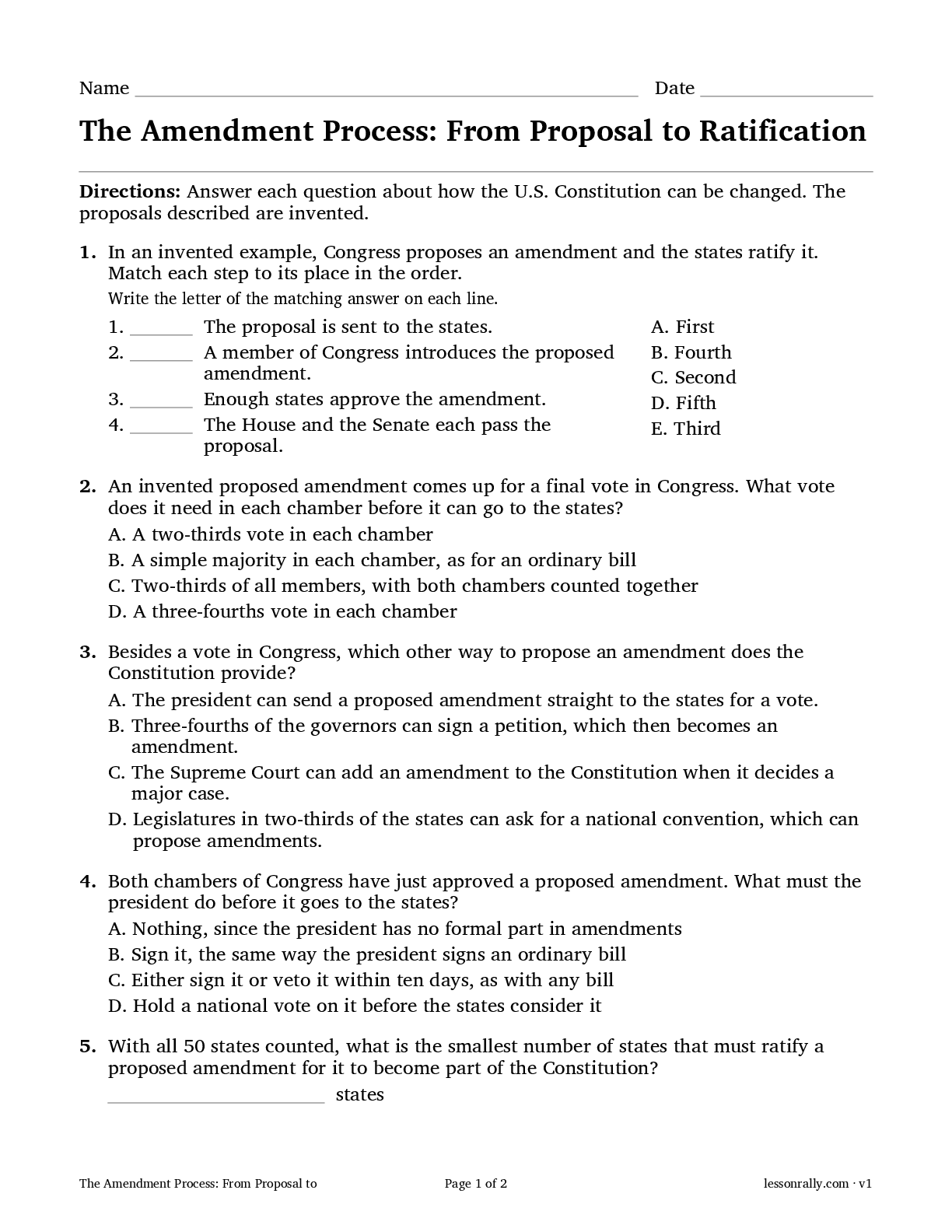
Answer each question about how the U.S. Constitution can be changed. The proposals described are invented.
Question 1
In an invented example, Congress proposes an amendment and the states ratify it. Match each step to its place in the order.
Match each item to an option.
Items
The proposal is sent to the states.
A member of Congress introduces the proposed amendment.
Enough states approve the amendment.
The House and the Senate each pass the proposal.
Options
Fifth
Third
Fourth
First
Second
Question 2
An invented proposed amendment comes up for a final vote in Congress. What vote does it need in each chamber before it can go to the states?
Choose one answer.
Two-thirds of all members, with both chambers counted together
A simple majority in each chamber, as for an ordinary bill
A two-thirds vote in each chamber
A three-fourths vote in each chamber
Question 3
Besides a vote in Congress, which other way to propose an amendment does the Constitution provide?
Choose one answer.
The Supreme Court can add an amendment to the Constitution when it decides a major case.
Three-fourths of the governors can sign a petition, which then becomes an amendment.
The president can send a proposed amendment straight to the states for a vote.
Legislatures in two-thirds of the states can ask for a national convention, which can propose amendments.
Question 4
Both chambers of Congress have just approved a proposed amendment. What must the president do before it goes to the states?
Choose one answer.
Nothing, since the president has no formal part in amendments
Either sign it or veto it within ten days, as with any bill
Sign it, the same way the president signs an ordinary bill
Hold a national vote on it before the states consider it
Question 5
With all 50 states counted, what is the smallest number of states that must ratify a proposed amendment for it to become part of the Constitution?
Enter a number.
states
Question 6
A proposed amendment is on its way to the states. Who decides whether the states will ratify it through their legislatures or through special ratifying conventions?
Choose one answer.
Congress
The president
The Supreme Court
Each state's governor
Question 7
In an invented example, 40 of the 50 states ratify a proposed amendment. What happens in the 10 states that voted against it?
Choose one answer.
It does not apply in those 10 states, since they voted against it.
Those 10 states must keep voting until each of them approves it.
It applies there too, as part of the Constitution for the whole country.
Those 10 states can cancel the amendment for themselves within one year.
Question 8
A student asks whether an amendment, once ratified, can ever be undone. Which answer is accurate?
Choose one answer.
Yes. The Twenty-first Amendment (1933) repealed the Eighteenth, which had banned alcoholic drinks.
Yes. The Supreme Court can repeal an amendment by ruling that it was a mistake.
No. Once ratified, an amendment stays in the Constitution forever without change.
Yes, but only if all 50 states vote together to repeal it.