Made by Claire Fenwood · LessonRally (AI-assisted)
Digital classroom activity
What is a digital classroom activity?
Teachers who sign in can assign LessonRally activities to their Google Classroom classes: students open them in Classroom and answer online, and their grades go to the teacher's Classroom gradebook. Practice lets you try it first, the way students see it.
Students read sentences that allude to Greek myths, Aesop's fables and other old stories, such as the Midas touch, an Achilles' heel and sour grapes. Each question briefly retells the story, and students explain what the allusion means in the sentence. Practice with allusions, mythology and figurative language, with no reading passage.
Learning goal: Interpret allusions to myths and old stories in context and explain what each suggests in a sentence.
Estimated reading level7.0
Grade 5Hard
Grade 6Stretch
Grade 7On level
Grade 8Easier
Grade 9Easy
About this estimate
The estimate is the middle score of five readability formulas. Their scores run from 5.7 to 8.5.
Flesch-Kincaid GradeSentence length and syllables per word5.7
Gunning FogSentence length and words of three or more syllables8.1
Coleman-Liau Middle scoreLetters per word and sentences per 100 words7.0
Automated Readability IndexCharacters per word and words per sentence5.8
SMOGWords of three or more syllables, for texts of 30 sentences or more8.5
Grade 181216
Flesch Reading Ease
80.2 on a 0 to 100 scale where higher is easier: easy. Not part of the estimate.
Text measured
954 words, 39 sentences
Adapted from common readability formulas (Flesch-Kincaid, Gunning Fog, Coleman-Liau and ARI, plus SMOG for long texts), which look at sentence length and word length. Answer choices count toward word length only. Grades below the estimate will likely find the text harder, grades above it easier. It does not measure ideas, background knowledge or images.
Common Core
Press Ctrl+C or Command+C to copy.
Closest anchor:CCRA.L.5Demonstrate understanding of figurative language, word relationships, and nuances in word meanings.Anchor Standards for LanguageShow 1 matched standardHide matched standard
The questions as students see them, without the answers.
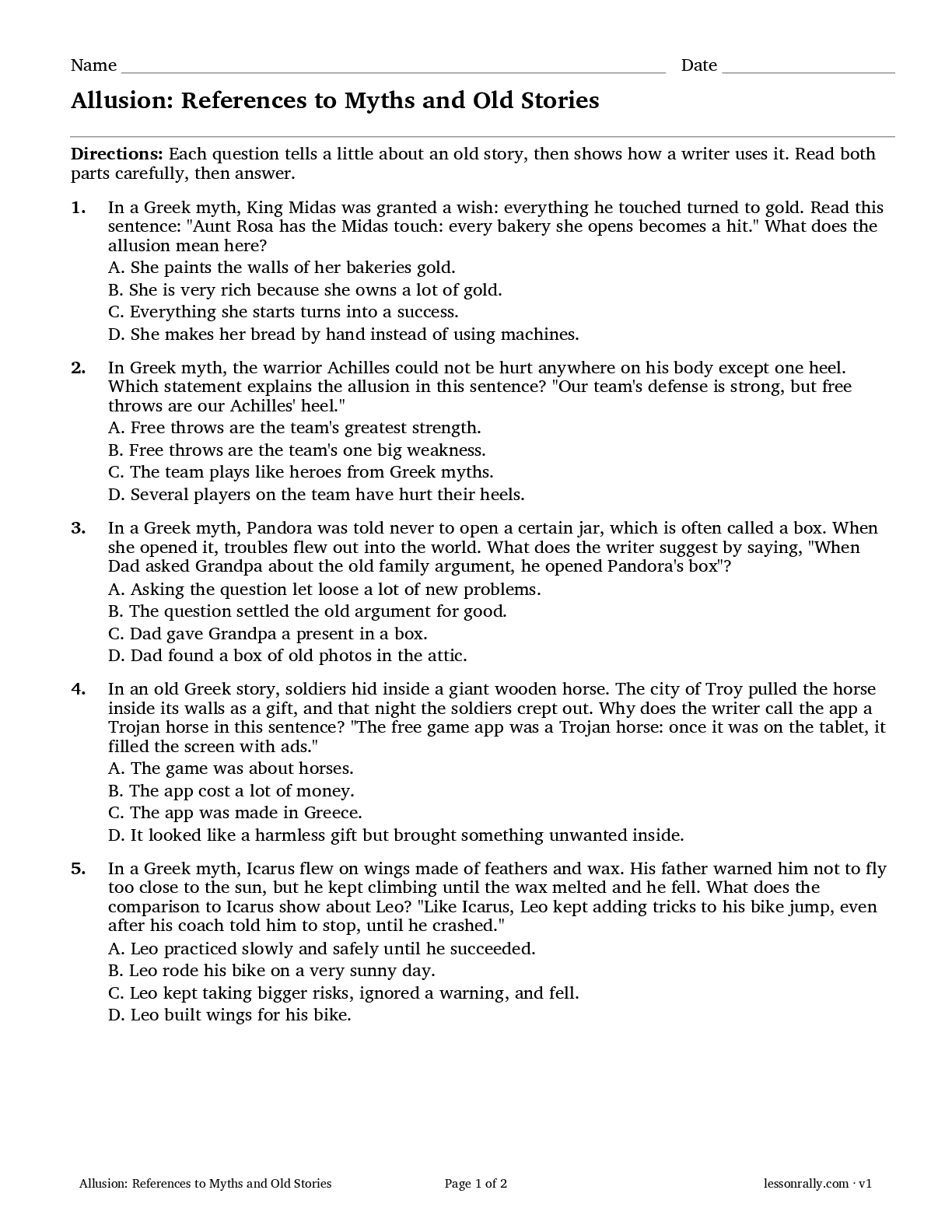
Each question tells a little about an old story, then shows how a writer uses it. Read both parts carefully, then answer.
Question 1
In a Greek myth, King Midas was granted a wish: everything he touched turned to gold. Read this sentence: "Aunt Rosa has the Midas touch: every bakery she opens becomes a hit." What does the allusion mean here?
Choose one answer.
She paints the walls of her bakeries gold.
Everything she starts turns into a success.
She makes her bread by hand instead of using machines.
She is very rich because she owns a lot of gold.
Question 2
In Greek myth, the warrior Achilles could not be hurt anywhere on his body except one heel. Which statement explains the allusion in this sentence? "Our team's defense is strong, but free throws are our Achilles' heel."
Choose one answer.
Several players on the team have hurt their heels.
Free throws are the team's one big weakness.
Free throws are the team's greatest strength.
The team plays like heroes from Greek myths.
Question 3
In a Greek myth, Pandora was told never to open a certain jar, which is often called a box. When she opened it, troubles flew out into the world. What does the writer suggest by saying, "When Dad asked Grandpa about the old family argument, he opened Pandora's box"?
Choose one answer.
Asking the question let loose a lot of new problems.
The question settled the old argument for good.
Dad gave Grandpa a present in a box.
Dad found a box of old photos in the attic.
Question 4
In an old Greek story, soldiers hid inside a giant wooden horse. The city of Troy pulled the horse inside its walls as a gift, and that night the soldiers crept out. Why does the writer call the app a Trojan horse in this sentence? "The free game app was a Trojan horse: once it was on the tablet, it filled the screen with ads."
Choose one answer.
The app cost a lot of money.
The game was about horses.
It looked like a harmless gift but brought something unwanted inside.
The app was made in Greece.
Question 5
In a Greek myth, Icarus flew on wings made of feathers and wax. His father warned him not to fly too close to the sun, but he kept climbing until the wax melted and he fell. What does the comparison to Icarus show about Leo? "Like Icarus, Leo kept adding tricks to his bike jump, even after his coach told him to stop, until he crashed."
Choose one answer.
Leo kept taking bigger risks, ignored a warning, and fell.
Leo practiced slowly and safely until he succeeded.
Leo built wings for his bike.
Leo rode his bike on a very sunny day.
Question 6
In one of Aesop's fables, a slow tortoise beats a fast hare in a race by moving steadily while the hare stops to nap. What does calling Jada a tortoise tell you in this sentence? "Jada was the tortoise of the science fair: she worked a little every night for a month while her friends rushed at the end, and her project took first place."
Choose one answer.
She won because she rushed at the end.
Her project was about turtles.
Her slow, steady work beat her friends' last-minute rush.
She is slow at everything she does.
Question 7
In one of Aesop's fables, a shepherd boy kept shouting that a wolf was coming, just as a joke. When a real wolf came, nobody believed him. What happened to Sam, according to the allusion? "Sam had faked being sick to skip practice three times, so when he really sprained his ankle, the coach didn't believe him. He had cried wolf once too often."
Choose one answer.
The coach is always unfair to him.
He cried because his ankle hurt so much.
His earlier fake excuses made the coach doubt him even when he told the truth.
He saw a wolf near the practice field.
Question 8
In one of Aesop's fables, a fox cannot reach some grapes, so he decides they were probably sour anyway. What did Eli's friends mean in this sentence? "When Eli didn't make the jazz band, he told everyone the band was boring anyway, but his friends could tell it was sour grapes."
Choose one answer.
Eli honestly never wanted to be in the band.
Eli was angry at his friends for making the band.
Eli was pretending not to want something he couldn't have.
Eli didn't like the snacks at band practice.
Question 9
In a Greek myth, Sisyphus was forced to push a huge boulder up a hill forever. Every time it neared the top, it rolled back down. Which situation could be called Sisyphean?
Choose one answer.
Opening a surprise gift at a birthday party
Winning a race after months of training
Taking a long nap on a sunny afternoon
Picking up trash on a beach while the waves keep washing more ashore
Question 10
Here are four old stories.
Rip Van Winkle fell asleep in the mountains for twenty years and woke up in a world that had changed.
Scrooge, in a story by Charles Dickens, was a stingy old man who hated spending money.
Cinderella went from being treated like a servant to being noticed by everyone at a royal ball.
In The Odyssey, Odysseus spent ten years on a long, troubled journey home.
Match each situation to the story it calls to mind.
Match each item to an option.
Items
After a month at a camp with no phones, Ana came home and had no idea what everyone was talking about.
Mr. Pike, who owns the corner store, never gives away a free sample and complains about every penny.
The backup goalie, who had sat on the bench all season, made the winning save in the championship.
Getting home through the blizzard took nine hours, two detours and a flat tire.