Louisiana Purchase and the Lewis and Clark Expedition: Words in Context

10 questions · 14 points · Grade 8 · English · Preview the 10 questions

Made by Monica Ellison · LessonRally (AI-assisted)

Digital classroom activity

What is a digital classroom activity?

Teachers who sign in can assign LessonRally activities to their Google Classroom classes: students open them in Classroom and answer online, and their grades go to the teacher's Classroom gradebook. Practice lets you try it first, the way students see it.

Free for teachers. Sign in to assign activities to your Google Classroom classes.

Printable worksheet

Students read a passage about the Louisiana Purchase of 1803 and the Lewis and Clark expedition, then use context clues to work out what each history word means, from territory and treaty to claim, port and expedition. Along with this history vocabulary, questions cover why New Orleans mattered, why France sold Louisiana, Jefferson's doubts about the Constitution, the help Native Americans such as Sacagawea gave, and what the purchase meant for Native nations.

Learning goal: Determine the meaning of history words and phrases as a passage uses them, and explain the causes and effects of the Louisiana Purchase and the Lewis and Clark expedition.

Estimated reading level 8.8

  1. Grade 6Hard
  2. Grade 7Stretch
  3. Grade 8On level
  4. Grade 9Easier
  5. Grade 10Easy
About this estimate

The estimate is the middle score of five readability formulas. Their scores run from 6.3 to 9.7.

  • Flesch-Kincaid GradeSentence length and syllables per word6.3
  • Gunning Fog Middle scoreSentence length and words of three or more syllables8.8
  • Coleman-LiauLetters per word and sentences per 100 words9.4
  • Automated Readability IndexCharacters per word and words per sentence6.9
  • SMOGWords of three or more syllables, for texts of 30 sentences or more9.7
Flesch Reading Ease
71.2 on a 0 to 100 scale where higher is easier: fairly easy. Not part of the estimate.
Text measured
941 words, 49 sentences

Adapted from common readability formulas (Flesch-Kincaid, Gunning Fog, Coleman-Liau and ARI, plus SMOG for long texts), which look at sentence length and word length. Answer choices count toward word length only. Grades below the estimate will likely find the text harder, grades above it easier. It does not measure ideas, background knowledge or images.

Common Core

Closest anchor: CCRA.R.4 Interpret words and phrases as they are used in a text, including determining technical, connotative, and figurative meanings, and analyze how specific word choices shape meaning or tone.Anchor Standards for ReadingShow 1 matched standardHide matched standard

Matched standard

  • RH.6-8.4

    Determine the meaning of words and phrases as they are used in a text, including vocabulary specific to domains related to history/social studies.

    Student preview questions 3, 4, 6, 7, 10

Matched independently by two AI models from this activity's questions.

© Copyright 2010. National Governors Association Center for Best Practices and Council of Chief State School Officers. All rights reserved.

Topic: Early Republic Chosen by LessonRally

Question types: multiple choice, matching, fill in the blank, select all that apply.

Student preview

The questions as students see them, without the answers.

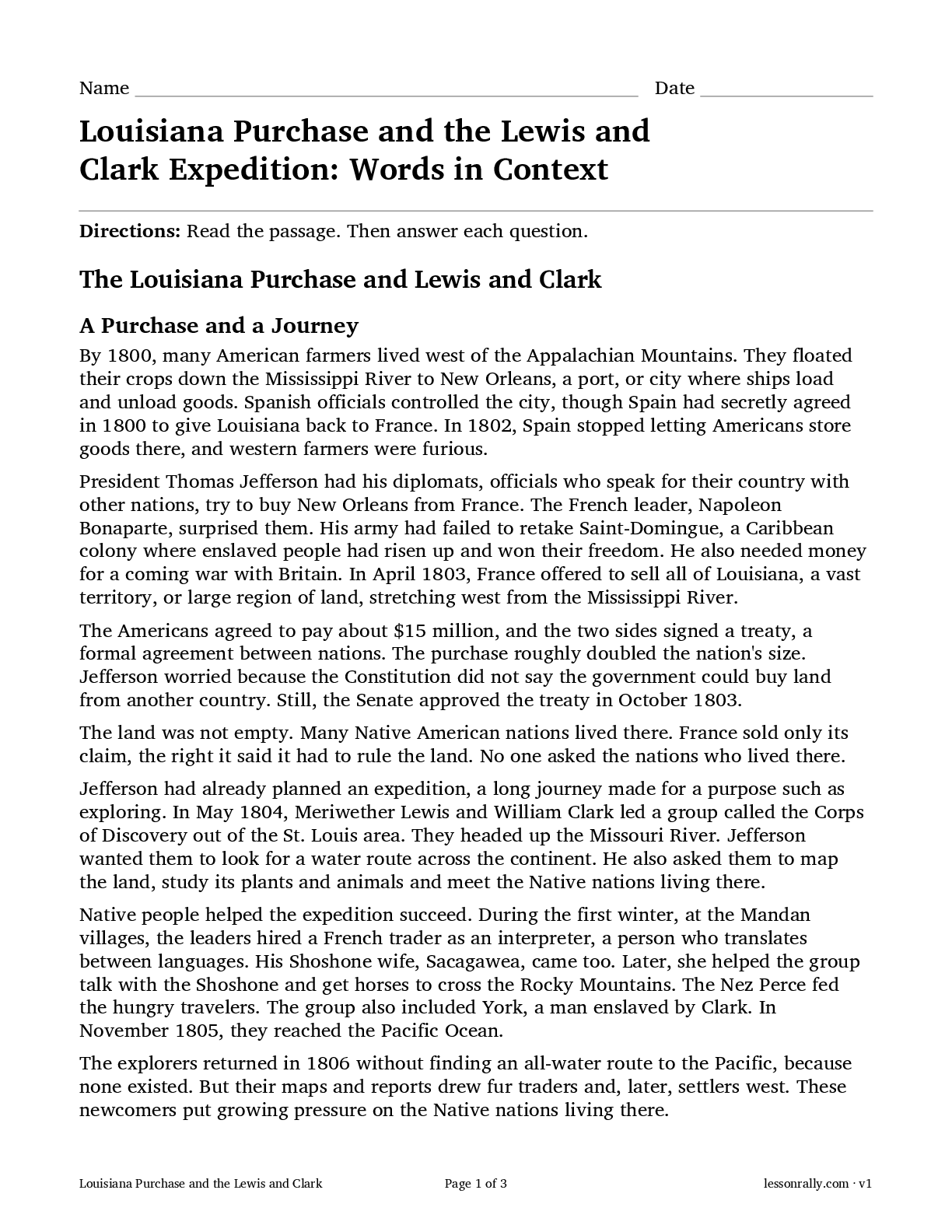
Read the passage. Then answer each question.

The Louisiana Purchase and Lewis and Clark

A Purchase and a Journey

By 1800, many American farmers lived west of the Appalachian Mountains. They floated their crops down the Mississippi River to New Orleans, a port, or city where ships load and unload goods. Spanish officials controlled the city, though Spain had secretly agreed in 1800 to give Louisiana back to France. In 1802, Spain stopped letting Americans store goods there, and western farmers were furious.

President Thomas Jefferson had his diplomats, officials who speak for their country with other nations, try to buy New Orleans from France. The French leader, Napoleon Bonaparte, surprised them. His army had failed to retake Saint-Domingue, a Caribbean colony where enslaved people had risen up and won their freedom. He also needed money for a coming war with Britain. In April 1803, France offered to sell all of Louisiana, a vast territory, or large region of land, stretching west from the Mississippi River.

The Americans agreed to pay about $15 million, and the two sides signed a treaty, a formal agreement between nations. The purchase roughly doubled the nation's size. Jefferson worried because the Constitution did not say the government could buy land from another country. Still, the Senate approved the treaty in October 1803.

The land was not empty. Many Native American nations lived there. France sold only its claim, the right it said it had to rule the land. No one asked the nations who lived there.

Jefferson had already planned an expedition, a long journey made for a purpose such as exploring. In May 1804, Meriwether Lewis and William Clark led a group called the Corps of Discovery out of the St. Louis area. They headed up the Missouri River. Jefferson wanted them to look for a water route across the continent. He also asked them to map the land, study its plants and animals and meet the Native nations living there.

Native people helped the expedition succeed. During the first winter, at the Mandan villages, the leaders hired a French trader as an interpreter, a person who translates between languages. His Shoshone wife, Sacagawea, came too. Later, she helped the group talk with the Shoshone and get horses to cross the Rocky Mountains. The Nez Perce fed the hungry travelers. The group also included York, a man enslaved by Clark. In November 1805, they reached the Pacific Ocean.

The explorers returned in 1806 without finding an all-water route to the Pacific, because none existed. But their maps and reports drew fur traders and, later, settlers west. These newcomers put growing pressure on the Native nations living there.


Question 1

According to the passage, why did western farmers care so much about New Orleans?

Choose one answer.

  • New Orleans was the capital of the United States.
  • Mills in New Orleans ground their grain into flour.
  • New Orleans was where they bought land from France.
  • They sent their crops down the Mississippi River to be shipped from New Orleans.

Question 2

According to the passage, what was one reason France offered to sell all of Louisiana?

Choose one answer.

  • The United States had defeated France in a war.
  • France's army had failed in Saint-Domingue, and Napoleon needed money for a war with Britain.
  • No one lived on the land, so it was worth little.
  • Spain had refused to let France keep the land.

Question 3

Match each word to its meaning as the passage uses it.

Match each item to an option.

Items

  1. territory
  2. treaty
  3. expedition
  4. interpreter

Options

  1. A long journey made for a purpose such as exploring
  2. A tax paid on goods brought into a country
  3. A large region of land
  4. A person who translates between languages
  5. A formal agreement between nations

Question 4

The passage says the purchase "roughly doubled the nation's size." What does this mean?

Choose one answer.

  • The country lost about half of its land.
  • The country split into two separate nations.
  • The country became about twice as large.
  • The country paid twice the price it had planned.

Question 5

Why did Jefferson worry about the purchase, according to the passage?

Choose one answer.

  • Spain had already sold Louisiana to Britain.
  • The Constitution did not say the government could buy land from another country.
  • France refused to sign a treaty.
  • The Senate had voted against the treaty.

Question 6

The passage says France sold only its claim to Louisiana. What does claim mean in this passage?

Choose one answer.

  • A list of the people who lived on the land
  • A yearly payment made for using the land
  • The right France said it had to rule the land
  • A fort built to guard the land

Question 7

Complete each sentence with a word from the word bank.

Fill in each blank.

A city where ships load and unload goods is a blank 1. Officials who speak for their country with other nations are blank 2.

Word bank

  • expedition
  • claim
  • diplomats
  • port
  • territory

Question 8

Which three goals does the passage say Jefferson gave the expedition?

Choose 3 answers.

  • Study the land's plants and animals
  • Buy more land from Spain
  • Meet the Native nations living there
  • Look for a water route across the continent
  • Find gold in the Rocky Mountains
  • Start farms along the Missouri River

Question 9

According to the passage, how did Sacagawea help the expedition?

Choose one answer.

  • She signed the treaty that sold Louisiana.
  • She stayed in St. Louis to guard supplies.
  • She led the Corps of Discovery from St. Louis.
  • She helped the group talk with the Shoshone and get horses to cross the Rocky Mountains.

Question 10

The passage says the fur traders and settlers who moved west "put growing pressure on the Native nations living there." What does this phrase mean?

Choose one answer.

  • The Native nations were paid for the land the United States bought.
  • The Native nations were asked to vote on the purchase.
  • The Native nations faced more and more strain as newcomers moved onto their lands.
  • The Native nations gained more land as the explorers left.

Reviews

No reviews yet.

Reviews come from teachers who assigned this activity to a class.

Sign in to write a review

Have a topic of your own? Make a printable worksheet and online quiz, free.

Create an activity

Answer key

Answer keys come with Premium

Print this worksheet with the correct answers marked. The key includes any explanations, sample answers, and rubrics supplied with the activity.

Answer keys aren't public: only teachers with Premium and the people who can edit an activity can download one, so students can't get a ready-to-print key from this page.

Premium includes:

  • No ads for you, and no ads for your students on the assignments you post.
  • Answer keys for printable worksheets, with the correct answers marked and any explanations, sample answers, and rubrics.
  • Create with AI: up to 100 activities a year (5 during the free trial), with every answer checked before you see the draft.

$29 a year, plus sales tax where it applies.

New Premium teachers can try it free for 7 days. A card or other payment method is needed to start. Unless you cancel before the trial ends, you are charged then and the plan renews every year.

Already have Premium or edit this activity? Sign in