Foreshadowing and Suspense: The Long Way Home

10 questions · 10 points · Grades 9–10 · English · Preview the 10 questions

Made by Eleanor Wrenfield · LessonRally (AI-assisted)

Digital classroom activity

What is a digital classroom activity?

Teachers who sign in can assign LessonRally activities to their Google Classroom classes: students open them in Classroom and answer online, and their grades go to the teacher's Classroom gradebook. Practice lets you try it first, the way students see it.

Free for teachers. Sign in to assign activities to your Google Classroom classes.

Printable worksheet

Students read an original short story about a brother and sister walking home around a thawing pond and analyze how the author builds suspense and tension. Questions cover foreshadowing, early details that hint at later events, a delay, a short sentence, a withheld fact and the order of events. Practice with foreshadowing, suspense, pacing, tension and story structure.

Learning goal: Analyze how an author's choices about the order of events, pacing and foreshadowing create suspense, tension and surprise in a story.

Estimated reading level 8.1

  1. Grade 6Hard
  2. Grade 7Stretch
  3. Grade 8On level
  4. Grade 9Easier
  5. Grade 10Easy
About this estimate

The estimate is the middle score of five readability formulas. Their scores run from 7.8 to 9.7.

  • Flesch-Kincaid Grade Middle scoreSentence length and syllables per word8.1
  • Gunning FogSentence length and words of three or more syllables9.7
  • Coleman-LiauLetters per word and sentences per 100 words7.8
  • Automated Readability IndexCharacters per word and words per sentence8.9
  • SMOGWords of three or more syllables, for texts of 30 sentences or more8.0
Flesch Reading Ease
73.4 on a 0 to 100 scale where higher is easier: fairly easy. Not part of the estimate.
Text measured
1,627 words, 47 sentences

Adapted from common readability formulas (Flesch-Kincaid, Gunning Fog, Coleman-Liau and ARI, plus SMOG for long texts), which look at sentence length and word length. Answer choices count toward word length only. Grades below the estimate will likely find the text harder, grades above it easier. It does not measure ideas, background knowledge or images.

Common Core

Closest anchor: CCRA.R.5 Analyze the structure of texts, including how specific sentences, paragraphs, and larger portions of the text (e.g., a section, chapter, scene, or stanza) relate to each other and the whole.Anchor Standards for ReadingShow 1 matched standardHide matched standard

Matched standard

  • RL.9-10.5

    Analyze how an author's choices concerning how to structure a text, order events within it (e.g., parallel plots), and manipulate time (e.g., pacing, flashbacks) create such effects as mystery, tension, or surprise.

    Student preview questions 1, 5, 6, 9

Matched independently by two AI models from this activity's questions.

© Copyright 2010. National Governors Association Center for Best Practices and Council of Chief State School Officers. All rights reserved.

Topic: Symbolism, Foreshadowing and Flashback Chosen by LessonRally

Question types: multiple choice, select all that apply.

Student preview

The questions as students see them, without the answers.

Read the story carefully, noticing the details that seem to hint at what will happen later. Then answer each question, checking every choice against the exact words of the story before you decide.

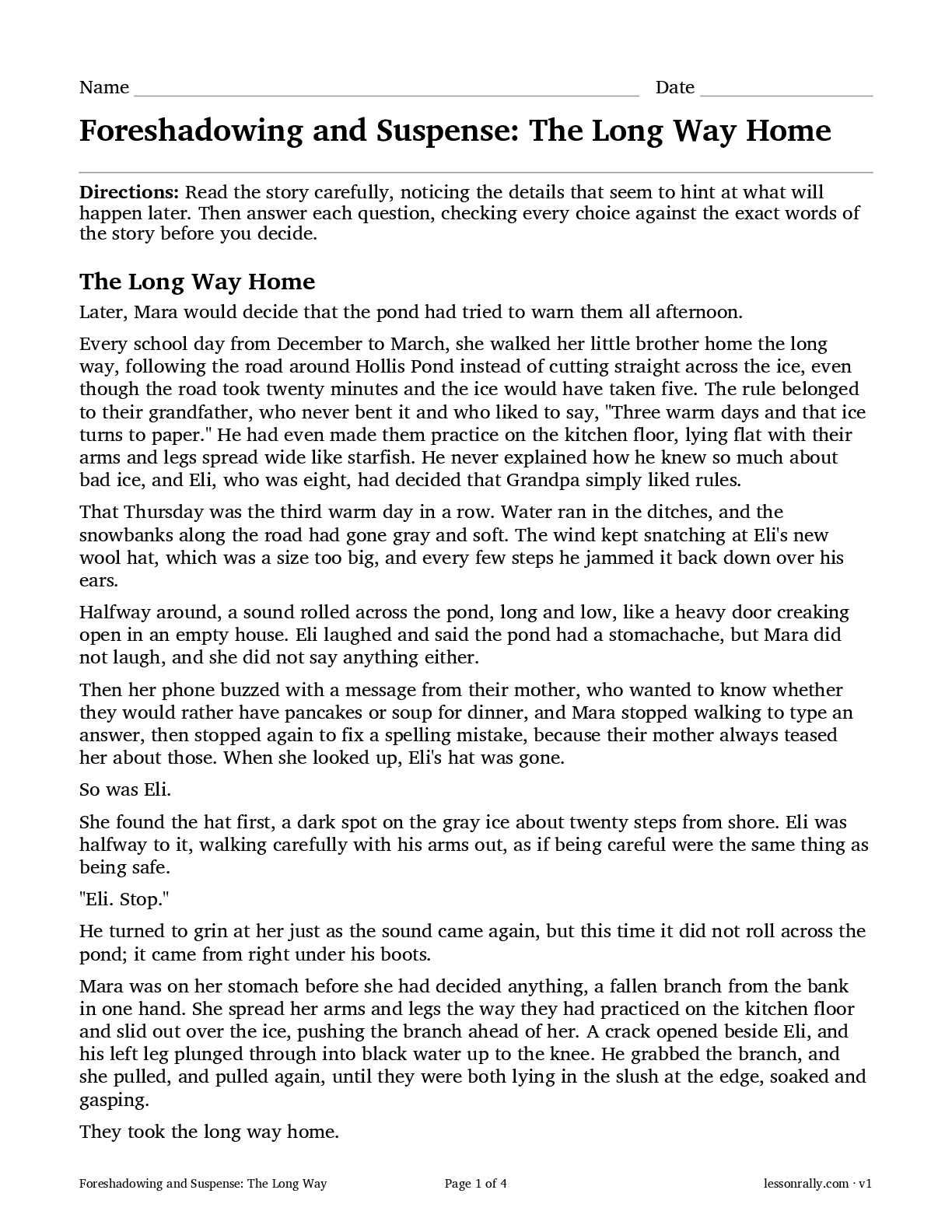
The Long Way Home

Later, Mara would decide that the pond had tried to warn them all afternoon.

Every school day from December to March, she walked her little brother home the long way, following the road around Hollis Pond instead of cutting straight across the ice, even though the road took twenty minutes and the ice would have taken five. The rule belonged to their grandfather, who never bent it and who liked to say, "Three warm days and that ice turns to paper." He had even made them practice on the kitchen floor, lying flat with their arms and legs spread wide like starfish. He never explained how he knew so much about bad ice, and Eli, who was eight, had decided that Grandpa simply liked rules.

That Thursday was the third warm day in a row. Water ran in the ditches, and the snowbanks along the road had gone gray and soft. The wind kept snatching at Eli's new wool hat, which was a size too big, and every few steps he jammed it back down over his ears.

Halfway around, a sound rolled across the pond, long and low, like a heavy door creaking open in an empty house. Eli laughed and said the pond had a stomachache, but Mara did not laugh, and she did not say anything either.

Then her phone buzzed with a message from their mother, who wanted to know whether they would rather have pancakes or soup for dinner, and Mara stopped walking to type an answer, then stopped again to fix a spelling mistake, because their mother always teased her about those. When she looked up, Eli's hat was gone.

So was Eli.

She found the hat first, a dark spot on the gray ice about twenty steps from shore. Eli was halfway to it, walking carefully with his arms out, as if being careful were the same thing as being safe.

"Eli. Stop."

He turned to grin at her just as the sound came again, but this time it did not roll across the pond; it came from right under his boots.

Mara was on her stomach before she had decided anything, a fallen branch from the bank in one hand. She spread her arms and legs the way they had practiced on the kitchen floor and slid out over the ice, pushing the branch ahead of her. A crack opened beside Eli, and his left leg plunged through into black water up to the knee. He grabbed the branch, and she pulled, and pulled again, until they were both lying in the slush at the edge, soaked and gasping.

They took the long way home.

Grandpa was waiting on the porch, and he looked at their wet clothes for a long moment before he spoke. Then, for the first time, he told them about the winter he was nine, and about the older sister who had pulled him out of Hollis Pond with a hockey stick.


Question 1

"The Long Way Home" begins with a paragraph made of a single sentence, "Later, Mara would decide that the pond had tried to warn them all afternoon." How does this opening sentence create suspense before anything in the story has actually happened?

Choose one answer.

  • It tells readers exactly what will happen to Eli, so the rest of the story holds no surprises.
  • It hints that something dangerous happens at the pond but withholds what it is, so readers watch the details that follow for possible warnings.
  • It suggests that Mara deliberately ignored her grandfather's rule and walked straight across the ice.
  • It shows that Mara is telling the story many years later, after she has grown up and moved away.

Question 2

Early in the story, Grandpa likes to say, "Three warm days and that ice turns to paper." Which two details show readers that the afternoon of the story is exactly the kind of day he warned about? Select two.

Choose 2 answers.

  • "The wind kept snatching at Eli's new wool hat, which was a size too big"
  • "Every school day from December to March, she walked her little brother home the long way"
  • "Then her phone buzzed with a message from their mother"
  • "Water ran in the ditches, and the snowbanks along the road had gone gray and soft."
  • "That Thursday was the third warm day in a row."

Question 3

When Mara looks up from her phone, she spots Eli's hat out on the pond, described as "a dark spot on the gray ice about twenty steps from shore." Which detail from earlier in the story best prepares readers for this discovery?

Choose one answer.

  • The wind keeps snatching at the hat, which is a size too big, and Eli has to keep jamming it back down.
  • Every school day from December to March, Mara walks her brother home along the road.
  • Grandpa makes the children practice lying flat on the kitchen floor.
  • The road around the pond takes twenty minutes, while the ice would take only five.

Question 4

Halfway around the pond, a sound rolls across it, "long and low, like a heavy door creaking open in an empty house"; Eli laughs and says that the pond has a stomachache, but "Mara did not laugh" and says nothing at all. How does the contrast between their reactions build tension?

Choose one answer.

  • Mara is annoyed with Eli for being silly, so readers expect the two of them to argue.
  • Eli treats the sound as a joke, while Mara's silence suggests that she is uneasy, so readers sense a danger that Eli does not.
  • Both children are frightened by the sound, so readers expect them to run home.
  • The sound turns out to be a real door in a nearby house, so readers can relax.

Question 5

Right after the strange sound, the story slows down for an ordinary moment in which Mara stops "to type an answer" about "pancakes or soup" and then stops again "to fix a spelling mistake" before she looks up. How does this delay affect the suspense?

Choose one answer.

  • It proves that Mara does not care what happens to her brother.
  • It explains how Grandpa came to know so much about bad ice.
  • It makes readers wait through small, everyday actions just after a warning sign, so the feeling that something is about to go wrong keeps growing.
  • It shows that the danger has passed, so the rest of the walk can be calm.

Question 6

What is the effect of setting the three-word sentence "So was Eli" apart as its own paragraph, right after Mara looks up and notices that her brother's hat is gone?

Choose one answer.

  • It slows the action down with a long description of the pond.
  • The bare sentence makes Eli's disappearance land as a sudden shock and, for a moment, withholds where he has gone.
  • It shows that Eli has run home ahead of his sister.
  • It suggests that Mara is relieved to have a moment to herself.

Question 7

When Mara spots her brother on the ice, the narrator describes him "walking carefully with his arms out, as if being careful were the same thing as being safe." How does this comment from the narrator add to the tension of the scene?

Choose one answer.

  • It shows that Eli is only pretending to be careful in order to tease his sister.
  • It suggests that Mara is proud of how carefully her brother is walking.
  • It suggests that Eli's careful steps cannot protect him, hinting that the ice may give way no matter how he walks.
  • It reassures readers that Eli is walking safely and will reach the hat without any trouble.

Question 8

When Eli turns to grin at her, the sound comes again, but "this time it did not roll across the pond; it came from right under his boots." How does this moment change the meaning of the sound that Eli joked about earlier?

Choose one answer.

  • It shows that Eli was right to laugh, because the sound is harmless.
  • It suggests that Mara is only imagining the sound because she is frightened.
  • It ties the sound to the ice beneath Eli, so the earlier warning becomes an immediate danger right where he stands.
  • It shows that the sound is moving away from Eli and toward the shore.

Question 9

Near the end of the story, Mara "was on her stomach before she had decided anything," spreading her arms and legs as she slides out toward Eli with the branch. Why does the author describe Grandpa's kitchen-floor practice so early in the story, long before anyone needs it?

Choose one answer.

  • So that readers will understand how Grandpa learned about bad ice.
  • So that the rescue scene can be skipped, since readers already know what happens.
  • So that Mara's quick, sure reaction on the ice feels prepared for rather than lucky.
  • So that readers will laugh at Grandpa's strange rules before the serious part of the story begins.

Question 10

Early in the story, the narrator says that Grandpa "never explained how he knew so much about bad ice" to the children, but in the final paragraph he tells them "about the older sister who had pulled him out of Hollis Pond with a hockey stick." What is the effect of holding back this fact until the very end?

Choose one answer.

  • It shows that Grandpa is angry with the children for coming home soaked.
  • It keeps the reason for his rule a mystery during the walk, and revealing it last shows that Mara has just done for Eli what Grandpa's older sister once did for him.
  • It proves that Eli was right all along that Grandpa simply liked rules.
  • It reveals that Grandpa made up the rule only to keep the children from being late for dinner.

Reviews

No reviews yet.

Reviews come from teachers who assigned this activity to a class.

Sign in to write a review

Have a topic of your own? Make a printable worksheet and online quiz, free.

Create an activity

Answer key

Answer keys come with Premium

Print this worksheet with the correct answers marked. The key includes any explanations, sample answers, and rubrics supplied with the activity.

Answer keys aren't public: only teachers with Premium and the people who can edit an activity can download one, so students can't get a ready-to-print key from this page.

Premium includes:

  • No ads for you, and no ads for your students on the assignments you post.
  • Answer keys for printable worksheets, with the correct answers marked and any explanations, sample answers, and rubrics.
  • Create with AI: up to 100 activities a year (5 during the free trial), with every answer checked before you see the draft.

$29 a year, plus sales tax where it applies.

New Premium teachers can try it free for 7 days. A card or other payment method is needed to start. Unless you cancel before the trial ends, you are charged then and the plan renews every year.

Already have Premium or edit this activity? Sign in