Question 1
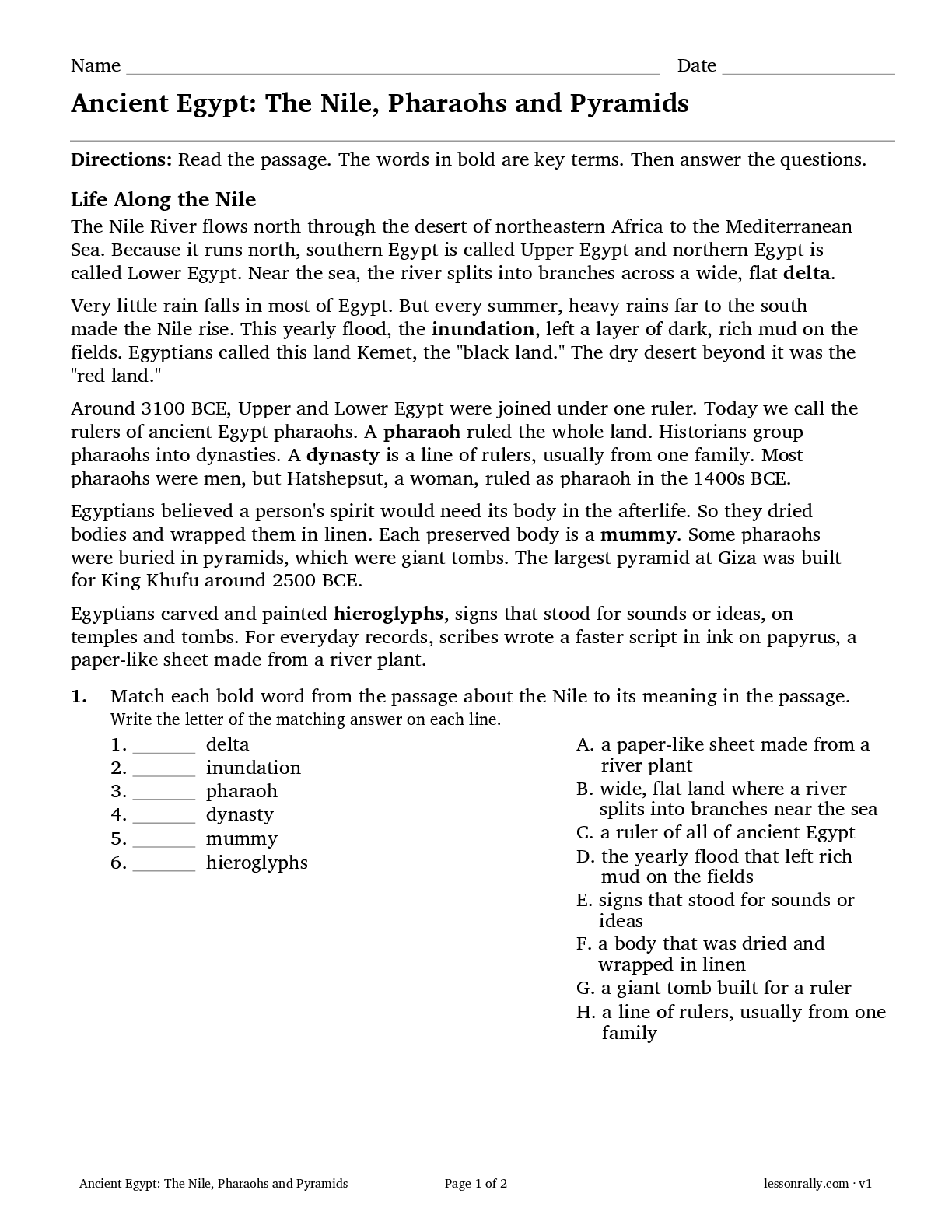
Match each bold word from the passage about the Nile to its meaning in the passage.
Match each item to an option.
Items
- delta
- inundation
- pharaoh
- dynasty
- mummy
- hieroglyphs
Options


Teachers who sign in can assign LessonRally activities to their Google Classroom classes: students open them in Classroom and answer online, and their grades go to the teacher's Classroom gradebook. Practice lets you try it first, the way students see it.
Free for teachers. Sign in to assign activities to your Google Classroom classes.
 (opens in a new tab)
2 pages · Student copy, no answers
Print worksheet (opens in a new tab)Answer keyPremiumStudents build ancient Egypt vocabulary by matching key terms from a short passage (delta, inundation, pharaoh, dynasty, mummy and hieroglyphs) to their meanings, then use the terms to answer questions about the Nile River, Upper and Lower Egypt, pyramids, mummies, scribes and the pharaohs Khufu and Hatshepsut.
Learning goal: Use key terms such as delta, inundation, pharaoh and dynasty to explain how the Nile shaped life in ancient Egypt and how Egyptians ruled, buried their dead and wrote.
The estimate is the middle score of five readability formulas. Their scores run from 4.7 to 8.1.
Adapted from common readability formulas (Flesch-Kincaid, Gunning Fog, Coleman-Liau and ARI, plus SMOG for long texts), which look at sentence length and word length. Answer choices count toward word length only. Grades below the estimate will likely find the text harder, grades above it easier. It does not measure ideas, background knowledge or images.
Topic: Ancient Civilizations Chosen by LessonRally
Question types: matching, multiple choice, fill in the blank.
The questions as students see them, without the answers.
Read the passage. The words in bold are key terms. Then answer the questions.
The Nile River flows north through the desert of northeastern Africa to the Mediterranean Sea. Because it runs north, southern Egypt is called Upper Egypt and northern Egypt is called Lower Egypt. Near the sea, the river splits into branches across a wide, flat delta.
Very little rain falls in most of Egypt. But every summer, heavy rains far to the south made the Nile rise. This yearly flood, the inundation, left a layer of dark, rich mud on the fields. Egyptians called this land Kemet, the "black land." The dry desert beyond it was the "red land."
Around 3100 BCE, Upper and Lower Egypt were joined under one ruler. Today we call the rulers of ancient Egypt pharaohs. A pharaoh ruled the whole land. Historians group pharaohs into dynasties. A dynasty is a line of rulers, usually from one family. Most pharaohs were men, but Hatshepsut, a woman, ruled as pharaoh in the 1400s BCE.
Egyptians believed a person's spirit would need its body in the afterlife. So they dried bodies and wrapped them in linen. Each preserved body is a mummy. Some pharaohs were buried in pyramids, which were giant tombs. The largest pyramid at Giza was built for King Khufu around 2500 BCE.
Egyptians carved and painted hieroglyphs, signs that stood for sounds or ideas, on temples and tombs. For everyday records, scribes wrote a faster script in ink on papyrus, a paper-like sheet made from a river plant.
Match each bold word from the passage about the Nile to its meaning in the passage.
Match each item to an option.
Items
Options
Why did Egyptians farm the black land instead of the red land?
Choose one answer.
A trader sails from the delta to Upper Egypt. In which direction is the trader traveling?
Choose one answer.
One year, the inundation was much smaller than usual. What problem would farmers most likely face?
Choose one answer.
Which of these events in ancient Egypt happened first?
Choose one answer.
What were Egypt's pyramids built to be?
Choose one answer.
What made Hatshepsut stand out among the pharaohs?
Choose one answer.
Egyptians believed a person's spirit would need its body in the afterlife. What did this belief lead them to do?
Choose one answer.
A scribe needs to write down a tax record quickly. Based on the passage, what would the scribe most likely do?
Choose one answer.
Complete the sentence about Khufu and Khafre with terms from the passage.
Fill in each blank.
Khufu and his son Khafre each ruled Egypt as blank 1, and both belonged to the Fourth blank 2.
Word bank
No reviews yet.
Reviews come from teachers who assigned this activity to a class.
Have a topic of your own? Make a printable worksheet and online quiz, free.
Create an activityMade by Owen Brackwell · LessonRally (AI-assisted)
Made by Owen Brackwell · LessonRally (AI-assisted)
Common Core RH.6-8.4
Made by Owen Brackwell · LessonRally (AI-assisted)
Made by Owen Brackwell · LessonRally (AI-assisted)