Made by Eleanor Wrenfield · LessonRally (AI-assisted)
Digital classroom activity
What is a digital classroom activity?
Teachers who sign in can assign LessonRally activities to their Google Classroom classes: students open them in Classroom and answer online, and their grades go to the teacher's Classroom gradebook. Practice lets you try it first, the way students see it.
Students interpret euphemisms and oxymorons in short sentences and exchanges. For each figure of speech, they decide what it means in context and analyze its role: what a euphemism softens or hides, and what an oxymoron captures. Practice with figurative language and figures of speech.
Learning goal: Interpret euphemisms and oxymorons in context and analyze the role each figure of speech plays in a sentence or exchange.
Estimated reading level8.5
Grade 6Hard
Grade 7Stretch
Grade 8On level
Grade 9Easier
Grade 10Easy
About this estimate
The estimate is halfway between the two middle scores of four readability formulas. Their scores run from 7.5 to 10.1.
Flesch-Kincaid GradeSentence length and syllables per word7.5
Gunning FogSentence length and words of three or more syllables10.1
Coleman-Liau Middle scoreLetters per word and sentences per 100 words9.0
Automated Readability Index Middle scoreCharacters per word and words per sentence8.0
Grade 181216
Flesch Reading Ease
70.1 on a 0 to 100 scale where higher is easier: fairly easy. Not part of the estimate.
Text measured
777 words, 23 sentences
Adapted from common readability formulas (Flesch-Kincaid, Gunning Fog, Coleman-Liau and ARI, plus SMOG for long texts), which look at sentence length and word length. Answer choices count toward word length only. Grades below the estimate will likely find the text harder, grades above it easier. It does not measure ideas, background knowledge or images.
Common Core
Press Ctrl+C or Command+C to copy.
Closest anchor:CCRA.L.5Demonstrate understanding of figurative language, word relationships, and nuances in word meanings.Anchor Standards for LanguageShow 1 matched standardHide matched standard
Question types: multiple choice, select all that apply.
Student preview
The questions as students see them, without the answers.
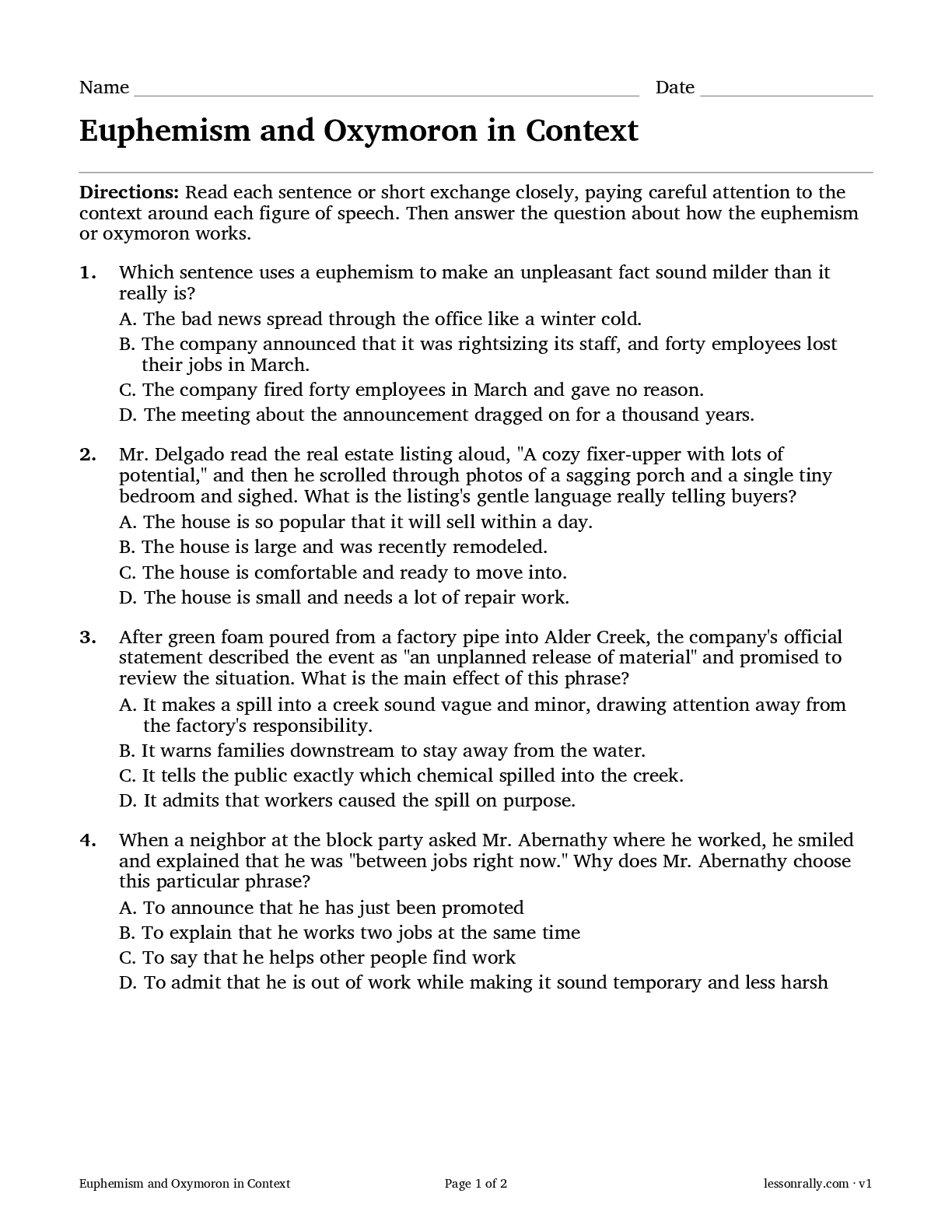
Read each sentence or short exchange closely, paying careful attention to the context around each figure of speech. Then answer the question about how the euphemism or oxymoron works.
Question 1
Which sentence uses a euphemism to make an unpleasant fact sound milder than it really is?
Choose one answer.
The meeting about the announcement dragged on for a thousand years.
The company announced that it was rightsizing its staff, and forty employees lost their jobs in March.
The bad news spread through the office like a winter cold.
The company fired forty employees in March and gave no reason.
Question 2
Mr. Delgado read the real estate listing aloud, "A cozy fixer-upper with lots of potential," and then he scrolled through photos of a sagging porch and a single tiny bedroom and sighed. What is the listing's gentle language really telling buyers?
Choose one answer.
The house is so popular that it will sell within a day.
The house is large and was recently remodeled.
The house is small and needs a lot of repair work.
The house is comfortable and ready to move into.
Question 3
After green foam poured from a factory pipe into Alder Creek, the company's official statement described the event as "an unplanned release of material" and promised to review the situation. What is the main effect of this phrase?
Choose one answer.
It admits that workers caused the spill on purpose.
It tells the public exactly which chemical spilled into the creek.
It warns families downstream to stay away from the water.
It makes a spill into a creek sound vague and minor, drawing attention away from the factory's responsibility.
Question 4
When a neighbor at the block party asked Mr. Abernathy where he worked, he smiled and explained that he was "between jobs right now." Why does Mr. Abernathy choose this particular phrase?
Choose one answer.
To announce that he has just been promoted
To admit that he is out of work while making it sound temporary and less harsh
To explain that he works two jobs at the same time
To say that he helps other people find work
Question 5
A euphemism can make something unpleasant sound gentler than it really is. In which two sentences is a euphemism used in that way? Select two.
Choose 2 answers.
Our defense was a brick wall in the second half.
After their shouting match, the two coaches described it to reporters as "a frank exchange of views."
The referee's call was flat-out wrong, and the whole crowd knew it.
The old furnace groaned and rattled all winter.
The teacher told the class gently that their hamster had "passed away" over the weekend.
Question 6
Read these sentences from a sports story: "After the loss, the locker room was a pressure cooker, and the coach's words landed like a slap. Then a deafening silence settled over the team." Which phrase is an oxymoron?
Choose one answer.
settled over the team
a deafening silence
landed like a slap
a pressure cooker
Question 7
Everyone at the bakery knew that Mrs. Kim planned to retire in June; it was an open secret, even though she had never said a word about it to anyone. What does the oxymoron "open secret" mean in this sentence?
Choose one answer.
News that Mrs. Kim announced to the whole bakery
Something meant to be private that everyone already knows
A plan that everyone has forgotten
A plan that only Mrs. Kim knows about
Question 8
Ms. Ferreira called the science fair setup "organized chaos": the tables were crammed with poster boards and tangled extension cords, yet by eight o'clock every single project sat in its numbered spot. What does her oxymoron suggest about the setup?
Choose one answer.
It looks wild and messy, but it is working according to a plan.
It is completely out of control.
It has been canceled because of the mess.
It is calm, neat and quiet.
Question 9
Graduation felt bittersweet to Kofi, who was proud to walk across the stage but sensed that every hug from his friends was really a goodbye. Why is "bittersweet" a fitting word for Kofi's day?
Choose one answer.
It shows that Kofi felt only sad about graduating.
It joins two opposite tastes to capture pride and sadness felt at the same time.
It shows that the graduation cake tasted strange.
It shows that Kofi was angry at his friends for leaving.
Question 10
On the crowded bus ride home, Mara and her best friend sat alone together, each wearing headphones and each watching the dark fields slide past the window. What does the oxymoron "alone together" suggest about the two friends?
Choose one answer.
They are the only two people on the bus.
They have chosen seats at opposite ends of the bus.
They are angry with each other and refuse to talk.
They are sitting together, but each is lost in private thoughts.