Teachers who sign in can assign LessonRally activities to their Google Classroom classes: students open them in Classroom and answer online, and their grades go to the teacher's Classroom gradebook. Practice lets you try it first, the way students see it.
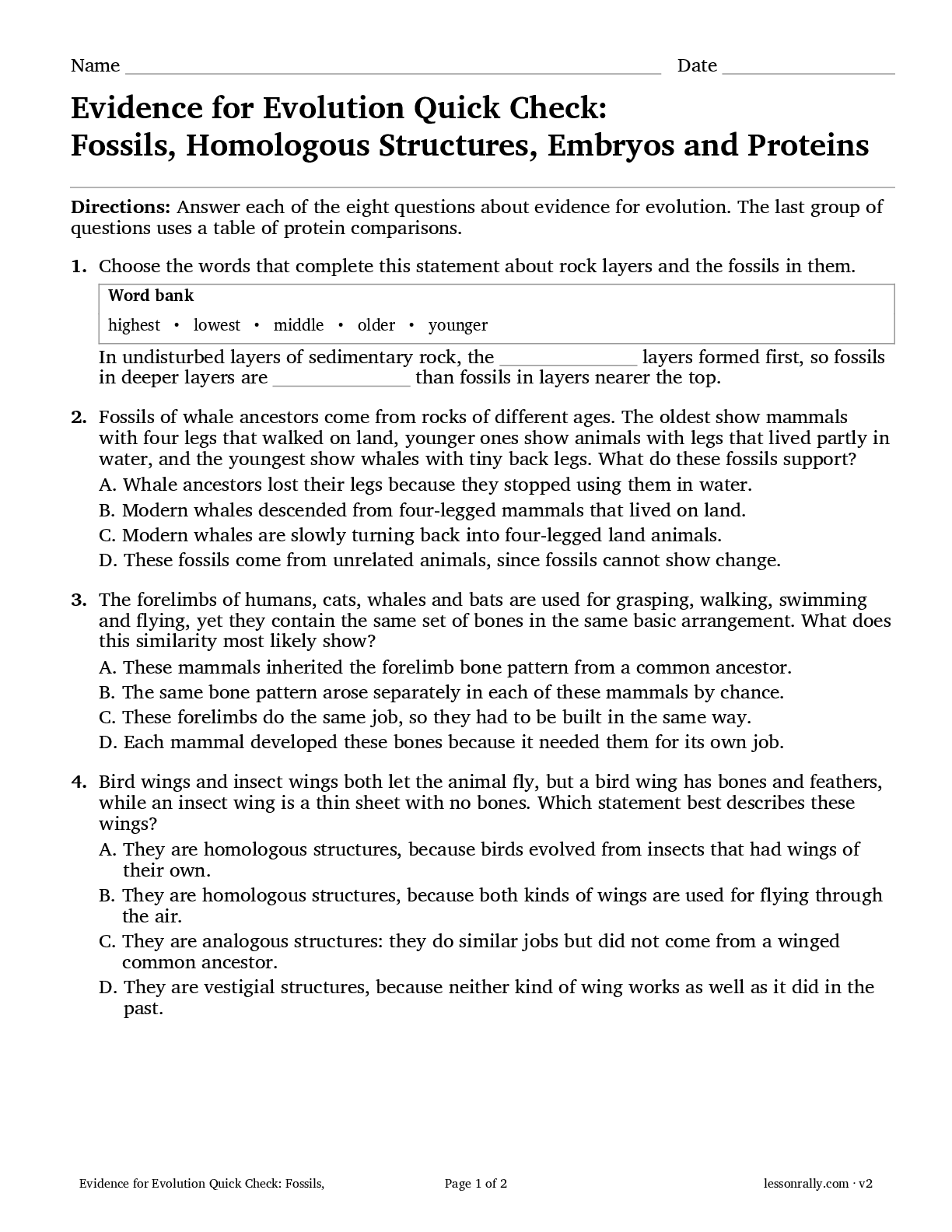
Students answer eight questions on evidence for evolution: rock layers and the age of fossils, fossils of whale ancestors, homologous forelimbs, analogous wings, vestigial hip bones in whales, similar early embryos, and a table of amino acid differences in one protein compared with humans.
Learning goal: Explain how fossils, homologous, analogous and vestigial structures, embryos and protein comparisons provide evidence for evolution from common ancestors.
Estimated reading level9.8
Grade 7Hard
Grade 8Stretch
Grade 9On level
Grade 10Easier
Grade 11Easy
About this estimate
The estimate is halfway between the two middle scores of four readability formulas. Their scores run from 8.0 to 10.6.
Flesch-Kincaid GradeSentence length and syllables per word8.0
Gunning Fog Middle scoreSentence length and words of three or more syllables10.2
Coleman-LiauLetters per word and sentences per 100 words10.6
Automated Readability Index Middle scoreCharacters per word and words per sentence9.4
Grade 181216
Flesch Reading Ease
66.8 on a 0 to 100 scale where higher is easier: standard. Not part of the estimate.
Text measured
662 words, 19 sentences
Adapted from common readability formulas (Flesch-Kincaid, Gunning Fog, Coleman-Liau and ARI, plus SMOG for long texts), which look at sentence length and word length. Answer choices count toward word length only. Grades below the estimate will likely find the text harder, grades above it easier. It does not measure ideas, background knowledge or images.
Common Core
Press Ctrl+C or Command+C to copy.
Closest anchor:CCRA.R.7Integrate and evaluate content presented in diverse media and formats, including visually and quantitatively, as well as in words.Anchor Standards for ReadingShow 1 matched standardHide matched standard
Translate quantitative or technical information expressed in words in a text into visual form (e.g., a table or chart) and translate information expressed visually or mathematically (e.g., in an equation) into words.
Question types: fill in the blank, multiple choice.
Student preview
The questions as students see them, without the answers.
Answer each of the eight questions about evidence for evolution. The last group of questions uses a table of protein comparisons.
Question 1
Choose the words that complete this statement about rock layers and the fossils in them.
Fill in each blank.
In undisturbed layers of sedimentary rock, the blank 1 layers formed first, so fossils in deeper layers are blank 2 than fossils in layers nearer the top.
Word bank
middle
older
younger
highest
lowest
Question 2
Fossils of whale ancestors come from rocks of different ages. The oldest show mammals with four legs that walked on land, younger ones show animals with legs that lived partly in water, and the youngest show whales with tiny back legs. What do these fossils support?
Choose one answer.
These fossils come from unrelated animals, since fossils cannot show change.
Whale ancestors lost their legs because they stopped using them in water.
Modern whales are slowly turning back into four-legged land animals.
Modern whales descended from four-legged mammals that lived on land.
Question 3
The forelimbs of humans, cats, whales and bats are used for grasping, walking, swimming and flying, yet they contain the same set of bones in the same basic arrangement. What does this similarity most likely show?
Choose one answer.
Each mammal developed these bones because it needed them for its own job.
The same bone pattern arose separately in each of these mammals by chance.
These forelimbs do the same job, so they had to be built in the same way.
These mammals inherited the forelimb bone pattern from a common ancestor.
Question 4
Bird wings and insect wings both let the animal fly, but a bird wing has bones and feathers, while an insect wing is a thin sheet with no bones. Which statement best describes these wings?
Choose one answer.
They are analogous structures: they do similar jobs but did not come from a winged common ancestor.
They are homologous structures, because both kinds of wings are used for flying through the air.
They are homologous structures, because birds evolved from insects that had wings of their own.
They are vestigial structures, because neither kind of wing works as well as it did in the past.
Question 5
Whales have small hip bones inside the body that are not attached to any legs, and these bones still anchor some muscles. Why do biologists still call these hip bones vestigial?
Choose one answer.
Vestigial means reduced from the form in an ancestor, even if the structure still has some use.
Vestigial means the structure appeared only recently, after the whales' ancestors moved into water.
Vestigial means the structure has no use of any kind, so these bones are called that by mistake.
Vestigial means the structure is growing larger over time and will someday form new back legs.
Question 6
Early embryos of fish, chickens and humans all have a tail and a series of folds in the neck region called pharyngeal arches. What does this shared pattern most likely show?
Choose one answer.
These animals share a common ancestor, and parts of its pattern of development are still used.
Human embryos pass through a fish stage and then a chicken stage before they grow into babies.
These embryos need tails so that they can swim around inside the egg or inside the mother.
These early embryos look alike only by chance, since the adult animals are so very different.
Comparing One Protein
In a study, the amino acid sequence of one protein was compared between humans and six other animals. The protein has the same length in all seven, and each number counts the positions where that animal's protein has a different amino acid from the human protein.
Amino acid differences between the human form of one protein and the same protein in six other animals
Animal
Amino acid differences from the human protein
Frog
57
Chimpanzee
1
Mouse
19
Shark
76
Rhesus monkey
6
Chicken
38
Question 7
Based on the table, which animal most likely shares the most recent common ancestor with humans?
Choose one answer.
Chimpanzee
Mouse
Shark
Rhesus monkey
Question 8
Which conclusion about common ancestors fits the data in the table?
Choose one answer.
Mice share a more recent common ancestor with humans than chickens do.
Chickens share a more recent common ancestor with humans than mice do.
Humans evolved from chimpanzees, since their proteins are nearly the same.
Frogs share no common ancestor with humans, since their proteins differ a lot.