Made by Nathan Kessler · LessonRally (AI-assisted)
Digital classroom activity
What is a digital classroom activity?
Teachers who sign in can assign LessonRally activities to their Google Classroom classes: students open them in Classroom and answer online, and their grades go to the teacher's Classroom gradebook. Practice lets you try it first, the way students see it.
Students put the levels of the federal courts in order, from district court to court of appeals to the Supreme Court, then answer a question on each: what trial courts and appeals courts do, how the Supreme Court chooses most of its cases, the few kinds of cases it hears first, where judicial review comes from (Marbury v. Madison), who sets the number of justices, and how long federal judges serve.
Learning goal: Put the levels of the federal court system in order and identify what each level does, where the power of judicial review comes from, and how the Constitution and Congress shape the courts.
Estimated reading level7.7
Grade 5Hard
Grade 6Stretch
Grade 7On level
Grade 8Easier
Grade 9Easy
About this estimate
The estimate is halfway between the two middle scores of four readability formulas. Their scores run from 6.0 to 9.1.
Flesch-Kincaid GradeSentence length and syllables per word6.0
Gunning FogSentence length and words of three or more syllables9.1
Coleman-Liau Middle scoreLetters per word and sentences per 100 words9.0
Automated Readability Index Middle scoreCharacters per word and words per sentence6.3
Grade 181216
Flesch Reading Ease
72.0 on a 0 to 100 scale where higher is easier: fairly easy. Not part of the estimate.
Text measured
525 words, 17 sentences
Adapted from common readability formulas (Flesch-Kincaid, Gunning Fog, Coleman-Liau and ARI, plus SMOG for long texts), which look at sentence length and word length. Answer choices count toward word length only. Grades below the estimate will likely find the text harder, grades above it easier. It does not measure ideas, background knowledge or images.
The questions as students see them, without the answers.
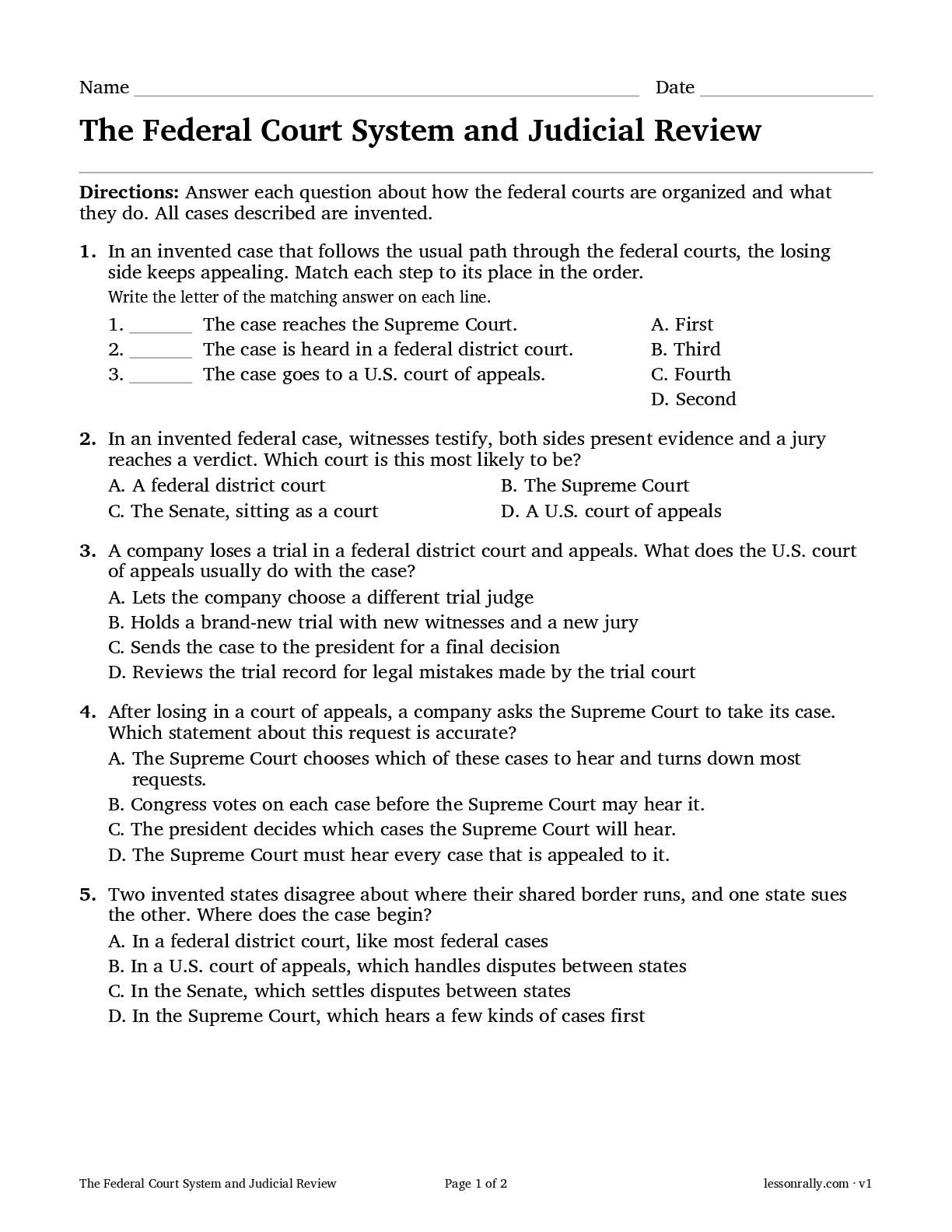
Answer each question about how the federal courts are organized and what they do. All cases described are invented.
Question 1
In an invented case that follows the usual path through the federal courts, the losing side keeps appealing. Match each step to its place in the order.
Match each item to an option.
Items
The case reaches the Supreme Court.
The case is heard in a federal district court.
The case goes to a U.S. court of appeals.
Options
Second
First
Fourth
Third
Question 2
In an invented federal case, witnesses testify, both sides present evidence and a jury reaches a verdict. Which court is this most likely to be?
Choose one answer.
The Supreme Court
A U.S. court of appeals
A federal district court
The Senate, sitting as a court
Question 3
A company loses a trial in a federal district court and appeals. What does the U.S. court of appeals usually do with the case?
Choose one answer.
Reviews the trial record for legal mistakes made by the trial court
Sends the case to the president for a final decision
Holds a brand-new trial with new witnesses and a new jury
Lets the company choose a different trial judge
Question 4
After losing in a court of appeals, a company asks the Supreme Court to take its case. Which statement about this request is accurate?
Choose one answer.
The Supreme Court must hear every case that is appealed to it.
Congress votes on each case before the Supreme Court may hear it.
The Supreme Court chooses which of these cases to hear and turns down most requests.
The president decides which cases the Supreme Court will hear.
Question 5
Two invented states disagree about where their shared border runs, and one state sues the other. Where does the case begin?
Choose one answer.
In a U.S. court of appeals, which handles disputes between states
In the Supreme Court, which hears a few kinds of cases first
In a federal district court, like most federal cases
In the Senate, which settles disputes between states
Question 6
A student says, "Article III includes a sentence giving courts the power of judicial review." Which correction is accurate?
Choose one answer.
The Constitution never names judicial review; the Supreme Court established it in Marbury v. Madison (1803).
Judicial review comes from a law that Congress passed in 1803 to give courts more power.
The student is right, because Article III names the power of judicial review word for word.
Judicial review comes from the Bill of Rights, which lists the powers of the courts.
Question 7
During a class discussion, someone asks where the number of Supreme Court justices comes from. Which answer is accurate?
Choose one answer.
Article III fixes the number of justices at nine for all time.
Congress sets the number by law, since the Constitution does not name one.
The chief justice adds seats whenever the Court becomes too busy.
Each new president decides how many justices the Court will have.
Question 8
Under Article III, how long do federal judges, including Supreme Court justices, keep their posts?
Choose one answer.
Until the next president takes office and names replacements
For six years, the same length as a senator's term in office
For as long as they behave well, unless removed through impeachment and conviction
For one ten-year term, after which the Senate must approve them again