Ecological Succession in Order: How Communities Rebuild After Lava Flows and Fires

10 questions · 16 points · Grades 9–10 · English · Preview the 10 questions

Made by Leah Rosen · LessonRally (AI-assisted)

Digital classroom activity

What is a digital classroom activity?

Teachers who sign in can assign LessonRally activities to their Google Classroom classes: students open them in Classroom and answer online, and their grades go to the teacher's Classroom gradebook. Practice lets you try it first, the way students see it.

Free for teachers. Sign in to assign activities to your Google Classroom classes.

Printable worksheet

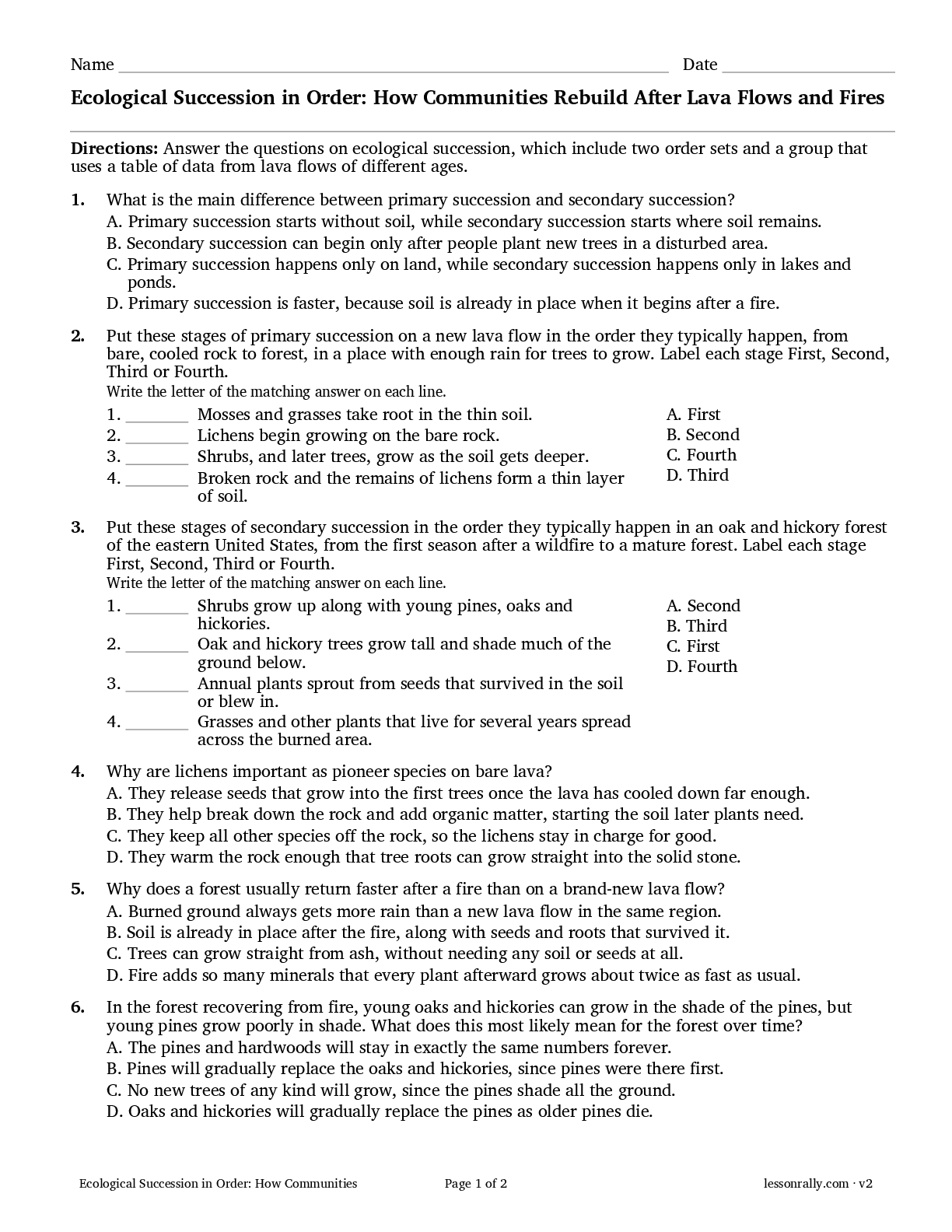
Students review ecological succession: how primary and secondary succession differ, the stages of primary succession on a new lava flow and of secondary succession after a forest fire in order, what pioneer species do, why secondary succession is faster, why shade-tolerant trees take over, how climate shapes where succession leads, and a table of data from lava flows of different ages.

Learning goal: Put the stages of primary and secondary succession in order and explain how pioneer species, soil, disturbance and climate shape the communities that develop.

Estimated reading level 7.8

  1. Grade 5Hard
  2. Grade 6Stretch
  3. Grade 7On level
  4. Grade 8Easier
  5. Grade 9Easy
About this estimate

The estimate is halfway between the two middle scores of four readability formulas. Their scores run from 6.9 to 9.4.

  • Flesch-Kincaid GradeSentence length and syllables per word6.9
  • Gunning FogSentence length and words of three or more syllables9.4
  • Coleman-Liau Middle scoreLetters per word and sentences per 100 words8.1
  • Automated Readability Index Middle scoreCharacters per word and words per sentence7.5
Flesch Reading Ease
74.3 on a 0 to 100 scale where higher is easier: fairly easy. Not part of the estimate.
Text measured
893 words, 19 sentences

Adapted from common readability formulas (Flesch-Kincaid, Gunning Fog, Coleman-Liau and ARI, plus SMOG for long texts), which look at sentence length and word length. Answer choices count toward word length only. Grades below the estimate will likely find the text harder, grades above it easier. It does not measure ideas, background knowledge or images.

Common Core

Closest anchor: CCRA.R.7 Integrate and evaluate content presented in diverse media and formats, including visually and quantitatively, as well as in words.Anchor Standards for ReadingShow 1 matched standardHide matched standard

Matched standard

  • RST.9-10.7

    Translate quantitative or technical information expressed in words in a text into visual form (e.g., a table or chart) and translate information expressed visually or mathematically (e.g., in an equation) into words.

    Student preview questions 8, 10

Matched independently by two AI models from this activity's questions.

© Copyright 2010. National Governors Association Center for Best Practices and Council of Chief State School Officers. All rights reserved.

Question types: multiple choice, matching.

Student preview

The questions as students see them, without the answers.

Answer the questions on ecological succession, which include two order sets and a group that uses a table of data from lava flows of different ages.

Question 1

What is the main difference between primary succession and secondary succession?

Choose one answer.

  • Primary succession happens only on land, while secondary succession happens only in lakes and ponds.
  • Secondary succession can begin only after people plant new trees in a disturbed area.
  • Primary succession starts without soil, while secondary succession starts where soil remains.
  • Primary succession is faster, because soil is already in place when it begins after a fire.
Question 2

Put these stages of primary succession on a new lava flow in the order they typically happen, from bare, cooled rock to forest, in a place with enough rain for trees to grow. Label each stage First, Second, Third or Fourth.

Match each item to an option.

Items

  1. Mosses and grasses take root in the thin soil.
  2. Lichens begin growing on the bare rock.
  3. Shrubs, and later trees, grow as the soil gets deeper.
  4. Broken rock and the remains of lichens form a thin layer of soil.

Options

  1. First
  2. Second
  3. Third
  4. Fourth

Question 3

Put these stages of secondary succession in the order they typically happen in an oak and hickory forest of the eastern United States, from the first season after a wildfire to a mature forest. Label each stage First, Second, Third or Fourth.

Match each item to an option.

Items

  1. Shrubs grow up along with young pines, oaks and hickories.
  2. Oak and hickory trees grow tall and shade much of the ground below.
  3. Annual plants sprout from seeds that survived in the soil or blew in.
  4. Grasses and other plants that live for several years spread across the burned area.

Options

  1. Third
  2. Fourth
  3. First
  4. Second

Question 4

Why are lichens important as pioneer species on bare lava?

Choose one answer.

  • They release seeds that grow into the first trees once the lava has cooled down far enough.
  • They help break down the rock and add organic matter, starting the soil later plants need.
  • They warm the rock enough that tree roots can grow straight into the solid stone.
  • They keep all other species off the rock, so the lichens stay in charge for good.

Question 5

Why does a forest usually return faster after a fire than on a brand-new lava flow?

Choose one answer.

  • Burned ground always gets more rain than a new lava flow in the same region.
  • Soil is already in place after the fire, along with seeds and roots that survived it.
  • Trees can grow straight from ash, without needing any soil or seeds at all.
  • Fire adds so many minerals that every plant afterward grows about twice as fast as usual.

Question 6

In the forest recovering from fire, young oaks and hickories can grow in the shade of the pines, but young pines grow poorly in shade. What does this most likely mean for the forest over time?

Choose one answer.

  • The pines and hardwoods will stay in exactly the same numbers forever.
  • Pines will gradually replace the oaks and hickories, since pines were there first.
  • No new trees of any kind will grow, since the pines shade all the ground.
  • Oaks and hickories will gradually replace the pines as older pines die.

Question 7

Primary succession begins on two new lava flows, one in a rainy region and one in a dry region. After a very long time, which outcome is most likely?

Choose one answer.

  • The dry region becomes forest first, since soil forms faster where there is little rain.
  • The rainy region becomes forest, while the dry region may stay shrubland or grassland.
  • Both regions become the same kind of forest, since succession always ends the same way.
  • Neither region ever supports plants, since lava can never be broken down into soil.

Five Lava Flows of Different Ages

In a study, ecologists measured soil depth and counted the species of plants and lichens at five sites on lava flows of different ages. The sites are on one mountainside and were chosen to have similar rainfall, elevation and rock type. Each value is the mean of 3 plots at that site.

Soil and living things at five sites on lava flows of different ages on one mountainside (each value is the mean of 3 plots)
Age of lava flow (years)Mean soil depth (cm)Mean number of species of plants and lichens per plotMain organisms covering the ground
502Lichens
400.56Lichens and mosses
150314Mosses, ferns and grasses
4001222Shrubs and young trees
1,5003527Forest trees

Question 8

How did mean soil depth change from the youngest lava flow to the oldest?

Choose one answer.

  • It decreased, from 35 cm at 5 years to no soil at 1,500 years.
  • It stayed at about 3 cm on the lava flows of every age.
  • It rose to 12 cm at 400 years and then fell back to zero.
  • It increased, from no soil at 5 years to 35 cm at 1,500 years.

Question 9

Which claim do these data support?

Choose one answer.

  • The 1,500-year-old site holds a final community that will never change, even after a fire.
  • Soil depth and the number of species showed no connection with each other at these five sites.
  • The data prove that every one of the five sites passed through each stage, since one site was watched for 1,500 years.
  • Older flows had deeper soil and more species on average, which fits soil building that lets more plants grow.

Question 10

A sixth site on the same mountainside has a lava flow about 800 years old. Based on the table, which description most likely fits it?

Choose one answer.

  • Mean soil depth over 70 cm, since soil depth doubles every 100 years on these flows
  • Only lichens and mosses, since grasses need at least 1,000 years to reach a new lava flow
  • Mean soil depth between 12 and 35 cm, with shrubs and trees covering much of the ground
  • Bare rock with no soil at all, since soil takes at least 1,500 years to start forming

Reviews

No reviews yet.

Reviews come from teachers who assigned this activity to a class.

Sign in to write a review

Have a topic of your own? Make a printable worksheet and online quiz, free.

Create an activity

Answer key

Answer keys come with Premium

Print this worksheet with the correct answers marked. The key includes any explanations, sample answers, and rubrics supplied with the activity.

Answer keys aren't public: only teachers with Premium and the people who can edit an activity can download one, so students can't get a ready-to-print key from this page.

Premium includes:

  • No ads for you, and no ads for your students on the assignments you post.
  • Answer keys for printable worksheets, with the correct answers marked and any explanations, sample answers, and rubrics.
  • Create with AI: up to 100 activities a year (5 during the free trial), with every answer checked before you see the draft.

$29 a year, plus sales tax where it applies.

New Premium teachers can try it free for 7 days. A card or other payment method is needed to start. Unless you cancel before the trial ends, you are charged then and the plan renews every year.

Already have Premium or edit this activity? Sign in