Thirteen Colonies Review: New England, Middle and Southern Colonies

12 questions · 18 points · Grade 8 · English · Preview the 12 questions

Made by Monica Ellison · LessonRally (AI-assisted)

Digital classroom activity

What is a digital classroom activity?

Teachers who sign in can assign LessonRally activities to their Google Classroom classes: students open them in Classroom and answer online, and their grades go to the teacher's Classroom gradebook. Practice lets you try it first, the way students see it.

Free for teachers. Sign in to assign activities to your Google Classroom classes.

Printable worksheet

Students review the 13 colonies with a passage and a table that compare three regions: the New England, Middle and Southern Colonies. They match each colony to its region, connect each region's land and climate to its economy, and explain how the text presents information by comparison (text structure). Questions also cover cash crops, plantations, trade and the South's dependence on enslaved labor.

Learning goal: Describe how a passage and a table compare the New England, Middle and Southern Colonies, and explain how each region's land and climate shaped its economy.

Estimated reading level 8.9

  1. Grade 6Hard
  2. Grade 7Stretch
  3. Grade 8On level
  4. Grade 9Easier
  5. Grade 10Easy
About this estimate

The estimate is the middle score of five readability formulas. Their scores run from 6.8 to 10.1.

  • Flesch-Kincaid GradeSentence length and syllables per word6.8
  • Gunning Fog Middle scoreSentence length and words of three or more syllables8.9
  • Coleman-LiauLetters per word and sentences per 100 words10.1
  • Automated Readability IndexCharacters per word and words per sentence7.8
  • SMOGWords of three or more syllables, for texts of 30 sentences or more9.6
Flesch Reading Ease
70.2 on a 0 to 100 scale where higher is easier: fairly easy. Not part of the estimate.
Text measured
979 words, 42 sentences

Adapted from common readability formulas (Flesch-Kincaid, Gunning Fog, Coleman-Liau and ARI, plus SMOG for long texts), which look at sentence length and word length. Answer choices count toward word length only. Grades below the estimate will likely find the text harder, grades above it easier. It does not measure ideas, background knowledge or images.

Common Core

Closest anchor: CCRA.R.5 Analyze the structure of texts, including how specific sentences, paragraphs, and larger portions of the text (e.g., a section, chapter, scene, or stanza) relate to each other and the whole.Anchor Standards for ReadingShow 2 matched standardsHide matched standards

Matched standards

  • RH.6-8.5

    Describe how a text presents information (e.g., sequentially, comparatively, causally).

    Student preview questions 1, 2, 11

  • RH.6-8.1

    Cite specific textual evidence to support analysis of primary and secondary sources.

    Student preview question 5

Matched independently by two AI models from this activity's questions.

© Copyright 2010. National Governors Association Center for Best Practices and Council of Chief State School Officers. All rights reserved.

Topic: Colonial America Chosen by LessonRally

Question types: multiple choice, matching, fill in the blank, select all that apply.

Student preview

The questions as students see them, without the answers.

Read the passage and study the table. Then answer each question.

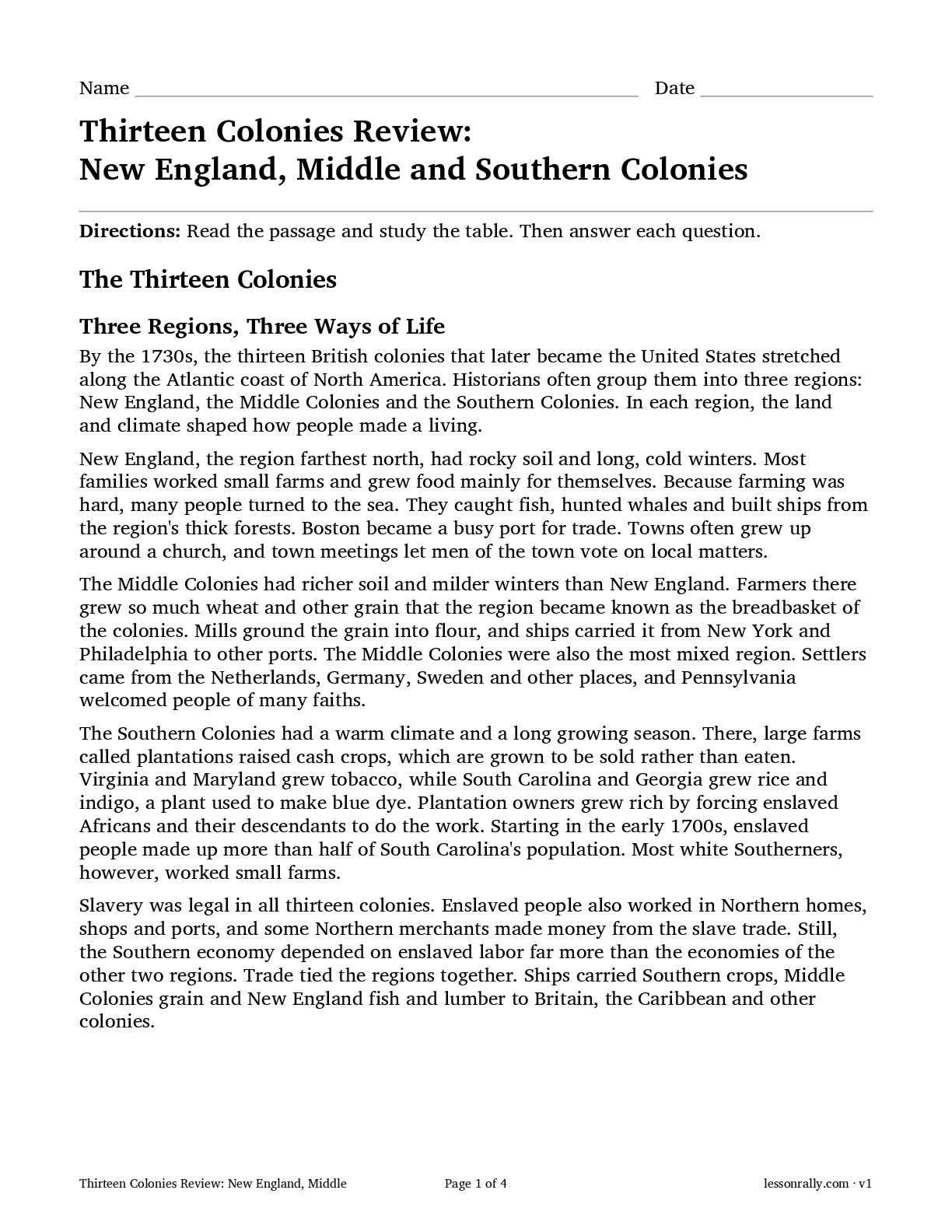
The Thirteen Colonies

Three Regions, Three Ways of Life

By the 1730s, the thirteen British colonies that later became the United States stretched along the Atlantic coast of North America. Historians often group them into three regions: New England, the Middle Colonies and the Southern Colonies. In each region, the land and climate shaped how people made a living.

New England, the region farthest north, had rocky soil and long, cold winters. Most families worked small farms and grew food mainly for themselves. Because farming was hard, many people turned to the sea. They caught fish, hunted whales and built ships from the region's thick forests. Boston became a busy port for trade. Towns often grew up around a church, and town meetings let men of the town vote on local matters.

The Middle Colonies had richer soil and milder winters than New England. Farmers there grew so much wheat and other grain that the region became known as the breadbasket of the colonies. Mills ground the grain into flour, and ships carried it from New York and Philadelphia to other ports. The Middle Colonies were also the most mixed region. Settlers came from the Netherlands, Germany, Sweden and other places, and Pennsylvania welcomed people of many faiths.

The Southern Colonies had a warm climate and a long growing season. There, large farms called plantations raised cash crops, which are grown to be sold rather than eaten. Virginia and Maryland grew tobacco, while South Carolina and Georgia grew rice and indigo, a plant used to make blue dye. Plantation owners grew rich by forcing enslaved Africans and their descendants to do the work. Starting in the early 1700s, enslaved people made up more than half of South Carolina's population. Most white Southerners, however, worked small farms.

Slavery was legal in all thirteen colonies. Enslaved people also worked in Northern homes, shops and ports, and some Northern merchants made money from the slave trade. Still, the Southern economy depended on enslaved labor far more than the economies of the other two regions. Trade tied the regions together. Ships carried Southern crops, Middle Colonies grain and New England fish and lumber to Britain, the Caribbean and other colonies.


Comparing the three colonial regions
RegionColoniesLand and climateMain ways of making a living
New EnglandMassachusetts, New Hampshire, Connecticut, Rhode IslandRocky soil, long cold winters, thick forestsSmall farms, fishing, whaling, shipbuilding, trade
Middle ColoniesNew York, New Jersey, Pennsylvania, DelawareRich soil, milder winters, wide riversWheat and other grains, flour mills, trade
Southern ColoniesMaryland, Virginia, North Carolina, South Carolina, GeorgiaWarm climate, long growing seasonPlantations growing tobacco, rice and indigo with enslaved labor; small farms

Question 1

How does the passage organize most of its information?

Choose one answer.

  • It explains the causes of the American Revolution.
  • It tells when each colony was founded, from first to last.
  • It argues that one region was a better place to live than the others.
  • It describes one region at a time, telling about the land and then the ways people made a living.

Question 2

Why does the passage describe each region's land and climate before the ways its people made a living?

Choose one answer.

  • Because the passage lists the regions from smallest to largest
  • Because the land and climate shaped how people made a living, so the passage shows the cause before its effects
  • Because each region's settlers cared more about weather than about work
  • Because the land and climate were the same in all three regions

Question 3

Match each kind of land and climate to the way of life it led to, as the passage describes them.

Match each item to an option.

Items

  1. Rocky soil and long, cold winters
  2. Richer soil and milder winters
  3. A warm climate and a long growing season

Options

  1. Settlers built towns around gold mines
  2. Many people fished, hunted whales and built ships
  3. Large farms grew tobacco, rice and indigo to sell
  4. Farmers grew enough grain to sell to other places

Question 4

Use the table to match each colony to its region.

Match each item to an option.

Items

  1. Rhode Island
  2. Delaware
  3. Maryland

Options

  1. Southern Colonies
  2. New England
  3. Middle Colonies

Question 5

The passage calls the Middle Colonies the most mixed region. Which detail best supports that description?

Choose one answer.

  • Settlers came from the Netherlands, Germany, Sweden and other places.
  • Ships carried flour from New York and Philadelphia to other ports.
  • Farmers grew wheat and other grain.
  • Mills ground the grain into flour.

Question 6

Fill each blank with a term from the word bank.

Fill in each blank.

In New England, blank 1 let men of the town vote on local matters. In the South, crops grown to be sold rather than eaten were called blank 2, and the large farms that grew them were called blank 3.

Word bank

  • cash crops
  • mills
  • plantations
  • breadbaskets
  • town meetings
  • harbors

Question 7

According to the passage, how did plantation owners in the South grow rich?

Choose one answer.

  • They earned money as leaders of town meetings.
  • They forced enslaved people to do the work of growing crops for sale.
  • They sold fish and whale oil to Britain.
  • They ground wheat into flour in large mills.

Question 8

Which sentence from the passage directly compares two regions?

Choose one answer.

  • "The Middle Colonies had richer soil and milder winters than New England."
  • "Boston became a busy port for trade."
  • "Mills ground the grain into flour, and ships carried it from New York and Philadelphia to other ports."
  • "Most white Southerners, however, worked small farms."

Question 9

Which two statements about slavery in the colonies does the passage support?

Choose 2 answers.

  • Slavery was legal in all thirteen colonies.
  • Northern merchants had no part in the slave trade.
  • Enslaved people were paid wages for their work.
  • Slavery existed only in the Southern Colonies.
  • The Southern economy depended on enslaved labor far more than the other regions' economies did.

Question 10

According to the passage, what tied the three regions together?

Choose one answer.

  • A single government in Boston
  • The same crops grown in every region
  • Trade carried by ships between their ports and beyond
  • One religion that every colony required

Question 11

How does the table present its information about the three regions?

Choose one answer.

  • It tells a story about one family in each region.
  • It shows how the population of each colony grew.
  • It sets the regions side by side under the same headings, so they can be compared.
  • It lists events in the order they happened.

Question 12

What does the passage say about how most white Southerners made a living?

Choose one answer.

  • They worked small farms.
  • They ran flour mills in New York.
  • They were whalers and shipbuilders.
  • They owned large plantations.

Reviews

No reviews yet.

Reviews come from teachers who assigned this activity to a class.

Sign in to write a review

Have a topic of your own? Make a printable worksheet and online quiz, free.

Create an activity

Answer key

Answer keys come with Premium

Print this worksheet with the correct answers marked. The key includes any explanations, sample answers, and rubrics supplied with the activity.

Answer keys aren't public: only teachers with Premium and the people who can edit an activity can download one, so students can't get a ready-to-print key from this page.

Premium includes:

  • No ads for you, and no ads for your students on the assignments you post.
  • Answer keys for printable worksheets, with the correct answers marked and any explanations, sample answers, and rubrics.
  • Create with AI: up to 100 activities a year (5 during the free trial), with every answer checked before you see the draft.

$29 a year, plus sales tax where it applies.

New Premium teachers can try it free for 7 days. A card or other payment method is needed to start. Unless you cancel before the trial ends, you are charged then and the plan renews every year.

Already have Premium or edit this activity? Sign in