Explaining Events and Finding the Main Idea in a Science Text: How a Bean Seed Sprouts

7 questions · 7 points · Grade 4 · English · Preview the 7 questions

Made by Andre Whitaker · LessonRally (AI-assisted)

Digital classroom activity

What is a digital classroom activity?

Teachers who sign in can assign LessonRally activities to their Google Classroom classes: students open them in Classroom and answer online, and their grades go to the teacher's Classroom gradebook. Practice lets you try it first, the way students see it.

Free for teachers. Sign in to assign activities to your Google Classroom classes.

Printable worksheet

Students read a short grade 4 science passage about a kidney bean. They choose answers about the main idea, what happens as the seed sprouts and how the young plant grows and gets its food.

Learning goal: Explain what happens when a seed sprouts and why, based on specific information in a science passage.

Estimated reading level 6.0

  1. Grade 4Hard
  2. Grade 5Stretch
  3. Grade 6On level
  4. Grade 7Easier
  5. Grade 8Easy
About this estimate

The estimate is the middle score of five readability formulas. Their scores run from 3.5 to 6.3.

  • Flesch-Kincaid GradeSentence length and syllables per word3.5
  • Gunning Fog Middle scoreSentence length and words of three or more syllables6.0
  • Coleman-LiauLetters per word and sentences per 100 words6.2
  • Automated Readability IndexCharacters per word and words per sentence4.5
  • SMOGWords of three or more syllables, for texts of 30 sentences or more6.3
Flesch Reading Ease
92.8 on a 0 to 100 scale where higher is easier: very easy. Not part of the estimate.
Text measured
710 words, 30 sentences

Adapted from common readability formulas (Flesch-Kincaid, Gunning Fog, Coleman-Liau and ARI, plus SMOG for long texts), which look at sentence length and word length. Answer choices count toward word length only. Grades below the estimate will likely find the text harder, grades above it easier. It does not measure ideas, background knowledge or images.

Common Core

Closest anchor: CCRA.R.3 Analyze how and why individuals, events, or ideas develop and interact over the course of a text.Anchor Standards for ReadingShow 2 matched standardsHide matched standards

Matched standards

  • RI.4.3

    Explain events, procedures, ideas, or concepts in a historical, scientific, or technical text, including what happened and why, based on specific information in the text.

    Student preview questions 3, 4, 5, 6, 7

  • RI.4.2

    Determine the main idea of a text and explain how it is supported by key details; summarize the text.

    Student preview question 1

Matched independently by two AI models from this activity's questions.

© Copyright 2010. National Governors Association Center for Best Practices and Council of Chief State School Officers. All rights reserved.

Topics: Relationships Between Events and Ideas, Main Idea and Key Details Chosen by LessonRally

Question types: multiple choice.

Student preview

The questions as students see them, without the answers.

Read the passage about how a kidney bean sprouts. Use the passage to choose one answer for each question.

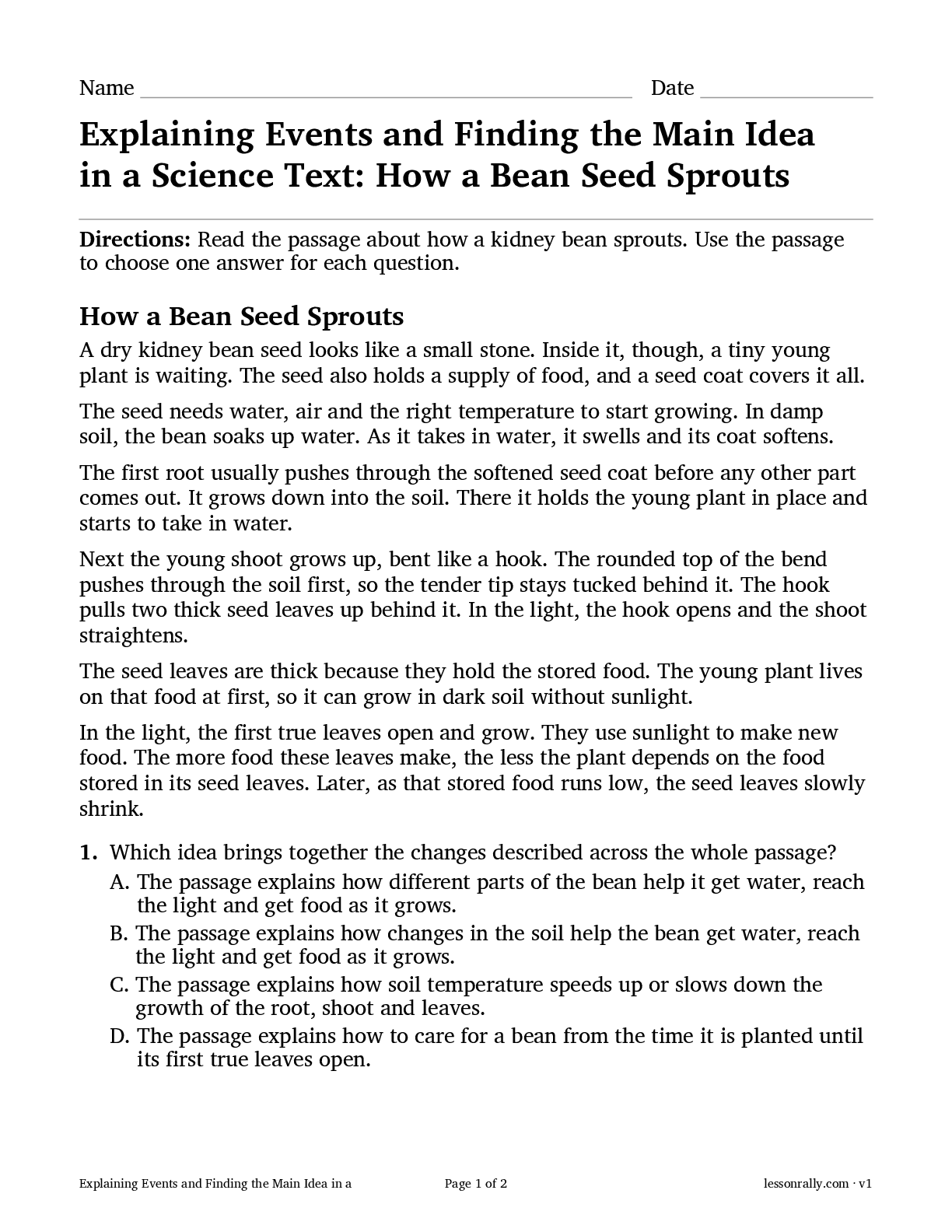
How a Bean Seed Sprouts

A dry kidney bean seed looks like a small stone. Inside it, though, a tiny young plant is waiting. The seed also holds a supply of food, and a seed coat covers it all.

The seed needs water, air and the right temperature to start growing. In damp soil, the bean soaks up water. As it takes in water, it swells and its coat softens.

The first root usually pushes through the softened seed coat before any other part comes out. It grows down into the soil. There it holds the young plant in place and starts to take in water.

Next the young shoot grows up, bent like a hook. The rounded top of the bend pushes through the soil first, so the tender tip stays tucked behind it. The hook pulls two thick seed leaves up behind it. In the light, the hook opens and the shoot straightens.

The seed leaves are thick because they hold the stored food. The young plant lives on that food at first, so it can grow in dark soil without sunlight.

In the light, the first true leaves open and grow. They use sunlight to make new food. The more food these leaves make, the less the plant depends on the food stored in its seed leaves. Later, as that stored food runs low, the seed leaves slowly shrink.


Question 1

Which idea brings together the changes described across the whole passage?

Choose one answer.

  • The passage explains how to care for a bean from the time it is planted until its first true leaves open.
  • The passage explains how changes in the soil help the bean get water, reach the light and get food as it grows.
  • The passage explains how different parts of the bean help it get water, reach the light and get food as it grows.
  • The passage explains how soil temperature speeds up or slows down the growth of the root, shoot and leaves.

Question 2

The second paragraph names three things a bean seed needs to start growing. Which one does it go on to describe?

Choose one answer.

  • the right temperature
  • sunlight
  • water
  • air

Question 3

Before the first root comes out, what does the second paragraph say happens to the seed's size and its coat?

Choose one answer.

  • The seed swells and its coat softens.
  • The seed swells and its coat splits open.
  • The seed stays the same size and its coat starts to peel.
  • The seed gets smaller and its coat wrinkles.

Question 4

After the first root grows down, what two jobs does the passage say it begins doing there?

Choose one answer.

  • It grows small side roots and carries water toward the stem.
  • It uses oxygen from the soil and takes in minerals.
  • It holds the plant in place and starts to take in water.
  • It holds the plant in place and starts to take in minerals.

Question 5

Which detail from the fourth paragraph explains how the shoot helps protect its growing tip on the way up?

Choose one answer.

  • The old seed coat covers the tip as the shoot rises.
  • The rounded bend goes through the soil first, with the tip tucked behind it.
  • The seed leaves push through the soil first with the tip between them.
  • A hard cap goes through the soil first, with the tip tucked behind it.

Question 6

The young bean can grow for a while in the dark. What detail in the fifth paragraph explains how it gets the food it needs?

Choose one answer.

  • It uses food stored in its thick seed leaves.
  • It uses food stored in its seed coat.
  • It uses food stored in its first root.
  • It uses food its first root takes in from the soil.

Question 7

What gives the bean a new source of food, and what clue in the last paragraph shows that the bean is using up its first supply?

Choose one answer.

  • The true leaves use sunlight to make food, and the part of the bean that stored its first food changes color.
  • The true leaves use sunlight to make food, and the part of the bean that stored its first food slowly shrinks.
  • The stem begins to make food, and the shoot gets thinner.
  • The roots take in food from the soil, and the first root stops growing.

Reviews

No reviews yet.

Reviews come from teachers who assigned this activity to a class.

Sign in to write a review

Have a topic of your own? Make a printable worksheet and online quiz, free.

Create an activity

Answer key

Answer keys come with Premium

Print this worksheet with the correct answers marked. The key includes any explanations, sample answers, and rubrics supplied with the activity.

Answer keys aren't public: only teachers with Premium and the people who can edit an activity can download one, so students can't get a ready-to-print key from this page.

Premium includes:

  • No ads for you, and no ads for your students on the assignments you post.
  • Answer keys for printable worksheets, with the correct answers marked and any explanations, sample answers, and rubrics.
  • Create with AI: up to 100 activities a year (5 during the free trial), with every answer checked before you see the draft.

$29 a year, plus sales tax where it applies.

New Premium teachers can try it free for 7 days. A card or other payment method is needed to start. Unless you cancel before the trial ends, you are charged then and the plan renews every year.

Already have Premium or edit this activity? Sign in