Constitutional Convention: Comparing the Virginia and New Jersey Plans

10 questions · 13 points · Grade 8 · English · Preview the 10 questions

Made by Monica Ellison · LessonRally (AI-assisted)

Digital classroom activity

What is a digital classroom activity?

Teachers who sign in can assign LessonRally activities to their Google Classroom classes: students open them in Classroom and answer online, and their grades go to the teacher's Classroom gradebook. Practice lets you try it first, the way students see it.

Free for teachers. Sign in to assign activities to your Google Classroom classes.

Printable worksheet

Students read a passage that compares the Virginia Plan and the New Jersey Plan at the Constitutional Convention, then practice text structure: compare and contrast, cause and effect, and sequence. Questions cover why large and small states disagreed and how two compromises settled disputes: the Great Compromise, which created the House and the Senate, and the Three-Fifths Compromise, which counted enslaved people when seats in the House were divided.

Learning goal: Describe how a passage compares the Virginia and New Jersey Plans, and explain how compromises at the Constitutional Convention settled disputes over representation.

Estimated reading level 9.5

  1. Grade 7Hard
  2. Grade 8Stretch
  3. Grade 9On level
  4. Grade 10Easier
  5. Grade 11Easy
About this estimate

The estimate is the middle score of five readability formulas. Their scores run from 6.3 to 10.1.

  • Flesch-Kincaid GradeSentence length and syllables per word6.3
  • Gunning Fog Middle scoreSentence length and words of three or more syllables9.5
  • Coleman-LiauLetters per word and sentences per 100 words10.1
  • Automated Readability IndexCharacters per word and words per sentence7.4
  • SMOGWords of three or more syllables, for texts of 30 sentences or more10.0
Flesch Reading Ease
70.6 on a 0 to 100 scale where higher is easier: fairly easy. Not part of the estimate.
Text measured
869 words, 43 sentences

Adapted from common readability formulas (Flesch-Kincaid, Gunning Fog, Coleman-Liau and ARI, plus SMOG for long texts), which look at sentence length and word length. Answer choices count toward word length only. Grades below the estimate will likely find the text harder, grades above it easier. It does not measure ideas, background knowledge or images.

Common Core

Closest anchor: CCRA.R.5 Analyze the structure of texts, including how specific sentences, paragraphs, and larger portions of the text (e.g., a section, chapter, scene, or stanza) relate to each other and the whole.Anchor Standards for ReadingShow 1 matched standardHide matched standard

Matched standard

  • RH.6-8.5

    Describe how a text presents information (e.g., sequentially, comparatively, causally).

    Student preview questions 1, 4, 6, 10

Matched independently by two AI models from this activity's questions.

© Copyright 2010. National Governors Association Center for Best Practices and Council of Chief State School Officers. All rights reserved.

Topic: U.S. Constitution Chosen by LessonRally

Question types: multiple choice, matching, select all that apply, fill in the blank.

Student preview

The questions as students see them, without the answers.

Read the passage. Then answer each question.

The Constitutional Convention

Two Plans and a Compromise

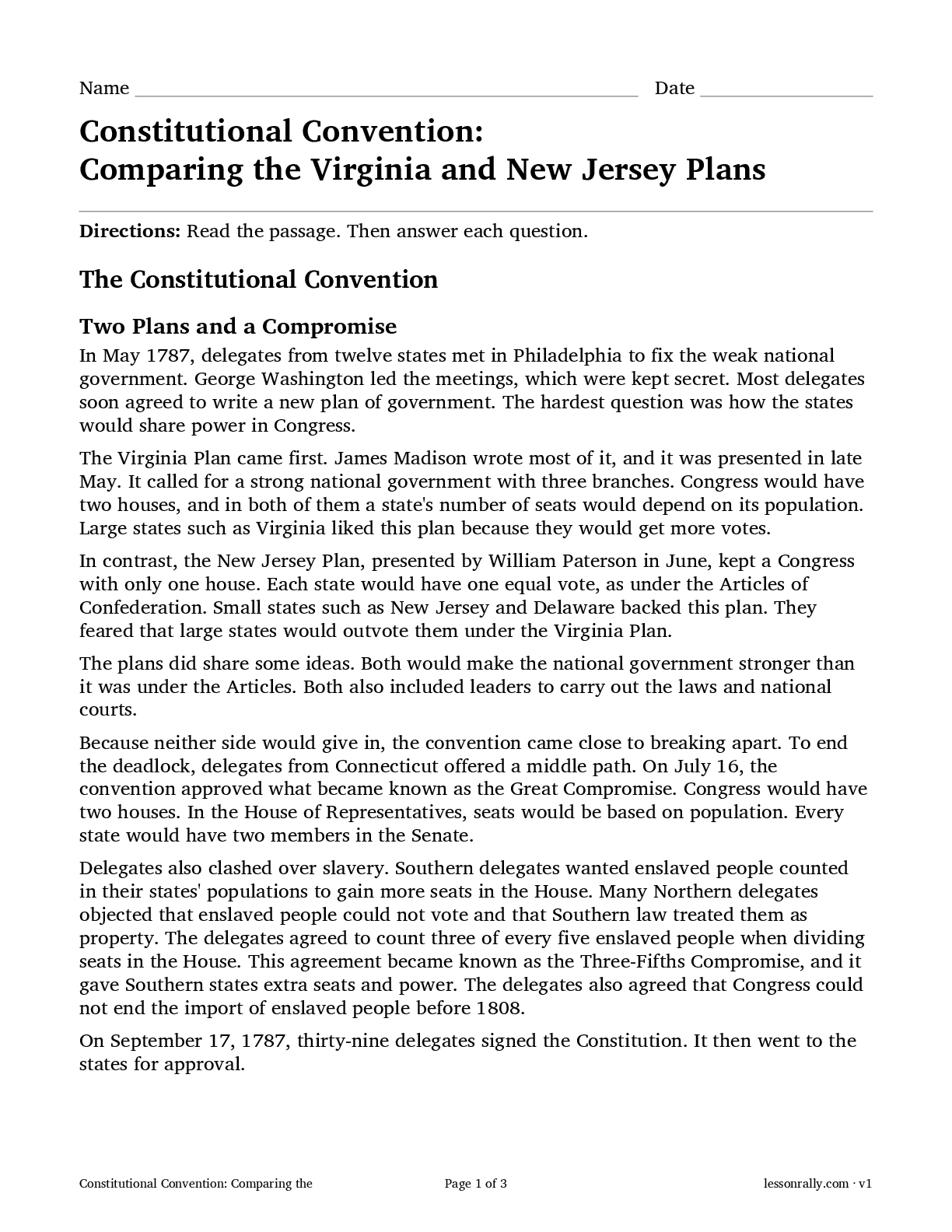
In May 1787, delegates from twelve states met in Philadelphia to fix the weak national government. George Washington led the meetings, which were kept secret. Most delegates soon agreed to write a new plan of government. The hardest question was how the states would share power in Congress.

The Virginia Plan came first. James Madison wrote most of it, and it was presented in late May. It called for a strong national government with three branches. Congress would have two houses, and in both of them a state's number of seats would depend on its population. Large states such as Virginia liked this plan because they would get more votes.

In contrast, the New Jersey Plan, presented by William Paterson in June, kept a Congress with only one house. Each state would have one equal vote, as under the Articles of Confederation. Small states such as New Jersey and Delaware backed this plan. They feared that large states would outvote them under the Virginia Plan.

The plans did share some ideas. Both would make the national government stronger than it was under the Articles. Both also included leaders to carry out the laws and national courts.

Because neither side would give in, the convention came close to breaking apart. To end the deadlock, delegates from Connecticut offered a middle path. On July 16, the convention approved what became known as the Great Compromise. Congress would have two houses. In the House of Representatives, seats would be based on population. Every state would have two members in the Senate.

Delegates also clashed over slavery. Southern delegates wanted enslaved people counted in their states' populations to gain more seats in the House. Many Northern delegates objected that enslaved people could not vote and that Southern law treated them as property. The delegates agreed to count three of every five enslaved people when dividing seats in the House. This agreement became known as the Three-Fifths Compromise, and it gave Southern states extra seats and power. The delegates also agreed that Congress could not end the import of enslaved people before 1808.

On September 17, 1787, thirty-nine delegates signed the Constitution. It then went to the states for approval.


Question 1

How does the passage present the Virginia Plan and the New Jersey Plan?

Choose one answer.

  • It treats them as two causes of the American Revolution.
  • It argues that the New Jersey Plan was the fairer choice.
  • It describes only the plan that the convention adopted without changes.
  • It compares them, showing how each would share power in Congress and what they had in common.

Question 2

Match each idea to the plan that included it.

Match each item to an option.

Items

  1. Seats in both houses of Congress based on how many people a state had
  2. One house of Congress with an equal vote for each state
  3. A House based on population and a Senate with two members per state

Options

  1. Bill of Rights
  2. Great Compromise
  3. New Jersey Plan
  4. Virginia Plan

Question 3

According to the passage, why did small states back the New Jersey Plan?

Choose one answer.

  • They hoped to end slavery in every state.
  • They wanted seats in Congress to be based on population.
  • They feared that large states would outvote them under the Virginia Plan.
  • They wanted a king to lead the new government.

Question 4

Which sentence from the passage shows a cause-and-effect relationship?

Choose one answer.

  • "George Washington led the meetings, which were kept secret."
  • "Because neither side would give in, the convention came close to breaking apart."
  • "The Virginia Plan came first."
  • "The plans did share some ideas."

Question 5

Which two ideas did both the Virginia Plan and the New Jersey Plan include, according to the passage?

Choose 2 answers.

  • A Senate with two members from each state
  • A national government stronger than the one under the Articles
  • One equal vote for each state
  • Leaders to carry out the laws and national courts
  • Seats in Congress based on each state's population

Question 6

Why does the passage explain both plans before it describes the Great Compromise?

Choose one answer.

  • The Great Compromise was the least important event at the convention.
  • Readers need to understand the disagreement to see how the compromise settled it.
  • The author wants readers to decide which plan was better.
  • The two plans were the only ideas the convention approved.

Question 7

Which of these happened first, based on the dates in the passage?

Choose one answer.

  • The Constitution went to the states for approval.
  • Thirty-nine delegates signed the Constitution.
  • William Paterson presented the New Jersey Plan.
  • Delegates approved the Great Compromise.

Question 8

Complete the sentence with words from the word bank.

Fill in each blank.

The delegates agreed that Congress could not end the blank 1 of enslaved people before blank 2.

Word bank

  • sale
  • 1865
  • 1808
  • 1776
  • import

Question 9

What was one effect of the Three-Fifths Compromise?

Choose one answer.

  • Slavery ended in every state by 1808.
  • Enslaved people gained the right to vote in House elections.
  • Southern states gained extra seats and power in the House.
  • Small states received as many House seats as large states.

Question 10

How does the passage organize what it says about the dispute over slavery?

Choose one answer.

  • It tells what Southern delegates wanted, why many Northern delegates objected, and how both sides settled it.
  • It lists events in the order they happened over many years.
  • It tells only the Southern side of the dispute.
  • It argues that the convention should have ended slavery.

Reviews

No reviews yet.

Reviews come from teachers who assigned this activity to a class.

Sign in to write a review

Have a topic of your own? Make a printable worksheet and online quiz, free.

Create an activity

Answer key

Answer keys come with Premium

Print this worksheet with the correct answers marked. The key includes any explanations, sample answers, and rubrics supplied with the activity.

Answer keys aren't public: only teachers with Premium and the people who can edit an activity can download one, so students can't get a ready-to-print key from this page.

Premium includes:

  • No ads for you, and no ads for your students on the assignments you post.
  • Answer keys for printable worksheets, with the correct answers marked and any explanations, sample answers, and rubrics.
  • Create with AI: up to 100 activities a year (5 during the free trial), with every answer checked before you see the draft.

$29 a year, plus sales tax where it applies.

New Premium teachers can try it free for 7 days. A card or other payment method is needed to start. Unless you cancel before the trial ends, you are charged then and the plan renews every year.

Already have Premium or edit this activity? Sign in