Ancient India: Origins and Core Teachings of Hinduism and Buddhism

10 questions · 16 points · Grade 6 · English · Preview the 10 questions

Made by Owen Brackwell · LessonRally (AI-assisted)

Digital classroom activity

What is a digital classroom activity?

Teachers who sign in can assign LessonRally activities to their Google Classroom classes: students open them in Classroom and answer online, and their grades go to the teacher's Classroom gradebook. Practice lets you try it first, the way students see it.

Free for teachers. Sign in to assign activities to your Google Classroom classes.

Printable worksheet

Students read an original passage on how Hinduism grew over many centuries with no single founder, what Hindus believe about dharma, karma, reincarnation, samsara and moksha, how ancient law books described the varnas, and how Buddhism began with Siddhartha Gautama about 2,500 years ago. Questions test key terms and phrases in context, including the Four Noble Truths, the Eightfold Path and the Middle Way. Each tradition is described in its own terms.

Learning goal: Explain how Hinduism and Buddhism began, and use key terms such as dharma, karma, samsara, moksha, the Four Noble Truths and nirvana to describe what each tradition teaches.

Estimated reading level 6.9

  1. Grade 4Hard
  2. Grade 5Stretch
  3. Grade 6On level
  4. Grade 7Easier
  5. Grade 8Easy
About this estimate

The estimate is the middle score of five readability formulas. Their scores run from 5.6 to 8.4.

  • Flesch-Kincaid GradeSentence length and syllables per word5.6
  • Gunning Fog Middle scoreSentence length and words of three or more syllables6.9
  • Coleman-LiauLetters per word and sentences per 100 words8.4
  • Automated Readability IndexCharacters per word and words per sentence5.6
  • SMOGWords of three or more syllables, for texts of 30 sentences or more8.4
Flesch Reading Ease
74.4 on a 0 to 100 scale where higher is easier: fairly easy. Not part of the estimate.
Text measured
744 words, 40 sentences

Adapted from common readability formulas (Flesch-Kincaid, Gunning Fog, Coleman-Liau and ARI, plus SMOG for long texts), which look at sentence length and word length. Answer choices count toward word length only. Grades below the estimate will likely find the text harder, grades above it easier. It does not measure ideas, background knowledge or images.

Question types: multiple choice, matching, fill in the blank, select all that apply.

Student preview

The questions as students see them, without the answers.

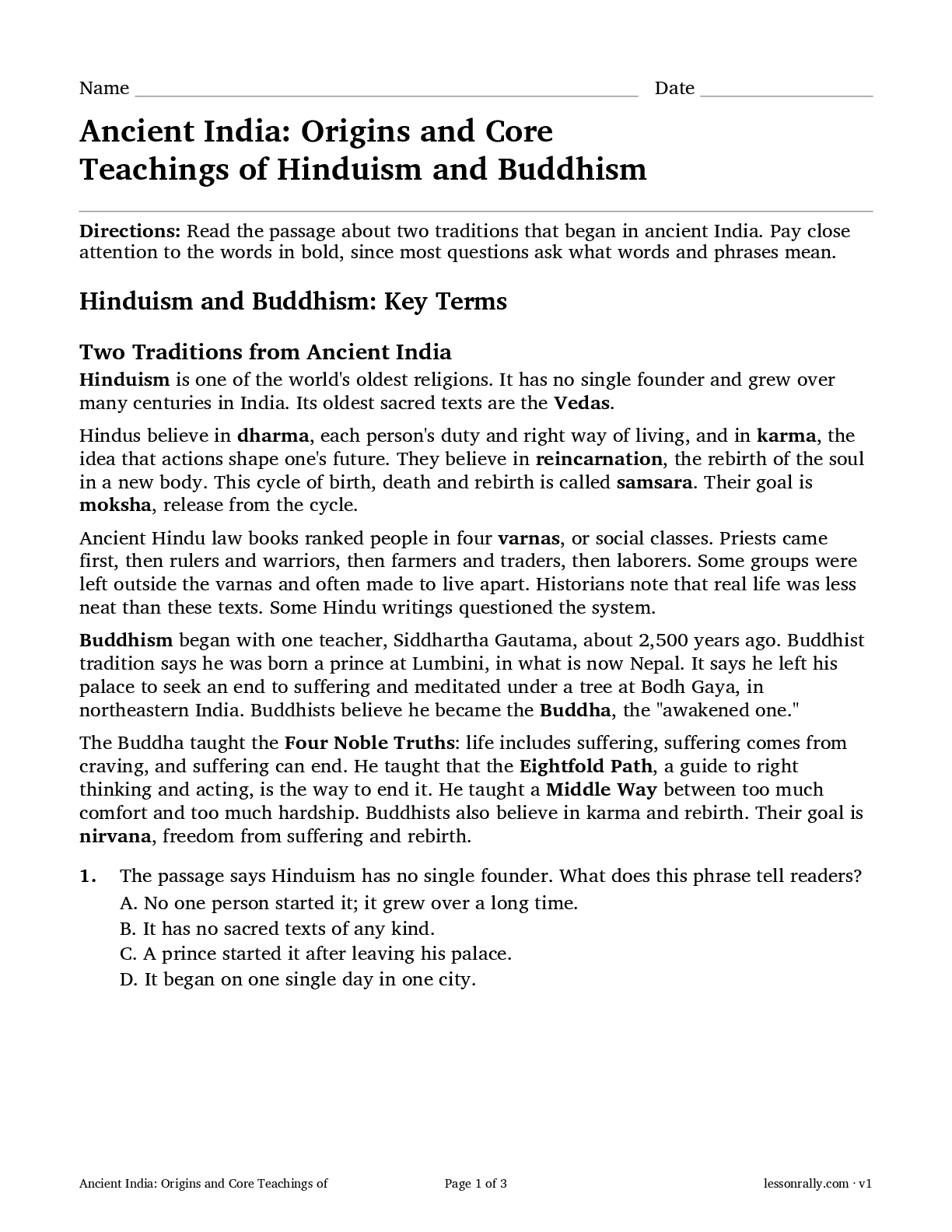
Read the passage about two traditions that began in ancient India. Pay close attention to the words in bold, since most questions ask what words and phrases mean.

Hinduism and Buddhism: Key Terms

Two Traditions from Ancient India

Hinduism is one of the world's oldest religions. It has no single founder and grew over many centuries in India. Its oldest sacred texts are the Vedas.

Hindus believe in dharma, each person's duty and right way of living, and in karma, the idea that actions shape one's future. They believe in reincarnation, the rebirth of the soul in a new body. This cycle of birth, death and rebirth is called samsara. Their goal is moksha, release from the cycle.

Ancient Hindu law books ranked people in four varnas, or social classes. Priests came first, then rulers and warriors, then farmers and traders, then laborers. Some groups were left outside the varnas and often made to live apart. Historians note that real life was less neat than these texts. Some Hindu writings questioned the system.

Buddhism began with one teacher, Siddhartha Gautama, about 2,500 years ago. Buddhist tradition says he was born a prince at Lumbini, in what is now Nepal. It says he left his palace to seek an end to suffering and meditated under a tree at Bodh Gaya, in northeastern India. Buddhists believe he became the Buddha, the "awakened one."

The Buddha taught the Four Noble Truths: life includes suffering, suffering comes from craving, and suffering can end. He taught that the Eightfold Path, a guide to right thinking and acting, is the way to end it. He taught a Middle Way between too much comfort and too much hardship. Buddhists also believe in karma and rebirth. Their goal is nirvana, freedom from suffering and rebirth.


Question 1

The passage says Hinduism has no single founder. What does this phrase tell readers?

Choose one answer.

  • No one person started it; it grew over a long time.
  • It began on one single day in one city.
  • A prince started it after leaving his palace.
  • It has no sacred texts of any kind.

Question 2

Match each term from the passage on Hinduism and Buddhism to its meaning.

Match each item to an option.

Items

  1. dharma
  2. karma
  3. samsara
  4. moksha
  5. Vedas
  6. nirvana

Options

  1. the cycle of birth, death and rebirth
  2. in Hindu belief, release from the cycle of rebirth
  3. a guide to right thinking and acting
  4. the oldest sacred texts of Hinduism
  5. a prince who left his palace to seek an end to suffering
  6. in Hindu belief, each person's duty and right way of living
  7. the idea that a person's actions shape his or her future
  8. in Buddhist teaching, freedom from suffering and rebirth

Question 3

Buddhists call the Buddha the "awakened one." What does awakened mean in this phrase?

Choose one answer.

  • having come to a new and deep understanding
  • having just woken up after a night's sleep
  • having been born into a family of rulers
  • having become the leader of a large army

Question 4

The passage tells where Buddhist tradition places events in the Buddha's life. Which statement matches it?

Choose one answer.

  • He was born and lived his whole life inside one palace.
  • He was born at Bodh Gaya and later meditated at Lumbini.
  • He was born at Lumbini and later meditated at Bodh Gaya.
  • He was born in China and later moved west to India.

Question 5

Complete the sentences about two of the Four Noble Truths.

Fill in each blank.

The Buddha taught that suffering comes from blank 1. He taught that the blank 2 is the way to end suffering.

Word bank

  • Vedas
  • Eightfold Path
  • palace
  • craving

Question 6

Which person is following the Buddha's teaching about the Middle Way?

Choose one answer.

  • Someone who never leaves home or meets other people
  • Someone who lives with as much hardship as possible
  • Someone who seeks as much comfort and pleasure as possible
  • Someone who avoids both too much comfort and too much hardship

Question 7

In the passage, what are varnas?

Choose one answer.

  • four social classes described in ancient Hindu law books
  • the steps of the Eightfold Path
  • the oldest sacred texts of Hinduism
  • places where the Buddha taught

Question 8

The passage defines reincarnation as the rebirth of the soul in a new body. Which part of the word reincarnation means again?

Choose one answer.

  • re-
  • -carn-
  • in-
  • -ation

Question 9

What does the passage say historians note about the varnas?

Choose one answer.

  • Everyone in ancient India agreed with the law books.
  • The Buddha wrote the law books that described them.
  • The law books described only one social class.
  • Real life was less neat than the law books described.

Question 10

According to the passage, which two ideas do Hindus and Buddhists share? Select 2.

Choose 2 answers.

  • rebirth
  • karma
  • the Vedas as sacred texts
  • the Four Noble Truths

Reviews

No reviews yet.

Reviews come from teachers who assigned this activity to a class.

Sign in to write a review

Have a topic of your own? Make a printable worksheet and online quiz, free.

Create an activity

Answer key

Answer keys come with Premium

Print this worksheet with the correct answers marked. The key includes any explanations, sample answers, and rubrics supplied with the activity.

Answer keys aren't public: only teachers with Premium and the people who can edit an activity can download one, so students can't get a ready-to-print key from this page.

Premium includes:

  • No ads for you, and no ads for your students on the assignments you post.
  • Answer keys for printable worksheets, with the correct answers marked and any explanations, sample answers, and rubrics.
  • Create with AI: up to 100 activities a year (5 during the free trial), with every answer checked before you see the draft.

$29 a year, plus sales tax where it applies.

New Premium teachers can try it free for 7 days. A card or other payment method is needed to start. Unless you cancel before the trial ends, you are charged then and the plan renews every year.

Already have Premium or edit this activity? Sign in